

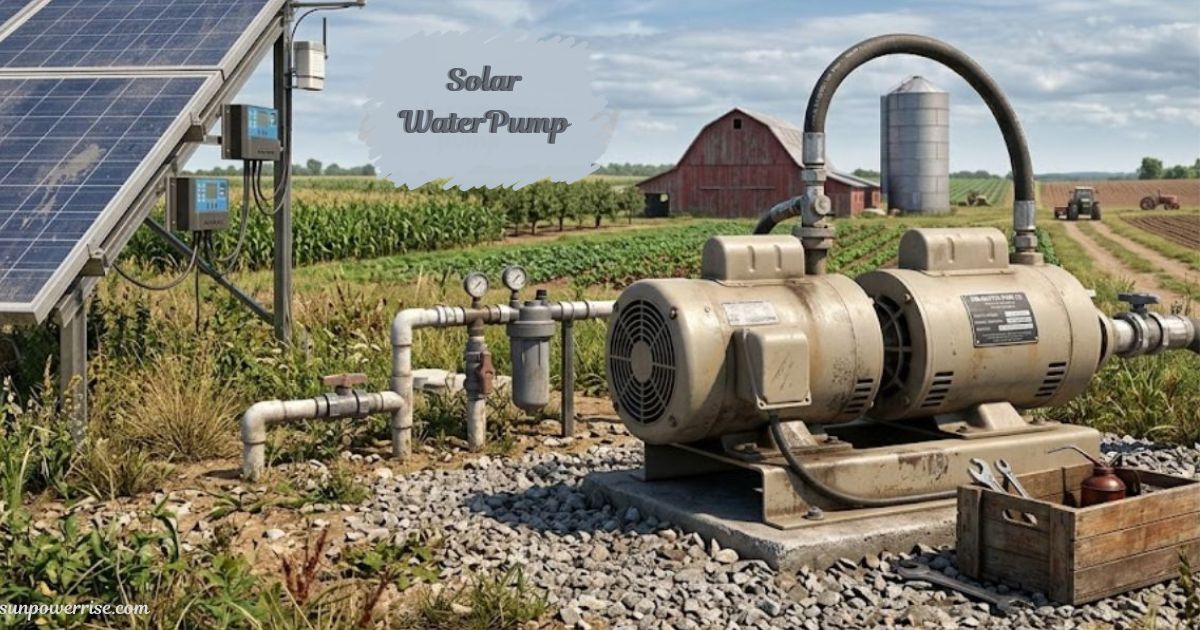
Solar water pump changes everything for people living in remote locations without access to electricity. You simply place the SPS unit near your water source, connect the suction hose, and the system starts delivering water at high pressure to your tanks and troughs without any running costs.
The battery reserve makes sure the solar water pump can operate through the day, overnight, and even on cloudy days because the system runs independently from direct daylight.
Setting up the SE1 takes very little time since the 60-watt panel comes with a stand, and you find all your tools, spares bag, connectors, and the installation manual packed neatly inside the box.
The 7.5m suction hose reaches deep into your water source, and a separate manual handle gives you a backup pumping option when needed.
The simple install process, zero running costs, and plug-and-play design make this the smartest choice for farms, livestock operations, and remote properties where gravity, voltage wiring, and friction losses from long inverter-based 230 Vac systems make traditional pumping impractical and expensive.
Core Performance Metrics Of Solar Water Pump
Choosing the right pump for your solar energy pumping system starts with understanding flow, head, pressure, power consumption, and suction lift, because each of these criteria directly affects how well your system delivers water from source to tank.
The flow rate tells you how many gallons per hour (gph) or gallons per minute (gpm) or in metric terms litres per hour (l/h) and per minute (l/m) your pump can deliver at a given pressure, while the head tells you the maximum height measured in metres or PSI (lbs per sq in) that the pump can push water upward without neglecting piping friction losses.
Understanding these numbers as a measure of your system’s capability helps you select a pump that matches your actual needs rather than guessing.
Distance and Long-Range Dynamics
The total head represents the entire vertical distance from the water source to the tank, and the horizontal distance matters just as much because pumps cannot move water far by suction alone even when the lift stays within acceptable limits.
For long distances with large volumes, the best approach places the pump near the supply and uses adequate wiring to compensate for voltage drop, while large diameter pipes help minimise losses caused by pipe friction.
In truly remote systems where large volumes are needed over great distances, running 230 Vac pumps from an inverter remains the most practical route and the easiest to manage long-term.
Holistic Evaluation and Placement
The pump works best when you think of flow, head, pressure, and power consumption together as a group, because selecting based on only one factor without considering the rest often leads to a pump that underperforms for your specific application and criteria.
A self-priming unit removes the need to position the pump below the water source to be fed by gravity, giving you more freedom in selecting where to place your equipment.
Whether your project involves livestock, irrigation, or household water supply, understanding rate, deliver, maximum, height, neglecting, piping, measure, below, fed, entire, vertical, and distance gives you a solid foundation for making the right solar water pump choice the first time.
Solar Water Pump Characteristics
The Flow and Pressure Trade-Off
Every pump delivers different performance depending on how much water it moves and the pressure it creates at any given moment, and understanding this relationship saves you from choosing a unit that cannot handle your system’s actual demands.
The key principle to remember is that as flow increases, pressure decreases this inverse relationship between the two is what the pump curves illustrate, and these curves make it much easier to determine whether a specific pump is suitable for your system.
Efficiency and Lift Demands
Power consumption, lift, and motor behavior all connect directly to how efficiently the pump moves water under varying load conditions, and a pump that works well at lower pressure may struggle when you increase head requirements suddenly.
The greater the lift demanded from the pump, the lower the flow becomes, and at the same time the power consumption increases, this is the fundamental trade-off that every installer must understand before creating a solar energy pumping layout.
These characteristics are not fixed; they vary depending on moving parts, water temperature, and pipe configuration, all of which the illustrated curves help you visualize clearly.
Utilizing Pump Curves
The important thing is that these pump curves show you exactly how performance varies across different operating points so you can match the pump to your system correctly from the start.
A pump that operates near the higher end of its pressure curve will obtain lower flow, while one running at lower pressure will obtain greater flow both scenarios are related directly to the pump characteristics your manufacturer determines through testing.
Once you understand the inverse relationship between pressure and flow, controlling your solar water pump system becomes a straightforward process that keeps water moving efficiently at all times.
Types of Pumping Systems
Direct vs. Battery-Backed Systems
Solar PV pump systems come in two main types: direct systems and battery-backed systems and choosing between them depends on whether you need water only during daylight hours or around the clock regardless of sunlight availability.
In a solar-direct system, pumping happens only when the sun shines, so the system fills an elevated storage tank sized large enough to supply water through cloudy weather and at night when no solar energy is available.
A water tank costs less and lasts longer than storing the same energy in batteries, and gravity then delivers water at steady pressure to all points of use below the tank level.
Smart Power Management and Battery Benefits
A controller sits between the PV modules and the pump motor, matching available power to the pump’s demands and allowing the unit to start even in weak sunlight without stalling or overloading the motor.
In a battery system, stored energy gives you the advantage of pumping water at any time, and matching PV modules to the pump becomes less critical because the battery provides sufficient surge power during motor startup.
Many remote home systems connect the pump to the same battery bank that powers lighting and other appliances, creating a pressurised supply that eliminates the storage tank entirely and delivers water to points above the source.
Elevation Advantages and Final Selection
The battery system also allows water to reach locations above the source level, which a gravity-fed direct system simply cannot achieve without additional pumping stages or an inverter.
Choosing the right system means weighing energy storage cost, water demand, and the equivalent durable cheaper benefits of tank storage against the flexibility that batteries and a pressurised supply provide.
Whether you choose solar-direct or battery-backed, both systems store and deliver water reliably to your tanks, troughs, and supply points using clean, free solar energy with no wiring to the grid and no inverter required in most remote setups.
Solar Garden Pumps and Fountains
A solar garden pump brings a working water feature to even the smallest garden or pond instantly, running directly from solar panels without any mains wiring, transformers, or costly safety equipment.
The brighter the sun shines, the greater the flow you get and because the system connects directly to the panels, it works automatically whenever sufficient sunlight reaches the cells.
This intrinsically safe design means anyone can enjoy a beautiful fountain or pond feature anywhere in the garden without calling an electrician or burying cables.
The plug-and-play installation process takes minutes, and the absence of mains wiring makes the entire setup simple and safe for homeowners, schools, and community spaces that want a water feature without the complexity of a grid-connected system.
Solar powered garden pumps work anywhere the sun reaches, making them perfect for patios, balconies, rooftop gardens, and ponds tucked far from the nearest power outlet.
How Solar Powered Water Pumps Work
Suction Lift and Intake Mechanics
The SPS solar water pump sits beside the water source up to 5m above the water level, and you can bolt it to a concrete slab for added stability if the installation site requires it.
The 5m suction pipe drops into the water source through a heavy-duty stainless-steel filter and foot-valve that keeps the line primed and blocks debris from entering the system. Water gets sucked in through this pipe and pumped out through the outlet at high pressure into your tanks and troughs automatically without any manual intervention.
Automated Pressure Switch Control
Once your tanks and troughs fill completely, pressure rises inside the pressure vessel and the pressure switch cuts the pump out, with operating pressures across models ranging from 40-80psi and cut-out set typically at 40psi while cut-in activates again at 30psi.
The deep-cycle battery connects using quick-attach clips, and a heavy-duty controller monitors voltage continuously, preventing overcharging and ensuring the longest battery life possible across all models.
The battery also powers secondary 12v devices like an electric fence, making the system more versatile than a standard solar water pump alone, while the lid stays locked for security and the 12-month warranty covers every unit sold.
Weather-Resilient Battery Management
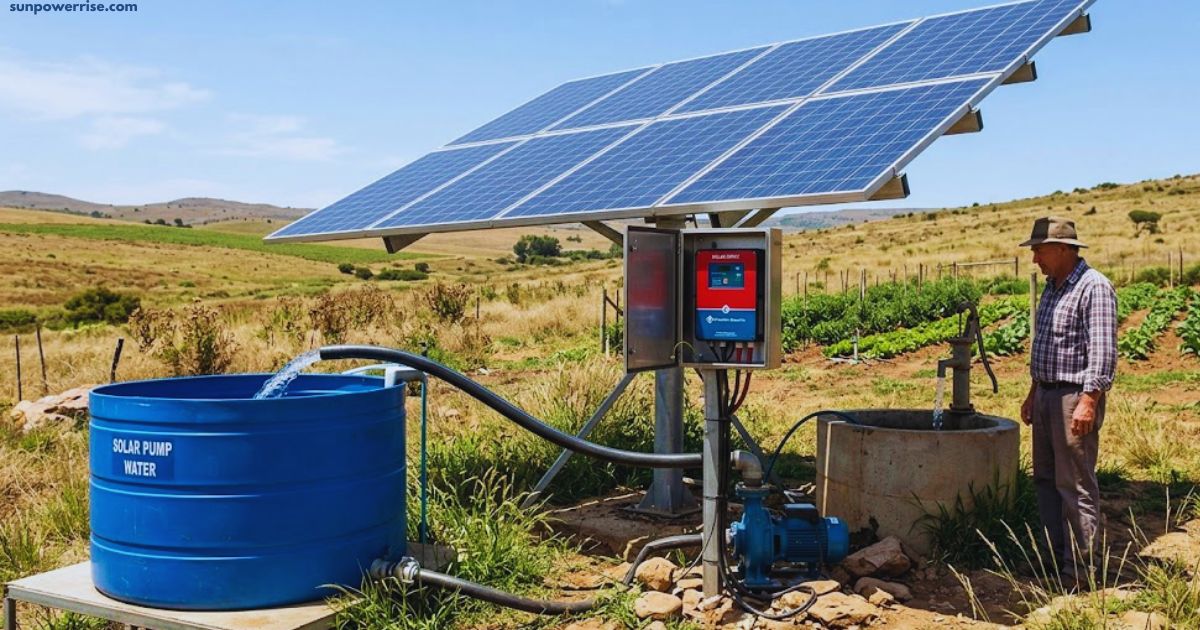
The solar panel needs daylight only not direct sun which means your SPS pump operates every month of the year regardless of season, and the battery reserve keeps water flowing overnight and through cloudy periods without interruption.
A heavy-duty controller regulates the battery charge so that when the battery reaches full capacity, excess solar power stops charging automatically, protecting the cells and extending service life.
The solar water pump continues to run automatically, sucking water in and discharging it at high pressure with adjusted settings available on every model to suit your specific operating pressure needs.
FAQs
Are solar-powered water pumps any good?
Yes, solar-powered water pumps are genuinely good. They use renewable energy from sunlight to move water without relying on grid electricity, making them a cost-effective, eco-friendly, and reliable solution for irrigation, domestic use, and off-grid properties.
Which solar water pump is best?
The best solar water pump depends on your water output needs, pump capacity, and installation location, submersible solar pumps suit deep boreholes and wells, while surface solar pumps work better for shallow water sources and garden irrigation systems.
What is a solar water pump system?
A solar water pump system consists of solar panels, a pump controller, and a water pump that work together to convert sunlight into DC electricity or AC electricity to move water from a source like a well, borehole, or reservoir directly to where it is needed.
What are the cons of a solar water pump?
The biggest drawbacks of solar water pumps are their weather dependency, output drops significantly on cloudy days and during winter, along with higher upfront costs compared to conventional pumps and reduced water flow during low sunlight hours.
What are the top 3 water pumps?
The top three solar water pumps widely recognised for reliability, pump efficiency, and flow rate are the Grundfos SQFlex, the Lorentz PS2, and the Shurflo 9300.