

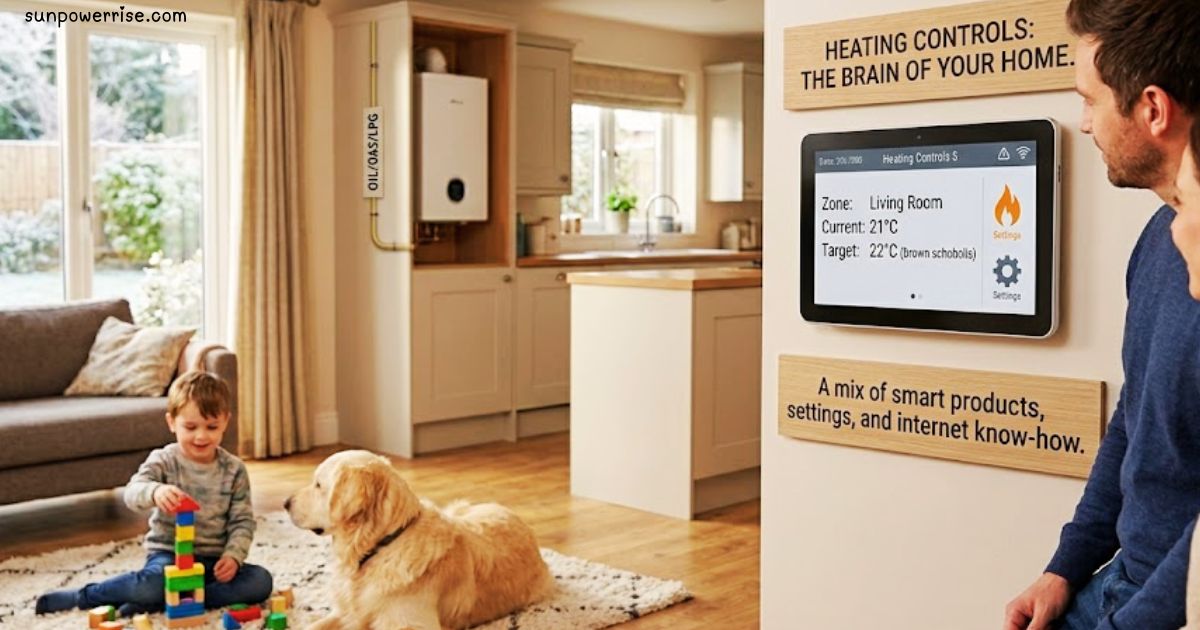
Heating controls are the thermostats, timers, valves and smart devices that decide when your heating switches on, how warm each room gets, and how hard your boiler has to work to get there. Get the mix right and a home heats itself around your routine the right rooms, at the right times, without you touching a dial. Get it wrong, and you’re either shivering in a cold living room or paying to heat bedrooms nobody’s using.
I found that out the hard way. I still remember the first time I walked into a freezing living room because nobody had set up the heating controls properly. That cold morning taught me a lesson I now share with every homeowner I talk to: the boiler is only half the story.
Warm Homes Plan Impact on Heating Controls
The Warm Homes Plan is one of the biggest pushes the UK has seen toward warmer, cheaper-to-run homes, with close to £15 billion set aside for improvements.
If you’re on a low income, this plan promises government support that’s fully funded, meaning you won’t pay a penny to install your heating controls.
Homeowners across every income bracket can also tap into low-interest loans and zero-interest loans, and we’ll keep updating this guide as fresh details land. For now, take a look at our blog on what it all means for you.
Benefits of Heating Controls
A well-tuned system keeps your home warm without ever feeling overheated, so every room stays cosy rather than stuffy. I’ve seen families cut down on wasted energy simply by paying closer attention to their heating bills, and the numbers back this up.
The Energy Saving Trust puts a full, well-used set of heating controls at around 10% off a typical heating bill compared with running no controls at all and it’s worth being precise about where that saving comes from, because it isn’t magic.
It comes from three habits controls make easy: heating for less time (so an empty house isn’t being warmed all day), heating to a slightly lower temperature, and heating fewer rooms at once. A smart thermostat helps you actually stick to that 10%; it doesn’t stack a second 10% on top just by existing.
Get the install right, and you could save money too, often around £110 a year whether you’re in Great Britain (GB) or Northern Ireland (NI). On top of the savings, there’s real convenience value: an app lets you adjust heating while you’re still out, so your house feels cosy the second you walk through the door.
What Heating Controls Should I Have?
Every solid setup for central heating systems and boilers starts with three basics: a programmer for time control, a room thermostat, and a set of thermostatic radiator valves (TRVs).
If your home runs a hot water cylinder, add a dedicated thermostat for that too, since it’s one of the core elements that keep everything balanced.
Beyond these basics, plenty of extra controls can be layered onto a modern heating system to make it more efficient, including a simple dial thermostat or a smarter internet control that reacts to outside weather changes with genuine sophistication.
How It Works
Picture a basic dial thermostat set to your desired temperature, say 21 degrees. Once the room temperature drops below that mark, the boiler fires up, and it switches off again once the room warms back through it.
The catch is that these basic units tend to overshoot by a degree or two before the boiler catches up, which makes them less efficient than newer options. Smarter compensation controls fine-tune the boiler’s output in tiny increments instead of just switching it fully on or off, which cuts that overshoot, saves real energy, and trims your fuel bills over time.
Types of Heating Controls
Manual Thermostats
Manual room thermostats are the simplest option, keeping your room temperature steady by turning the heating on and off automatically once you’ve set it. They’re simple, inexpensive, and pack a handful of money-saving features worth knowing about: a frost protection mode (look for the snowflake symbol), an ideal temperature range for staying comfortable and economical, and even stand-alone timers if you want a basic heating schedule.
For more flexibility, smart room thermostats let you manage things through an app or a smart speaker, while old-school dial thermostats set near 21 degrees still do a reliable job.
Standard Thermostats and Programmers
Alongside thermostats, time clocks mounted on the boiler use small pins you push in to mark on-times, and pairing one with a thermostat gives you reasonable control. They’re cheap and easy to adjust, though you can’t vary settings by day of the week.
That’s where programmers step in: digital programmers, including 7-day and 5/2 day programmers, let you set different times for weekdays and weekends. These run on channels a single-channel unit suits combi boilers, a twin-channel model works with heat-only or system boilers alongside a hot water cylinder, and a three-channel programmer manages multiple heating zones, though setup usually needs a heating engineer.
Smart Heating Controls
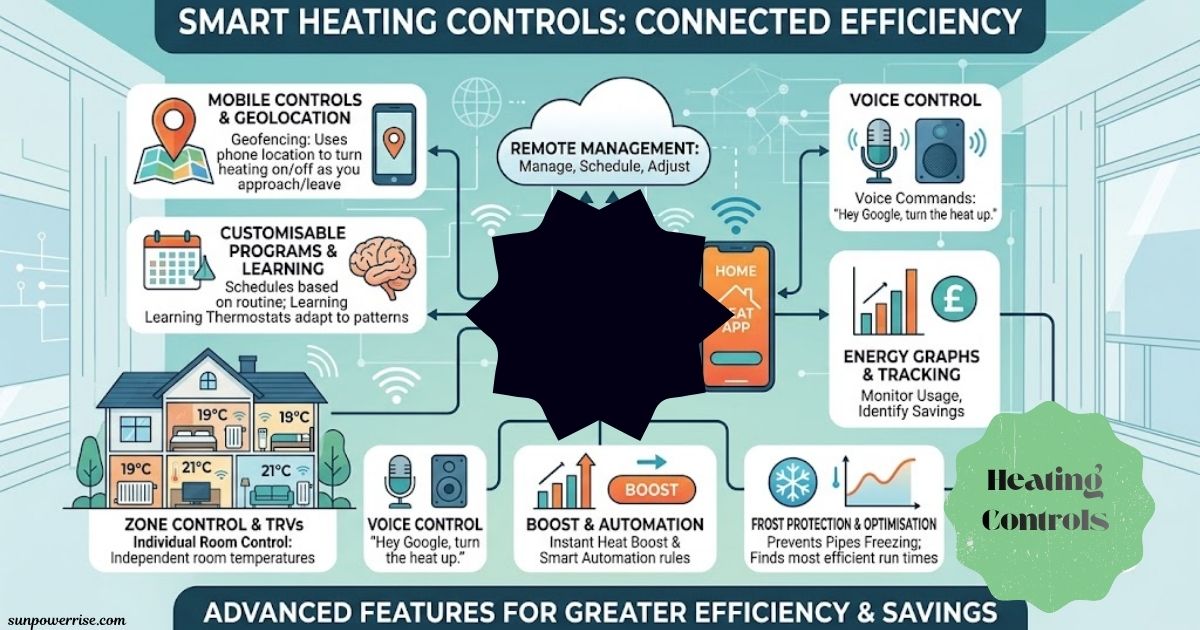
Smart thermostats and TRVs sit at the top of the range: internet-enabled devices that let you manage, schedule, and adjust heating and hot water remotely through an app, web browser, or even text message. They cost more, but the money-saving and ease-of-use features more than make up for it.
Even simpler models like Hive lift overall efficiency, provided you’ve got a working modem and smartphone. Look out for optimisation, zone control, automatic frost protection, temperature graphs, boost functions, customisable programs, voice control, learning behaviour that picks up your routine, and geolocation via your phone.
Automation and Optimisation Controls
Automation and optimisation sit under the Boiler Plus umbrella and cover anything that adjusts time and temperature settings based on occupancy, geolocation, or stored usage patterns.
Many run on a learned schedule that studies how fast your home loses or gains heat, then fine-tunes itself automatically. The good news: they stay compatible with all boilers, though they don’t always match the efficiency of the more advanced compensation controls below.
Compensation Controls (Load and Weather)
All modern boilers are “modulating,” meaning their output adjusts up and down to match demand and shift the flow temperature sent to your radiators, which saves gas and lowers fuel bills.
To get real value from this, your compensation control needs to “speak” the same language as your boiler, either by using the boiler manufacturer’s own unit or by choosing a system built on OpenTherm, the shared standard that lets different boiler and control manufacturers produce compatible products.
Beyond simple load or weather compensation alone, a combined load-and-weather system delivers the most stable room temperatures at the cost of a higher price and more limited compatibility.
Cost to Install Heating Controls
If you’re starting from nothing, fitting a full package programmer, thermostat, and TRVs on every radiator typically runs around £550 including installation. Already own a programmer and thermostat? Then adding TRVs alone usually costs closer to £410.
How to Get Heating Controls Installed
Gather a few quotes from different installers before committing; comparing offers is the easiest way to check value for money. Make sure whoever you hire is certified with a scheme like TrustMark and properly registered: GasSafe for gas boilers, OFTEC for oil. A good installer reviews your current setup before recommending what’s genuinely suitable for your home.
On/Off vs Continuous Heating
Your system depends partly on its heat source: gas, oil, biomass, electric boiler, or heat pump. On/off systems, especially older units, blast out heat in short bursts, leaving radiators very hot before cooling again. Continuous heating suits heat pumps and underfloor systems, which stay on at a lower temperature for longer, and even condensing boilers hit their stated efficiencies better run this way.
Heating Controls Efficiency Classes
The ErP control classes run from I to VIII (Class III and VII aren’t used). Class I covers basic on/off controls, dial thermostats, standard programmable room thermostats, and internet-connected programmable stats like Hive. Move up the scale, and you’ll find Class V for load compensation and Class VI for combined weather compensation. Broadly, the higher the class, the less your boiler overshoots and the more it modulates.
FAQs
What is the best home heating control system?
The best setup pairs a smart heating control with programmable room thermostats and TRVs, giving you real comfort and money-saving features without lifting a finger.
What is the 30-minute heating rule?
It means setting your heating to come on 30 minutes before you need it warm, so your boiler reaches the right room temperature gently instead of overworking.
How much to replace heating controls?
A full install with a programmer, thermostat, and TRVs runs around £550, while adding just TRVs to existing controls costs nearer £410.
How to control a heating system?
Use a mix of a programmer for time control, a room thermostat for temperature, and thermostatic radiator valves for each room, simply, and it really does save you money.
How much does it cost to upgrade heating controls?
Upgrading to full smart heating controls typically costs more than basic options, but the long-term savings on your heating bills make it worth the investment.