

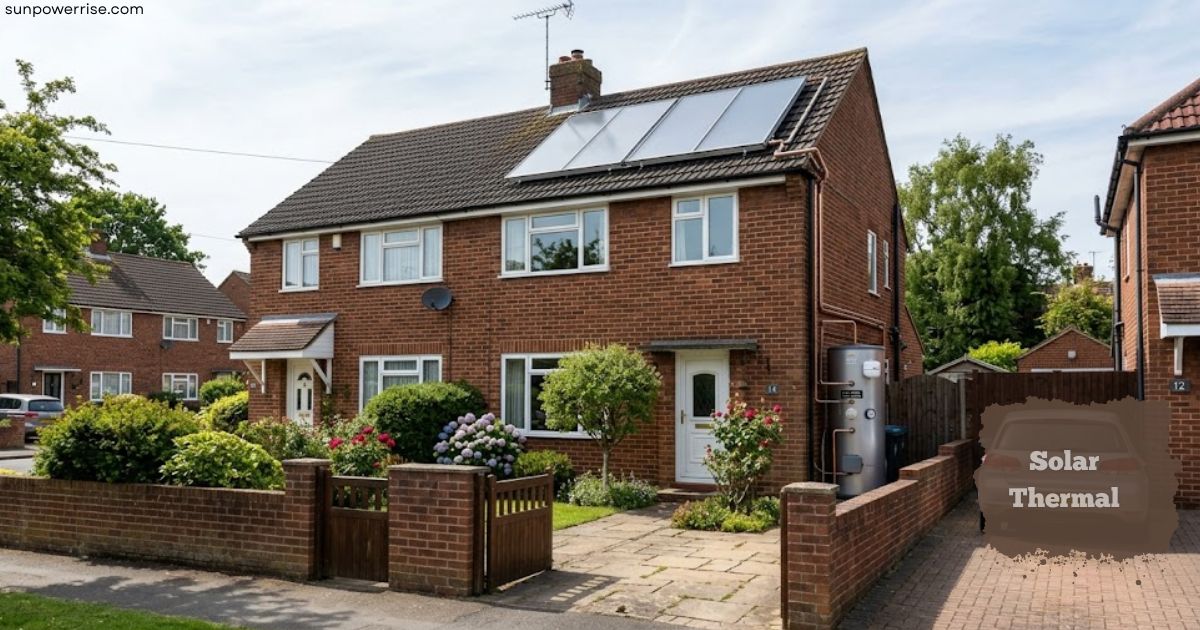
Solar thermal is a renewable heating technology that uses rooftop collectors to capture the sun’s heat and feed it directly into your home’s hot water cylinder, instead of converting sunlight into electricity the way solar PV does. A well-installed UK system typically pre-heats 40–60% of a household’s annual hot water demand, with your existing boiler or immersion heater topping up the rest.
It’s a genuinely simple, decades-old technology, it runs on a sealed loop of glycol fluid rather than grid power, and it still cuts a real chunk off a gas or electric hot-water bill. What’s changed is where it sits in the market: once the default “green” home upgrade, it’s now a niche choice that most installers, including us, no longer lead with over solar PV.
How Solar Thermal Works
Roof-mounted collectors pull in sunlight and transfer that heat into your cylinder via one of two designs. Flat-plate collectors are the cheaper, more common option: rectangular panels fixed flush to the roof. Evacuated-tube collectors use cylindrical glass tubes and perform noticeably better in cold, overcast conditions, which matters more in the UK than in sunnier climates.
The trade-off: tube systems cost more upfront, and on a straight cost-per-unit-of-heat-produced basis, flat-plate collectors still win for most UK homes unless you’re in a particularly shaded or northern location.
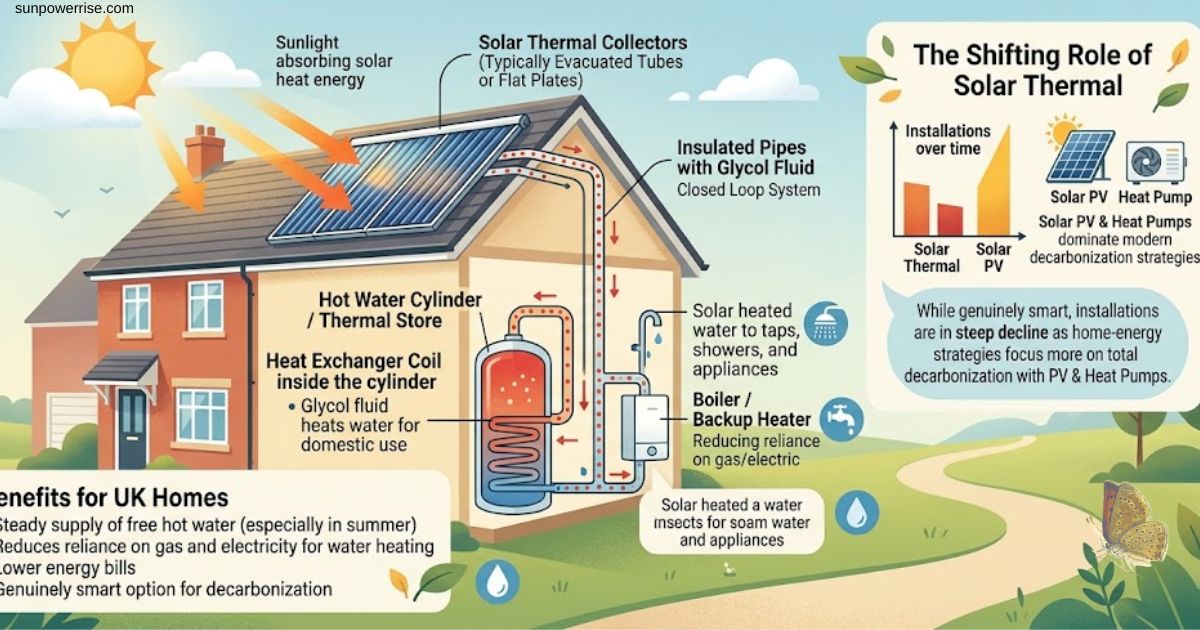
A small pump circulates glycol an antifreeze fluid ,through the collectors and into a copper coil inside your hot water tank, controlled by a sensor that only runs the pump when it’s actually worth it.
Two numbers installers use to judge performance: collector efficiency (how much of the sunlight hitting the panel actually converts to usable heat) and solar fraction (the share of your total hot water demand the system covers over a year). When a quote says “60% coverage,” that’s the solar fraction talking ask for it by name when comparing installers.
Sizing a System for Your Home
Nobody tells you this upfront, but sizing is simple. A typical four-person household needs roughly 3–4m² of collector area and a 200–350 litre solar-compatible cylinder.
Smaller households can get away with less; anything larger than a five-bed home with heavy hot water use usually needs a bigger tank rather than more panels, since collector area maxes out its usefulness fast on a domestic roof. If your current cylinder is undersized or you’re on a combi boiler with no cylinder at all, that’s the first cost to budget for not the panels themselves.
DIY Kits vs a Professional Install
Most of the £5,000–£6,000 UK price tag you’ll see quoted is for a fully installed, MCS-certified system with labour included. DIY solar thermal kits exist and typically run £1,500–£2,500 for the hardware alone a real option for a confident self-builder or renovator, but you’re taking on the plumbing, the glycol loop, and the risk of a poorly commissioned system that underperforms for years without any obvious sign something’s wrong. For most households, the labour cost buys peace of mind more than anything else.
Complementing Your Heating System
Solar thermal is designed to sit alongside your existing heat source, not replace it. If you already have a system boiler or a regular boiler paired with a twin-coil solar cylinder, you’re set up to get full value from day one one coil runs off the boiler, the other off the solar loop.
Combi boilers are the sticking point. Most combis have no cylinder to connect a solar coil to, so adding solar thermal usually means installing a separate cylinder from scratch extra plumbing, extra cost, and in some homes, nowhere sensible to put a tank. A handful of combi models support solar pre-heat natively, but treat that as the exception, not the plan. Get a straight answer from an installer before assuming your combi will work with it. On the upside, solar thermal integrates cleanly with air source and ground source heat pumps, and your backup heater always covers the shortfall, so you’re never without hot water on a dark January week.
Installations in Decline: What the Data Shows
UK demand has collapsed. MCS-certified domestic solar thermal installations fell from 571 in 2022 to 300 in 2023, 173 in 2024, 65 in 2025, and just 4 recorded in 2026. Roughly 0.2% of UK homes now have solar thermal, against about 5% with solar PV and climbing. Installers, manufacturers, and government funding have all shifted toward heat pumps and PV as the backbone of home decarbonisation solar thermal hasn’t been banned or discredited, it’s just been out-competed.
Costs, Savings, and Carbon Impact UK and US
In the UK, MCS data puts installed cost at £2,283–£3,465 per kW over the past five years, with total system cost consistently landing between £5,000 and £6,000 a price that’s barely moved while solar PV has gotten dramatically cheaper over the same period.
Energy Saving Trust field trials found real-world systems delivering around 39% of annual hot water demand on average, with well-designed setups reaching 60%, translating to typical annual savings of £55–£110 on gas-heated water and £80–£210 where it displaces electric immersion heating. A system typically lasts 20–25 years, and for most gas-heated homes, payback stretches close to or past that lifespan the core reason demand has dried up.
In the US, a comparable residential solar water heating system costs $7,600–$10,000 installed. The bigger change for 2026: the 30% federal residential solar tax credit (Section 25D), which used to apply to solar water heating as well as PV, was ended by the One Big Beautiful Bill Act for any system bought after December 31, 2025.
Anyone purchasing in the US in 2026 is paying full price unless they qualify for a state-level credit or go through a third-party-owned (leased) arrangement a detail that’s changed the US economics of solar thermal significantly and isn’t reflected in most guides still quoting the old 30% figure.
Solar Thermal vs the Alternatives
| Solar Thermal | Heat Pump | Solar PV | |
| What it heats | Hot water only | Space + water heating | Nothing directly generates electricity |
| Typical UK cost | £5,000–£6,000 | £7,000–£13,000+ | £5,000–£9,000 |
| Lifespan | 20–25 years | 15–20 years | 25–30+ years |
| Roof/site dependent | Yes | No | Yes |
| UK government support | Largely withdrawn | Boiler Upgrade Scheme | Smart Export Guarantee |
A heat pump covers both space and water heating in one system and delivers bigger carbon savings, though it often needs radiator or insulation upgrades to run well. Solar PV generates electricity you can use anywhere in the house, export for payment, or route through an immersion diverter to heat water for free on sunny days, which is worth flagging directly: a PV system with a diverter can do a version of solar thermal’s job as a byproduct, without a second roof system.
Solar thermal still has a place where roof space is limited to a south-facing slope, hot water demand is high and steady, or a home is off-grid, but as a standalone purchase it rarely beats either alternative on flexibility.
Limitations to Be Aware Of
Solar thermal only offsets hot water energy it does nothing for your household electricity use, which is where most modern bills are heading as homes electrify heating and transport.
Upfront costs remain high relative to the savings available in a typical gas-heated home; UK grant support has shifted to heat pumps and PV, and payback periods often run close to or beyond the system’s working life. A PV system, by comparison, chips away at electricity bills and grid imports from day one and can be paired with a battery, an EV charger, or a diverter for water heating versatility solar thermal can’t match.
Our Recommendation
Weighing cost, flexibility, and long-term value, solar PV wins for the large majority of UK and US households. Electricity does more jobs than hot water alone it can heat water, power a heat pump, charge a car, and sell back to the grid, which is exactly why, as installers, we now supply and install solar PV only. Solar thermal remains a sound niche choice for the right roof and the right hot-water habits, but it’s no longer the default we recommend.
FAQs
How much of my hot water can solar thermal realistically cover?
A well-installed solar thermal system typically covers 40–60% of your annual hot water demand, rising to as high as 90% during peak summer months.
How much does a solar thermal system cost to install in the UK?
Based on recent MCS data, most domestic thermal installations in the UK cost between £5,000 and £6,000 upfront, with running costs remaining low after installation.
Is solar thermal better than solar PV for my home?
For most homes, solar PV delivers greater flexibility and cost-efficiency because it generates electricity for multiple uses, whereas solar thermal only heats water.
Does my home need a specific setup to use solar thermal?
Yes, you ideally need a south-facing unshaded roof and an existing hot water cylinder; combi-boiler homes require an additional cylinder, adding cost and complexity.
Are there any government grants available for solar thermal in the UK?
Most government incentives and grants have shifted toward heat pumps and solar PV, though solar thermal may still qualify for Domestic Renewable Heat Incentive (RHI) payments in some cases.