


Naked Energy has built a strong name in the system design service world, helping businesses across the UK plan and model their own integrated solar thermal systems from the ground up.
This Virtu PVT technology matures steadily through 2024, and it’s clear the British company earned real credibility when it secured the Solar Keymark certificate for its Virtu PVT collectors back in October 2024.
A press release highlighted a high-profile reference project using this hybrid collector on the roof of the British Library in London, a site that now relies on 240 Virtu PVT units alongside 710 Virtu HOT collectors, covering 712.5 m2 in total.
Unlike conventional solar PV panels, this solar thermal approach focuses on producing renewable heat instead of electricity, and that’s exactly where the Virtu PVT collectors shine, since they hold the highest energy density among solar PV panels while running up to ten times more efficiently than traditional PV panels.
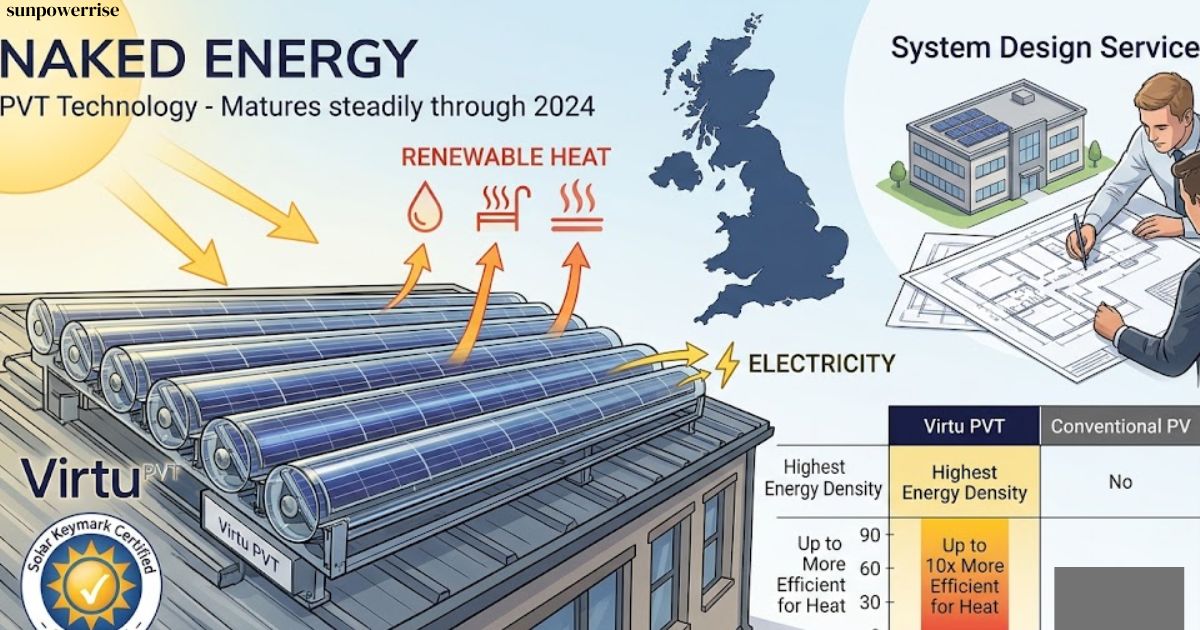
Virtu PVT & Virtu HOT Technology
Dual-Energy Hybrid Innovation
From an engineering standpoint, the Virtu HOT collector produces clean heat reaching 120 °C, while the Virtu PVT collector blends PV with solar thermal to deliver both electricity and heat up to 75 °C.
Both products carry the respected TÜV Rhineland certification, and Virtu PVT stands as the world’s first evacuated hybrid solar collector to receive it, a true game changer within the solar industry.
Each unit is built from 19 cm-wide evacuated single-glass tubes housing an aluminium absorber that’s laminated with PV cells, and I appreciate how the company stays mindful of its carbon footprint by sourcing glass tubes from Germany to cut down on short transport routes, while only the glass caps travel from China; the assembly itself happens locally in the UK.
Engineering the Next Generation of Solar Density
Inside each tube, a U-shaped copper pipe moves the heat transfer fluid from the absorber to the manifold, and the trickiest part of manufacturing is the metal-plastic-glass seal where the metal pipes exit the glass tube.
These collectors adapt well to façades, inclined roofs, and flat roofs, since installers can adjust the incidence angle to suit any installation.
For projects needing heat alone, the vacuum tube collector known as Virtu HOT reaches 120 °C without PV cells attached; the company was founded in 2012, and the Virtu line has been commercially available since 2018, now sold across 20 countries with a strong footing across Europe.
The Anatomy of Certified High-Efficiency Solar Tubes
What makes the modular design genuinely practical is how easy it makes things to install and maintain, since every tube ships with its own individual mounting system, saving time and materials on-site.
The whole array sits at a remarkably low profile, just 25 centimetres above the roofline, which sidesteps many planning issues and cuts down wind shear compared to bulky racks and A-frames.
Each tube is angled and spaced carefully based on latitude to prevent self-shading during winter while boosting summer outputs, and a clever reflector captures stray solar energy that would otherwise miss the tubes, lifting peak performance by 40 percent and raising average annual yields by 15%.
Redefining Solar Performance and Modular Installation
The vacuum inside each tube dramatically lowers thermal losses, allowing higher temperature outputs for hot water and process heat even in colder climates.
That same vacuum shields the cells from humidity while keeping them actively cooled to a uniform temperature via the solar absorber, which boosts peak electrical performance and extends their useful life.
In my view, this combination has created an entirely new category for solar heat and power, giving Virtu the highest rooftop energy density in the world.
UK’s First System Design Service
Pioneering Bespoke System Design for UK Decarbonisation
Naked Energy became the first UK solar thermal manufacturer to offer bespoke plans showing how to integrate its technology into a customer’s overall energy systems, something no British Original Equipment Manufacturer had offered before.
To run this division, Sam Notter joined as Principal Design Engineer; this chartered engineer previously shaped UK district heating systems at Vital Energi, leading large decarbonisation, industrial, healthcare, and commercial application projects, and he also brings experience from Veolia and Engie as a systems design engineer.
Overcoming Integration Hurdles in Commercial Renewable Heating
Inefficient design has long troubled the industry, since modern energy systems combine multiple technologies, each carrying different specifications and unique characteristics, which makes building an efficient system a genuinely challenging task.
The system design team at Naked Energy uses standard industry platforms like Polysun and EnergyPro, alongside a proprietary in-house design tool that simulates heating system interactions to produce accurate performance forecasts.
Commercial businesses and industrial businesses with year-long heat demand make up the core customers, and they depend on accurate information to sustainably plan their heat decarbonisation journey.
Bridging the Efficiency Gap with Advanced System Simulation
Christophe Williams, CEO of Naked Energy, has spoken about how more businesses now understand why renewable heating systems matter, yet too many still run a mix of technologies that don’t cooperate, resulting in under performing systems and hesitation around renewables.
He’s pleased to offer the support these companies need and welcomes Sam to lead the team, calling this hire a clear signal of the company’s intent to stay among the leaders of the UK’s decarbonisation push, especially given Sam’s history with some of the biggest companies in this space.
He’s genuinely excited to lead this systems design service for a recognized leader in the solar thermal industry, believing Virtu technology can reshape how people think about decarbonisation, calling it a privilege to work alongside such a talented team to grow their impact.
The British Library High-Profile PVT Reference
It’s an honour for Naked Energy to partner with such an iconic British institution as the British Library, supporting its journey toward its net-zero goals.
The solar heat primarily supplies sanitary hot water and space heat throughout the building, while also feeding the heat-driven dehumidification system that protects the rare books section, keeping books and texts, some centuries old, under truly ideal conditions.
An online monitoring system tracks the performance of the setup on the roof of the library constantly, and the team is happy with the results from the first year of operation, which they presented at Eurosun in August 2024.
The solar thermal yield across the 180 m2 PVT field reached 297 kWh/m2, beating what was simulated, while on the electricity side, the yield of 72 kWh/m2 came in slightly below what was expected, off by -2.5%.
Heat-As-A-Service With E.ON Energy Infrastructure Solutions
To support the funding behind its global acceleration, Naked Energy pushed forward the international rollout of its Virtu PVT collectors through summer 2024 via a Series B capital raise, pulling in GBP 17 million from E.ON Energy Infrastructure Solutions, known as EIS, and Barclays, both of whom are shareholders in the company.
Williams noted both partners share the same urgency around the need to decarbonise heat, and according to the press release, the deal moved from scouting to signing in just one year, marking a meaningful strategic partnership between Naked Energy and E.ON.
EIS describes itself as an accomplished partner delivering integrated, sustainable, and digitally-enabled energy solutions for cities and industries working to cut carbon emissions, operating across 16 European countries and serving 1.5 million customers through 4,500 plants.
Best of all, E.ON EIS covers the upfront costs, so installation costs don’t touch the client’s balance sheet, freeing up resources for the rest of the operation.
FAQs Related To Virtu PVT
What are PV-T solar panels?
PVT panels, like Naked Energy’s Virtu PVT collector, combine PV and solar thermal in one unit, producing both electricity and heat at once, so a single roof does double the work.
Are PV-T better than PV?
For most homes, PV-T isn’t simply “better,” but when both heat and electricity are needed, it beats standard PV panels on overall energy density and space efficiency, almost like getting two systems for the price of one.
Is solar PV panels worth buying in the UK?
Yes, with the right installation and steady UK sunshine, solar PV genuinely pays off over time, and honestly, watching your own bills drop each month brings a quiet sense of pride.
Which is better, TOPCon or Bifacial?
TOPCon cells generally deliver stronger peak performance in standard setups, while Bifacial panels capture extra solar energy from reflected light on both sides, so the right choice depends on the installation site.
How many PV panels for 5kW?
Most UK homes need around 12 to 14 panels for a 5kW system, though the exact number shifts slightly based on each panel’s wattage and the roof’s available space.