

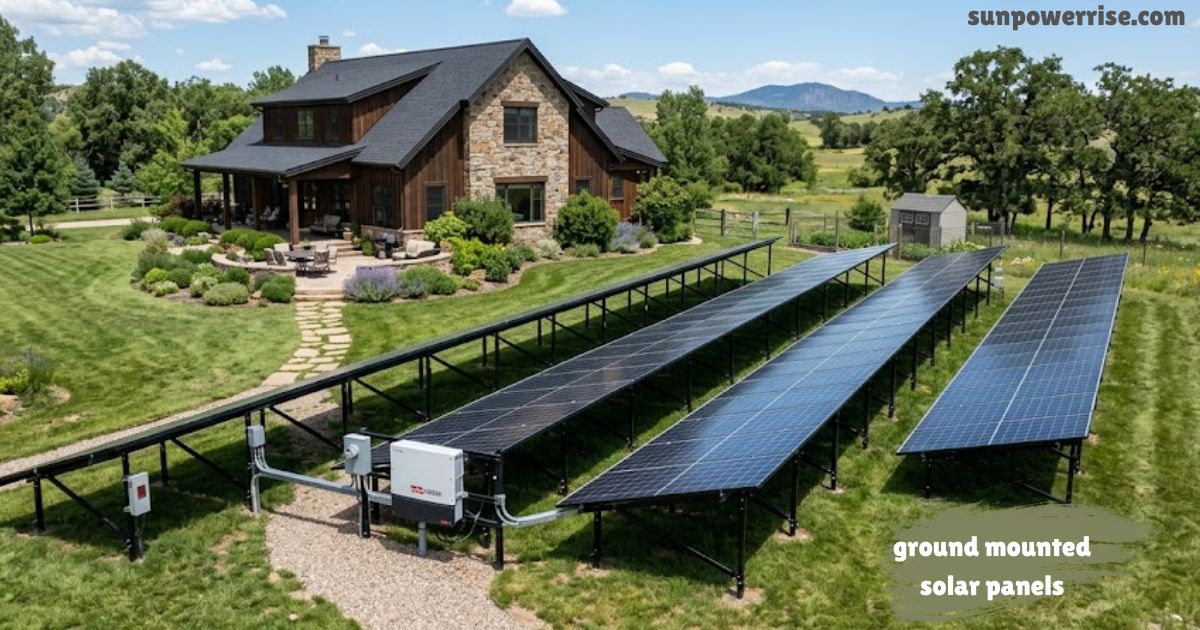
A sloped roof, a shaded north side, or the wrong material can shut the door on rooftop panels fast. That’s exactly where a ground mounted solar panel system steps in and changes the situation completely. If you own a sun-drenched yard or a big yard, you already have what most people wish they had.
Data pulled from EnergySage in 2026 shows these setups run about 51% pricier than rooftop solar, mainly because of extra equipment. Still, that cost often buys real electric bill savings through tracking systems that follow the sun across the sky.
Ground-mounted solar energy systems count as a genuine alternative to standard rooftop solar installations, and they’re common on farms, in the garden, or across any large open property.
Ground Mounted Solar Panels
Ground-mounted solar power system is a solar array built at ground level instead of on your roof, using a dedicated racking system that lifts panels anywhere from a few inches to several feet off the ground.
Required module-level power electronics handle rapid shutdown safety, while other system components can sit farther away entirely.
That flexibility is genuinely handy. You can tuck temperature-sensitive equipment like string inverters and solar batteries into your garage instead of leaving them exposed outside.
Ground setups also welcome solar panels of any size, including bulky commercial modules built from 72 cells or 144 half-cells, unlike rooftop systems, which usually stick to smaller, lighter 60-cell panels.
You’ll also hear this setup called by other names: backyard solar panels, free-standing solar panels, or simply ground-mount PV systems. All three terms point to the exact same idea.
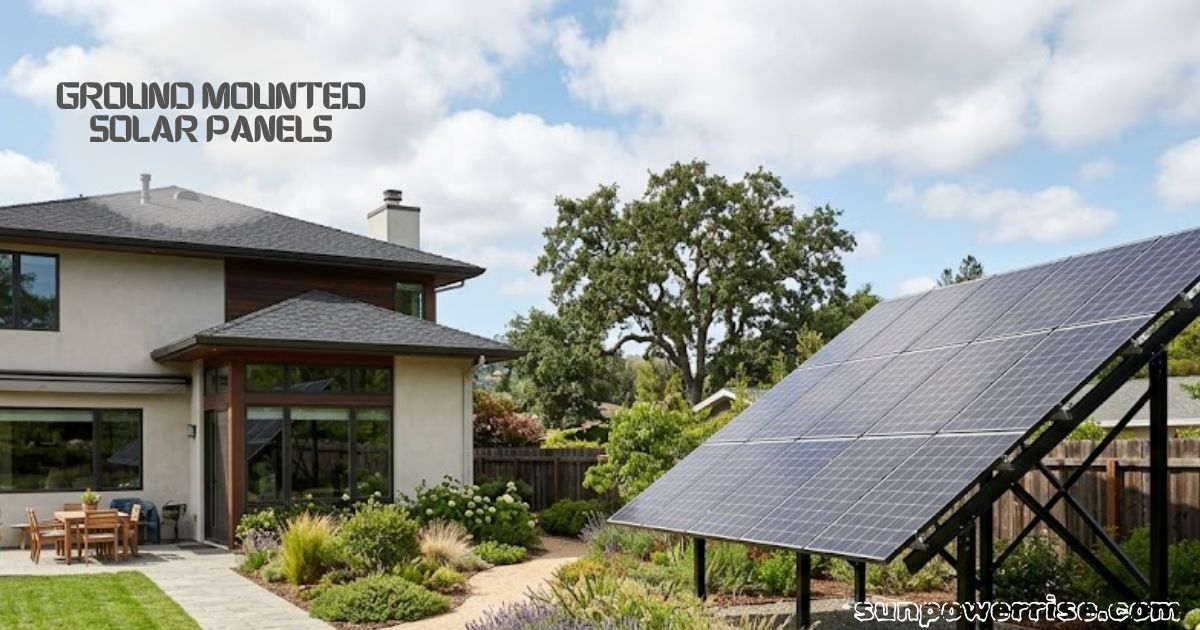
What Are the Best Ground Mounted Solar Panels?
Qcells earns its reputation through U.S. manufacturing and consistently high-quality solar panels. Maxeon, formerly known as SunPower, builds the most efficient panels on the market, though that performance comes at a genuinely expensive price point.
REC Group deserves a mention too, known for delivering excellent performance without breaking the bank. Meanwhile, Trina Solar and Canadian Solar stand out as solar manufacturing giants, offering highly reliable panels at friendlier budget prices. Together, these make up my personal shortlist of the top five companies worth researching.
Types of Ground Mounted Solar Systems
Standard Ground Mount
A standard ground mount uses sturdy metal poles or metal framing, drilled deep with a post pounder to form a framework built from beams. This kind of structure holds panels at a fixed angle, though operators can manually adjust the tilt a few times a year to handle seasonal shifts as the sun moves.
South-facing panels almost always outperform north-facing panels, and the ideal degree of tilt shifts with your geographic location.
Then there’s the pole mount, sometimes called the standard ground solar mount panels more athletic cousin. This design plants a single pole or main pole into the ground and uses it to elevate panels higher up, giving better clearance above foliage and ground obstructions.
Pole-Mounted Solar
Pole-mounted solar systems frequently pair with solar trackers, letting several solar panels rotate and adjust their angle to move solar panels toward the sky all day long.
Tracking hardware comes in two flavors. Single-axis tracking systems and single-axis setups simply follow the sun left to right, while dual-axis tracking systems and a full dual-axis system also react to seasonal variations in the sun’s position, boosting electricity production by roughly 25%.
A standard ground-mount array stays simpler on purpose. It uses traditional ground mounts anchored with small anchors such as concrete piers, driven piers, helical piles, or concrete ballasts, depending on your ground conditions.
This fixed-position design, sometimes upgraded with manual adjustment, remains the most cost-effective solution for any ground install.
Solar Carport
A solar carport is really just a taller variation of the standard build, suspended high enough to shelter vehicles parked in driveways or parking lots, giving protection from the elements while producing cost-free electricity and emissions-free electricity.
It’s a smart way to use underutilised space, and many owners pair it with electric vehicle charging stations.
Cost of Ground-Mounted Solar Systems
The EnergySage Marketplace puts the average ground-mount project at $46,041, a figure built on a typical 14.1-kilowatt system running at about $3.26/W in cost-per-watt terms, all recorded in 2026.
That number sits before incentives kick in, and both state incentives and local incentives can trim it down nicely, though interest rates on a loan will nudge the financing total back up.
Ground-mount systems demand more labor and materials than a roof-mount, because your installer must build a fresh racking system and drive steel beams into the earth rather than lean on the roof as the main support. That extra installation cost stings in the short term.
But here’s the twist: roof suitability isn’t guaranteed. Some homes need reinforcements or even a full roof replacement before panels go up, and a north-facing roof or a heavily shaded roof can crush your electricity generation for years. That’s precisely why a ground-mounted solar system stays appealing despite the increased installation cost; the extra cost often gets offset over time as the system continues to produce more energy.
Benefits of Ground Mounted Solar Panels (vs. Rooftop)
Once the framework is up, the payoff becomes obvious. A ground system can maximize energy production thanks to ideal orientation, and it’s genuinely easy to maintain, plus it comfortably handles high energy demands that smaller rooftop solar panels simply can’t match. Because installers work on flat open land instead of a ladder, it’s also easier to install a big system, with zero roof work required.
Rooftop options still carry their own strengths, mind you. They typically run 21% less per watt, and they’re often simpler to fund through a loan, a lease, or a power purchase agreement (PPA). Ground setups fight back with practical perks though: it’s far easier to remove debris, dust, and snow, and you avoid vandalism and wildlife damage entirely on the roofline, even if it does eat up more valuable land.
Ground mounts also solve real problems. If your home has roof issues, limited space, or a structurally weak roof, going to the ground sidesteps all of it. You’ll usually see higher energy production because you can set the optimal direction and optimal angle yourself, and it stays easy to clean on top of being easy to maintain.
There’s a small trade-off worth naming honestly: ground arrays can affect your home’s aesthetic, and the harder installation process takes real time. Panels can face south or southwest for the strongest direct sunlight, something a slanted roof simply can’t offer on flat ground.
That freedom brings more sunlight, which means you generate more solar power and end up saving money, without fighting a skylight, a chimney, or other roof obstructions for more room. Yes, the installation panels stage takes more time and effort and stays somewhat expensive, but the long-run math still tends to be cost-effective, since you keep full control over direction and angle.
Conclusion
While ground mounted solar panels require a clear patch of land, a ground array can be the difference between going solar and giving up entirely when a rooftop installation simply won’t work for a home. Yes, you’ll face upfront cost and some yard space sacrifice, but optimized energy production over the decades usually means the math works out in your favor.
Everything comes down to your roof limitations and whether they justify the premium. A south-facing roof with no shade rarely needs anything beyond standard rooftop panels. But a north-facing roof buried under dormers and tall trees? That’s when a ground system becomes your clearest route to meaningful electricity savings.
The extra energy these systems produce genuinely makes them well worth the price for the right property. Do your own research, talk to a trusted local solar installer, and match the system to your home’s energy needs.
FAQs
Are ground mounted solar panels worth it?
For many homeowners, yes. Strong electric bill savings build up over decades of production, and while there’s an extra cost upfront, it usually gets offset over time through higher energy production.
Are ground mounted solar panels right for my home?
If you’ve got large open space and high energy usage, absolutely. That extra room lets you add more solar panels and generate more power than a roof ever could.
How many ground mounted solar panels will I need?
Most homes land around 19 solar panels using 400-watt panels, based on 4 peak sun hours, 1.6 kWh daily output, and 1,600 watt-hours per panel.
What are the best ground mounted solar panels?
My shortlist stays consistent: Qcells, Maxeon, SunPower, REC Group, Trina Solar, and Canadian Solar.