

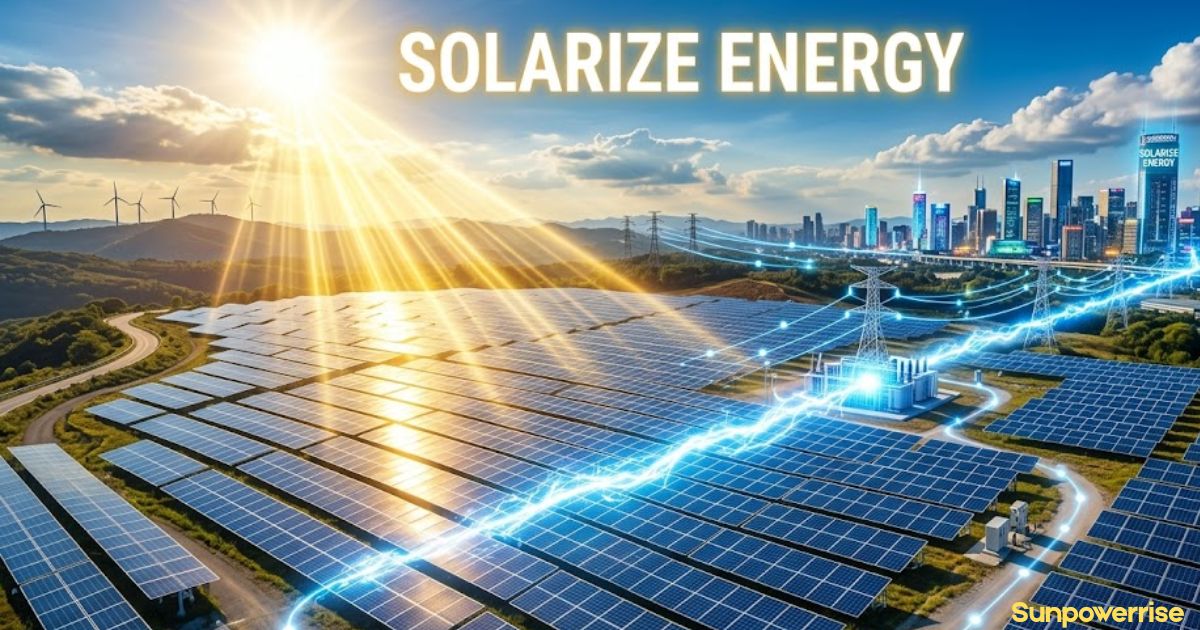
To solarize energy simply means switching a home or business from grid-only electricity to solar power, either by installing your own PV system or by joining a group scheme that helps a whole street or town do it together at a lower cost.
Solarize Energy
The term first caught on in the US through “Solarize” campaigns: local, time-limited group-buying drives that used collective bargaining power to bring installation prices down for everyone who signed up.
In the UK and across Europe, the same idea now shows up as household solar adoption paired with government-backed buyback schemes, letting homeowners generate their own power, cut their bills, and get paid for whatever electricity they don’t use.
I got a close-up look at how this works back in 2017, when a neighbour asked me about a local Solarize programme that was gathering interest. That same year, 104 households in Linn County, Iowa, pooled their buying power and locked in real savings on solar installations an early example of how a community-driven pricing model could spread fast once people saw their neighbours doing it.
A local organiser, Eric Holthaus, ran roughly 20 information sessions so families could understand the technology and the economics before committing to anything. That grassroots approach to solar adoption hasn’t really slowed down since it just looks different depending on where you live.
Why 2026 Is a Good Year to Solarize
Solar uptake across the UK and wider Europe has genuinely accelerated. New residential installations rose by around 35% in 2025, and that trend is expected to hold through 2026 as more households look for ways to both lower their energy costs and earn something back by exporting surplus power.
A lot of that momentum traces back to UK and EU policy: renewable self-generation is increasingly treated as a mainstream household responsibility rather than a niche lifestyle choice.
When a household solarizes its energy, the immediate effect is a smaller carbon footprint but the practical effect is that any electricity you generate and don’t use becomes useful to the wider grid instead of being wasted. None of this works without the right supporting hardware, though.
A smart meter is essential, since it’s what accurately tracks how much electricity you’re exporting and reports that data back to your supplier so you actually get credited for it.
The Real Payoff: Selling Electricity Back to the Grid
The financial case for solar becomes obvious the moment you start exporting. There are two clear benefits. First, there’s the straightforward one lower bills, month after month, simply by generating some of your own power.
Second, every unit you export supports grid decarbonisation, making the local network cleaner for everyone connected to it, not just your own household.
That said, self-consumption tends to beat exporting when you look at the numbers over time. Using the solar power you generate yourself, rather than selling it straight back to the grid, usually produces stronger long-term savings, especially once a battery enters the picture. Storage also makes Time-of-Use tariffs much easier to manage, since you’re relying less on the grid during the expensive peak-rate hours.
Battery Storage and Smart Export Strategies
A well-sized battery dramatically improves self-consumption because it captures the surplus your panels would otherwise send straight to the grid. The catch is compatibility your storage unit needs to work properly with your existing PV setup.
Something like the EcoFlow PowerOcean is built specifically for this, letting you draw on stored power during peak-price hours or unexpected outages instead of buying from the grid at the worst possible time.
Pairing that with the EcoFlow HEMS app and a monitor like PowerInsight 2 takes it further, since the system can automate load-switching on its own cutting how much electricity you import and trimming your monthly bill without you having to think about it.
Over time, smart storage decisions shorten the payback period on the whole solar-plus-battery investment, and many regions still run grants or incentive schemes specifically for storage uptake.
Understanding the Renewable Energy Buyback Scheme
In the UK, getting paid for the power you export comes down to three schemes: SEG, FiT, and PPA.
SEG (Smart Export Guarantee) is the current mechanism most UK homes use. It’s market-based rather than government-funded, and rates aren’t fixed they can change yearly depending on your supplier.
FiT (Feed-in Tariff) ran from 2010 to 2019 and is closed to new applicants, but anyone already signed up keeps their rate locked for 20 to 25 years.
PPA (Power Purchase Agreement) is aimed at businesses with larger-scale generation, offering fixed rates typically for around 10 years or more.
You can switch from an old FiT arrangement to SEG at no cost whenever you like, though FiT and PPA rates themselves are locked once signed. With FiT now closed, SEG is the practical route for most households, while PPA remains the option for large commercial generators.
How SEG Actually Works
The SEG replaced the FiT in 2020 as the UK’s main buyback route, and unlike its predecessor, it runs on market pricing rather than a fixed government subsidy, which is exactly why it became the default choice for homeowners selling power back.
To qualify, Ofgem requires your renewable source (solar, wind, or hydro) to have a capacity up to 5 MW, with Micro-CHP systems capped separately at 50 kW. Your installation also needs MCS certification, plus a supplier-approved smart meter installed at the right point in your system.
Steps to Start Selling Solar Power Back to the Grid
Confirm your PV system is installed by an MCS-certified installer.
Get a supplier-approved smart or export meter fitted. Choose SEG or a PPA depending on your system’s scale, and compare rates, remembering SEG rates move yearly.
Size your battery carefully, since that decides how much power you keep for yourself versus sell. Check for local grants or incentive schemes that can shorten your payback period. Use a properly certified installer throughout; it protects the whole investment.
Community Solar, Done Together
Group-buy programmes remain some of the best evidence for how fast solar adoption can spread once a community gets behind it. In Iowa, 483 residents turned out for one campaign after Linn County government, the City of Cedar Rapids, The Nature Conservancy, the Indian Creek Nature Center, and Iowa 350 all got involved; organisers only had to supply the venue; the community did the rest.
Connecticut runs a similar model through the Solarize Energy Granby programme, where GS Energy, a locally selected and certified installer, offers reduced group pricing to speed up adoption town-wide. A dedicated operations team based in Bloomfield provides ongoing education and support, backed by workshops and flexible financing to suit different budgets.
Locking in protection against rising electricity costs makes the decision an easy one for most Granby residents though anyone interested needs to sign before August 9th to qualify. More details are available directly through GS Energy for anyone in the Granby area.
FAQs
Can I really earn money by solarizing energy?
Yes., through schemes like the SEG in the UK, you get paid for every unit of surplus energy you export.
What’s the difference between SEG, FiT, and PPA?
SEG is the current UK scheme for homes; FiT is closed to new applicants, and PPA suits larger businesses with fixed-rate agreements.
Do I need a smart meter to sell power back to the grid?
Yes, a smart or export meter approved by your supplier is required to measure and report your exported energy.
Is battery storage worth adding to a solar system?
Yes, it boosts self-consumption, cuts peak-hour costs, and shortens your system’s payback period.
What’s the first step to start solarizing energy?
Confirm your installer is MCS-certified and your PV system meets certification standards before applying for a scheme.