

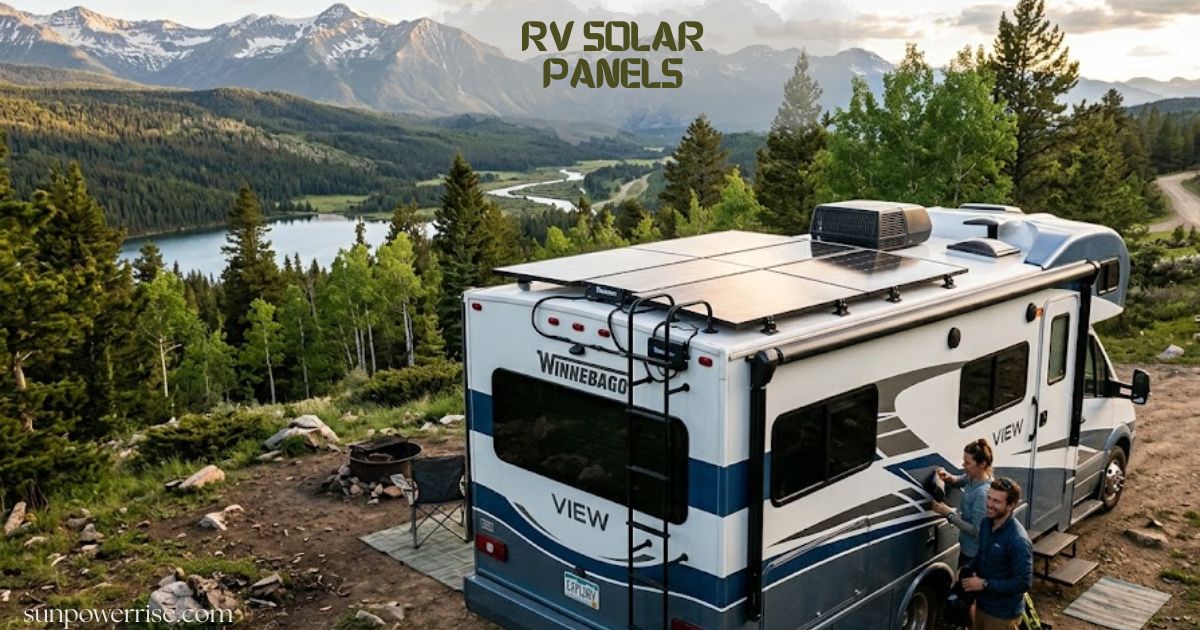
RV solar panels ensure that life on the road in your RV feels like true freedom, but that freedom only lasts if you have power on-demand wherever you park.
Many campers get tired of loud, smelly generators and want clean energy instead, which is why solar panels have become the go-to answer for anyone chasing energy independence.

Whether you are a full-timer living in your rig year-round or someone planning a weekend getaway, pairing your energy needs with the sun gives you real off-grid comfort at any campsite or sunny spot you choose.
This buying guide walks you through everything worth knowing before you buy, including types of modules, components, and expert advice on picking the right setup for your budget.
To make things easier, we also put together our top five picks for the best RV solar system options on the market today, each one built to deliver free energy for a truly quiet getaway.
What Are RV Solar Panels?
At their core, RV solar panels use solar modules that convert sunlight into usable electricity, giving campers a steady stream of solar energy production wherever the sun shines.
Owners can bolt panels to the vehicle roof with fixed racking, or place portable solar panels at the sunniest spot near their site. As long as nothing is shading the panels, they soak up solar radiation all day and turn it into power for both DC loads and AC loads, running everything from lights to a microwave.
This kind of sun exposure means owners no longer need to stop at campgrounds just to plug into an external power outlet, nor do they need loud diesel generators to keep their batteries charged. The setup gives real energy independence while camping, since the roof itself becomes a constant source of external power.
Beyond charging batteries, these systems also run small appliances and a TV, proving that solar is not just a backup option but a genuine daily power source for RV living.
Components of an RV Solar System
Every off-grid installation needs more than just solar panels to work properly. A full kit usually includes a charge controller, a battery bank, and an inverter, each playing its own role in turning sunlight into livable power. The charge controller manages the voltage and amperage flowing to the batteries, using Maximum Power Point Tracking (MPPT) to squeeze the most power output out of the panels while protecting against overcharging.
The battery bank stores that energy for later, and most setups run on 12V, 24V, or 48V systems depending on size. This stored DC power keeps DC loads like small appliances and a TV running smoothly, even after the sun goes down.
The inverter then steps in to change that stored energy into a modified sine wave or pure sine wave at 120V, which is exactly what a coffee maker or a computer needs to operate like it would at home, handling both AC loads and everyday devices without any trouble.
How Many Watts Do You Need, and What Will It Cost?
Figuring out how much solar you actually need comes down to your daily electricity usage and how much solar exposure your camping spots get.
Experienced boondockers often recommend starting with a 200-watt system to cover basics, while comfort-minded RVers tend to land somewhere between 400-700 watts, and most people fall within the 200- and 600-watts range depending on their appliances. Full-timers who rely on solar every day usually push toward a 400-watt system or larger.
Pricing depends heavily on what’s included. A simple 100W kit might run below $100, while a 100W kit with a flexible solar panel can climb toward $250.
Complete RV solar panels kit with a charge controller, inverter, wiring, and battery banks typically start just above $2,000 and can reach $3,000 for larger setups, especially if you add professional installation instead of running it as a DIY solar project.
Don’t forget battery capacity, measured in Ah or Amp hours & a common rule is 100 usable Amp hours for every 200 watts of panels.
This keeps your fridge, electric oven, and smaller devices like a tablet, smartphone, or smartwatch charged, and over time the energy savings from not paying for appliances or hookups add up nicely.
What to Consider When Choosing RV Solar Panels
Setup
Picking the right setup starts with understanding your own power consumption. Unlike residential solar systems, RVs rarely have power-hungry devices, but you should still add up your daily loads: a TV running at about 150W, satellite internet pulling 25W, a laptop at 100W, and a coffee maker spiking to 1,000W for just a few minutes.
Most RV campers use around 20 kilowatt hours, or 20 kWh, each day, and this number drives your PV system sizing, which also factors in Peak Sun Hours (PSH) and a derating factor to account for PV losses.
Mounting
Mounting matters too. Fixed mounting relies on mounting brackets and drilling holes, giving strong roof mounting for a type of solar panels like rigid monocrystalline or polycrystalline panels.
Flexible mounting works well for a curved roof, like on an Airstream, using VHB tape or EternaBond tape instead of screws, and pairs nicely with flexible thin-film panels.
If you want more power in the fall or winter, a tilting platform through tilt mounting lets you angle roof-mounted panels straight at the sun to capture more solar radiation, while a portable setup gives you the freedom to skip drilling holes entirely.
Battery Choice
Battery choice of RV solar panels rounds out your system setup. Understanding battery size means converting amp-hour ratings into watt-hours for example, a 100Ah battery running at 24V stores 2,400Wh, enough for your energy needs across a full day, giving you several days of autonomy before recharging.
Lead-acid batteries remain common, but lithium-ion batteries are gaining popularity for their longer life. Just make sure your charge controller matches the voltage input and current output of your panel string, along with proper amperage, so your Ah rating and batteries work together safely.
Top Brands and Best RV Solar Panel Products
Renogy
When it comes to trusted brands, Renogy stands out for quality RV solar panel kit options, with prices ranging from $312.99 up to $679.99, plus Kit Add-on Suggestions if you want to build your own combination.
Their kits often include monocrystalline panels, a MPPT solar charge controller, a Bluetooth module for tracking performance, and a 25-year production warranty that gives real peace of mind.
Prices can vary by retailer the same Renogy kit also shows up listed at $739.99 in some comparison charts. Goal Zero takes a different approach, focusing on portable solar panels and vehicle-integration kits starting around $199.98, along with batteries sized for different needs.
Our team at SolarReviews tested several kits and picked favorites across categories. The Renogy 400 watts kit topped the list at $799.99, offering four monocrystalline panels with 21% efficiency and a strong 25-year power output warranty, though it has some cons, like needing extra space and not including batteries or an inverter still, the pros make it worth considering.
Rich Solar came in as runner-up at $699.99, offering 200-watt panels that are expandable to 600 watts on a 12-volt battery system.
BougeRV Yuma
For portable options, the BougeRV Yuma panel uses CIGS technology and thin-film solar panels construction, priced at $479.99 with coupon code AFF20 or $599.99 elsewhere, rated at 17% efficiency with a 10-year product warranty.
Jackery’s SolarSaga
Jackery’s SolarSaga folding solar panel hits 24.3% efficiency at $699.99 and works well with portable power stations, backed by a 3-year warranty plus a 2-year warranty extension, and it functions across a wide -4 to 149 degrees Fahrenheit range.
Bluetti’s PV420
Finally, Bluetti’s PV420 delivers a 420-watt, 23.4% efficiency rating with an adjustable kickstand and pairs nicely with Bluetti portable generators, though its warranty and efficiency rating only cover one year, and its Z-Brackets design keeps mounting simple for those who need it.
Benefits of RV Solar Panels
Solar panels become a loyal ally on every trip, offering real portability and true independence from the grid. Whether you choose portable solar panels or flexible solar panels stuck right to the roof, installation is often simple, sometimes skipping drilling holes altogether.
RV solar panels just need sunlight to work, running for 20 to 25 years without needing fuel or maintenance, unlike an external generator or other power generators that create loud noises and constant refueling.
The only thing to watch for is parking in a shaded spot, since that leads to reduced performance, cutting how much charge reaches your deep cycle batteries. Avoid the shade, and your panels will keep powering every one of your adventures without complaint.
What Types of Solar Panels Are Used for RVs?
Not every roof is the same, and obstructions like ventilation shafts or flat roofs can limit your options, which is why knowing the different panel types matters.
Rigid solar panels, also called traditional solar panels, come in two main types: monocrystalline silicon and polycrystalline silicon.
Monocrystalline is grown from a single silicon crystal through the Czochralski process, reaching 25.4% efficiency at around $1.25/W, with a temperature coefficient of -0.38%/ºC.
Polycrystalline forms by melting silicon crystals together, resulting in slightly more impurities but a lower price of $1.00/W and 24.4% efficiency, with a coefficient near -0.39%/ºC.
Thin-film amorphous silicon, used since the 1970s, only reaches 14% efficiency but costs just $0.69/W and handles high temperatures well thanks to its -0.234%/ºC coefficient, making it a smart pick for hot climates.
This thin-film approach also opens the door to unique designs for tight spaces, and it can even become rollable solar panels for easy storage at camping sites. There are also flexible monocrystalline solar panels, hitting 23% to 25% efficiency, built for curved roofs where a rigid fixing rack simply won’t fit.
Beyond material, think about how the panels attach. Rigid panels typically need a fixing rack for rooftop installations, while flexible versions skip that setup entirely.
Each type comes with its own power rating, and whether you pick portable designs or bolted-down units, flexible solar panels and rigid ones both get the job done differently depending on your roof shape and travel style.
Are RV Solar Panels Worth It?
So, are RV solar panels actually worth buying? That answer depends on your specific needs. With limited space and limited power output to work with, it takes real planning to get the most from a system.
If you camp often as a frequent boondocker, pairing a generator with a set of solar panels makes a lot of sense, and the RV solar panel kits covered above give you a solid starting point for transitioning to solar energy.
And don’t stop at your rig. Home solar panels can power your whole house, delivering bigger money savings and real benefits for the environment. A solar panel calculator can show exactly how much you’d save at home too.
FAQs
How many solar panels do I need to run a RV?
Most RVs run comfortably on 200 to 600 watts of solar, depending on your appliances and daily electricity usage. Boondockers often start with a 200-watt system, while comfort-minded RVers lean toward 400-700 watts.
What is the ideal solar panel choice for an RV setup?
Monocrystalline silicon panels are usually the best pick, offering the highest conversion efficiency (up to 25.4%) and strong power output, though flexible solar panels work better for a curved roof.
Is 400W solar enough for RV?
Yes, a 400-watt system covers most appliances and energy needs nicely for regular boondocking, giving full-timers a comfortable, reliable amount of free energy each day.
Will a 100-watt solar panel keep my RV battery charged?
A 100W kit can trickle-charge your battery bank and cover small DC loads, but it won’t fully sustain a busy setup think of it as a gentle helper, not a full energy independence solution.
How long will it take a 400W solar panel to charge a 100Ah battery?
With good sun exposure, a 400-watt system can recharge a 100Ah battery in roughly 2 to 3 hours, thanks to an efficient charge controller managing the power output.