

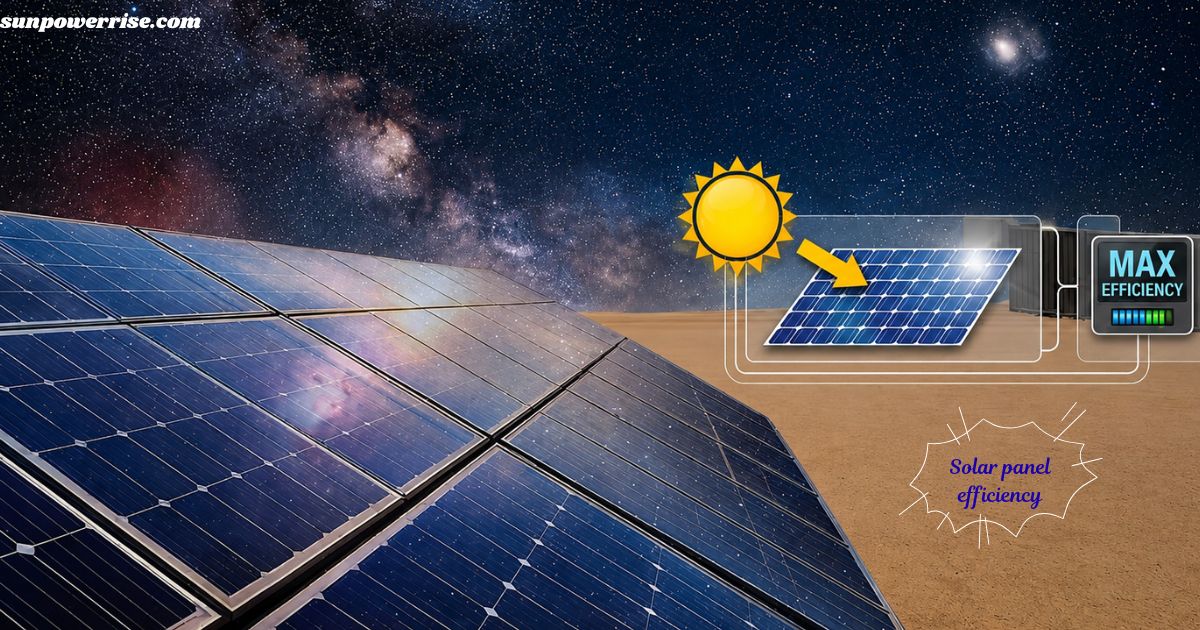
When we first looked into solar panels for our own home, the sheer number of choices felt overwhelming. But once we understood the solar panel efficiency, everything clicked into place.
Most domestic systems across the UK run at around 10-20% efficient, though premium options push that figure closer to 25%.
Your solar cell quality directly controls how much sunlight gets turned into electricity, which then flows straight into reducing your energy bills.
Photovoltaic technology works by converting sunlight into usable power, and the process is measured against strict benchmarks that have steadily increased in performance year on year.
Today’s best panels sit comfortably in the 20-25% range, meaning for every 100 watts of light hitting the surface, you realistically get 20-25 watts back as usable power.
What Does Solar Panel Efficiency Mean?
Decoding the Percentage
Solar panel efficiency ratings tell you exactly how effective a panel is at converting sunlight into electricity, expressed as a simple percentage.
For most residential installations, that figure lands between 15-20%, which sounds modest until you realise a well-designed 4 kW solar panel system can slash your energy bills and carbon emissions significantly.
The kW rating essentially describes the power output your panels deliver under optimal conditions.
Maximizing Limited Roof Space
When a panel carries a 20% efficiency label, it converts one-fifth of all incoming sunlight into usable converted electricity, and even small gains here compound beautifully over years of use.
If you have generous roof space, you have more flexibility in choosing panels, but tighter shaded rooftops demand higher-performing options to compensate.
Your total solar energy generation depends on a combination of how many panels you install, which inverter you pair them with, and your local climate patterns.
Real-World UK Benchmarks
Independent research confirms that 15-22% covers the typical conditions range for UK homes, while top-tier panels inch beyond that in ideal setups.
Standards like Standard Test Conditions, abbreviated as STC, and the PTC rating or system PTC rating give you reliable benchmarks for comparing products before you buy.
The inverter plays an equally important role since it governs how cleanly solar energy flows from panels into your home, particularly on a cloudy day here in the UK, where irradiance rarely hits the laboratory standard of 1000 W/m2 at 25°C under controlled laboratory conditions run by scientists.
Solar Panel Efficiency Calculation
Inside the Testing Lab
Solar panel efficiency gets calculated by scientists working inside a controlled laboratory under what the industry calls Standard Test Conditions, or STC for short.
The test exposes cells to a sunny day equivalent of 25°C and an irradiance level of 1000 W/m2 to see precisely how much they convert raw light into electricity. These numbers give you a clean starting point for comparison, but real life rarely cooperates so neatly.
Shifting to Real-World Ratings
Back in the real world, the weather in the UK is anything but consistent, and your panels will spend plenty of time generating power under grey skies where the efficiency level naturally falls below the lab peak.
Manufacturers introduced the PTC rating to address exactly this gap, offering a score that reflects performance across a variety of climates rather than just perfect sunshine.
Some products also carry a system PTC rating that factors in how efficiently your inverter handles the conversion from raw solar energy into household current.
Managing Output Expectations
The honest truth is that the maximum efficiency figure on the box represents a ceiling, not an everyday guarantee, and the real-world conditions your panels face will always pull that number down slightly.
What matters most is understanding the gap between lab performance and your actual rooftop output so you can plan your system realistically.
Knowing this upfront prevents disappointment and helps you set accurate expectations about payback timelines and the monthly decrease in energy costs.
What Factors Affect Solar Panel Efficiency?
Photovoltaic solar panels respond to a surprisingly wide range of variables, and knowing them in advance helps you get the most from your investment.
The type of solar cell you choose sets the ceiling on what your system can achieve, while the amount of sunlight your location receives determines how close to that ceiling you get on any given day.
The Temperature Paradox
Temperature sits right at the heart of real-world solar panel behaviour, and its effect is counter intuitive for many new owners.
On blazing sunny days when the sun sits directly overhead, panels generate abundantly, but push temperatures too high, and efficiency quietly starts slipping.
Switch to cloudy days or moments when the sun drops to a low angle, and output naturally falls as the panel receives weaker, more diffuse light.
Mitigating the Heat Penalty
Keeping panels from running too hot is one practical step any homeowner can take, especially in warmer months, by ensuring good airflow beneath the panels during installation. In hot climates, this matters even more, since the efficiency penalty for overheating compounds quickly.
Solar remains a clean, fully renewable source of power that reduces your reliance on imported electricity and moves you meaningfully away from fossil fuels with every kilowatt-hour you generate.
Solar Panel Efficiency by Type
The Three Main Technologies
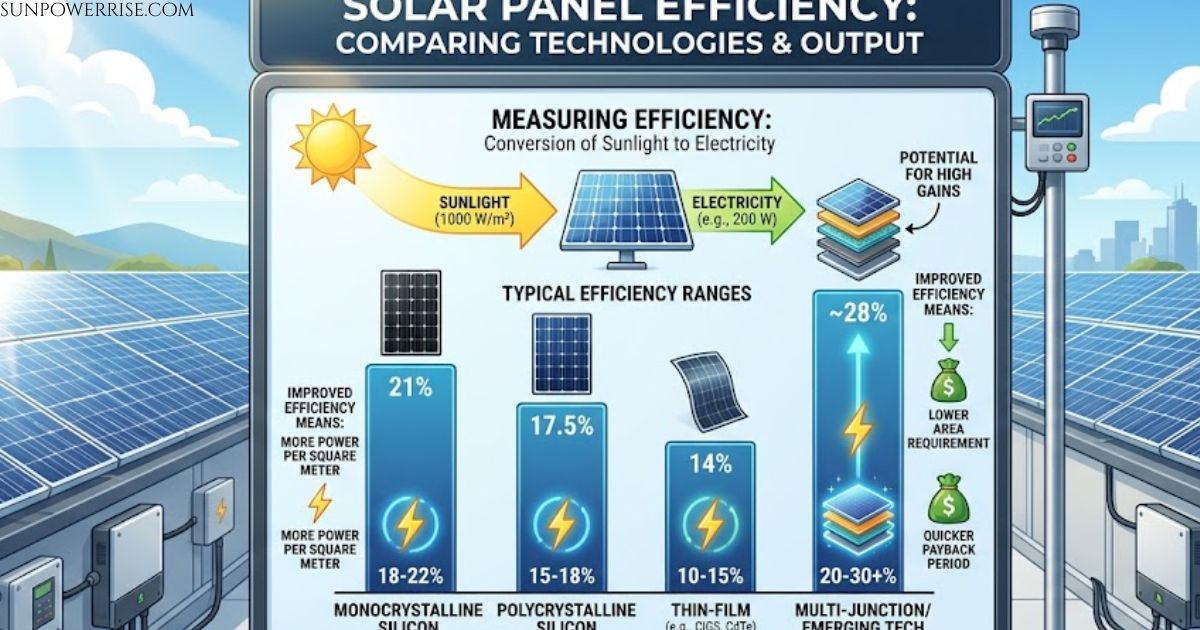
Choosing the right solar panel technology upfront shapes everything that follows, and the three main paths are mono crystalline, poly crystalline, and thin-film solar cells.
Each type performs differently, carries a different price point, and suits different installation scenarios, so understanding the distinction is genuinely worth your time.
From a pure, efficient energy generation standpoint, the hierarchy is fairly clear once you understand how each type is built.
Structural Differences and Current Flow
Mono crystalline panels are cut from a single piece of silicon, which means electrons travel through a pure, uninterrupted structure, making these the most efficient option available for residential installation.
Poly crystalline panels, by contrast, press together multiple silicon crystals, and the tiny spaces between those crystals reduce the panel’s ability to convert solar energy cleanly, though the larger physical size and cheaper price tag often compensate for the efficiency gap.
Thin-film technology applies ultra-thin layers of photovoltaic material onto electrical components, producing panels that are lighter, more flexible, and cheaper to manufacture, though they sacrifice efficiency to get there.
Quantifying the Efficiency Trade-Offs
From an efficiency perspective, mono-crystalline panels typically reach around 20% efficient under real conditions, while poly-crystalline options settle in the 15-17% efficient band. Both have genuine pros and cons depending on your roof size, budget, and energy targets, so there is rarely one universally correct answer.
Understanding these trade-offs helps you have a far more informed conversation with your installer rather than simply accepting whatever gets recommended first.
The Most Efficient Solar Panels
Mapping the Current Market
When we mapped out the solar panels delivering the highest solar panel efficiency for UK homes, the differences between manufacturers were striking, and the efficiency gap between budget and premium products has genuinely narrowed in recent years.
Established names like LG at 21.4%, Sharp at 20%, and Canadian Solar at 19.89% represent solid mid-to-high performers with proven track records in British conditions.
Brands like Panasonic at 19.7%, Yingli Solar at 19.1%, Solar World at 17.89%, and Solar century paired with IKEA at 16.82% fill out the broader market, each offering its own balance of cost and output.
The Cutting Edge: Top-Tier Specs
At the cutting edge, AIKO Neostar 3N54 reaches 24.3% with a 485W output, while SunPower Maxeon 7 hits 24.1% across its 435-445W range and posts impressively low long-term degradation.
LONGi Hi-MO X6 Scientist delivers 23.3% at a hefty 630W, Jinko Tiger Neo 72HL4 sits at around 22.8% in the 560-580W bracket using N-type cell chemistry, and REC Alpha Pure-RX achieves 22.6% at 470W with outstanding retention of power over decades
The Role of Placement Over Specs
Smart buyers always look beyond raw efficiency numbers and weigh up roof orientation, shading risk, and overall system design before committing.
Your real-world output depends on all three working together, and a perfectly placed mid-range panel on an unshaded south-facing roof will routinely beat a high-spec panel that ends up partially shaded or poorly aligned with the sun’s path.
FAQs
What is a good solar panel efficiency rating for a UK home?
For most UK homes, an efficiency rating of 15-22% covers typical needs comfortably, though aiming for at least 20% gives you stronger long-term returns on your roof space.
How much does shading affect solar panel efficiency?
Even 10% shading on a single panel can cut output by up to 50%, making shade avoidance and a proper shading analysis before installation absolutely essential.
Do solar panels still work on cloudy days in the UK?
Yes, solar panels continue generating electricity on cloudy days, though at a reduced efficiency level, meaning your system stays productive year round even in the typically grey UK climate.
How long do solar panels maintain their efficiency?
Most solar panels retain 80-90% of their original efficiency after 25 years, with manufacturers backing this through performance guarantees covering 90% output at year 10 and 80% at year 25.
Is adding a battery storage system worth it for maximising solar efficiency?
Absolutely, a battery storage system captures excess solar energy during the day and powers your home through the night, significantly cutting your reliance on the grid and lowering your electricity bills consistently.