

Home battery storage UK without solar systems are a topic I’ve spent a fair bit of time talking about with homeowners, and one thing always comes up first: can this actually work without panels on the roof? It can, and once you understand the mechanics, the appeal makes a lot more sense.
How Grid-Only Home Battery Storage UK Without Solar
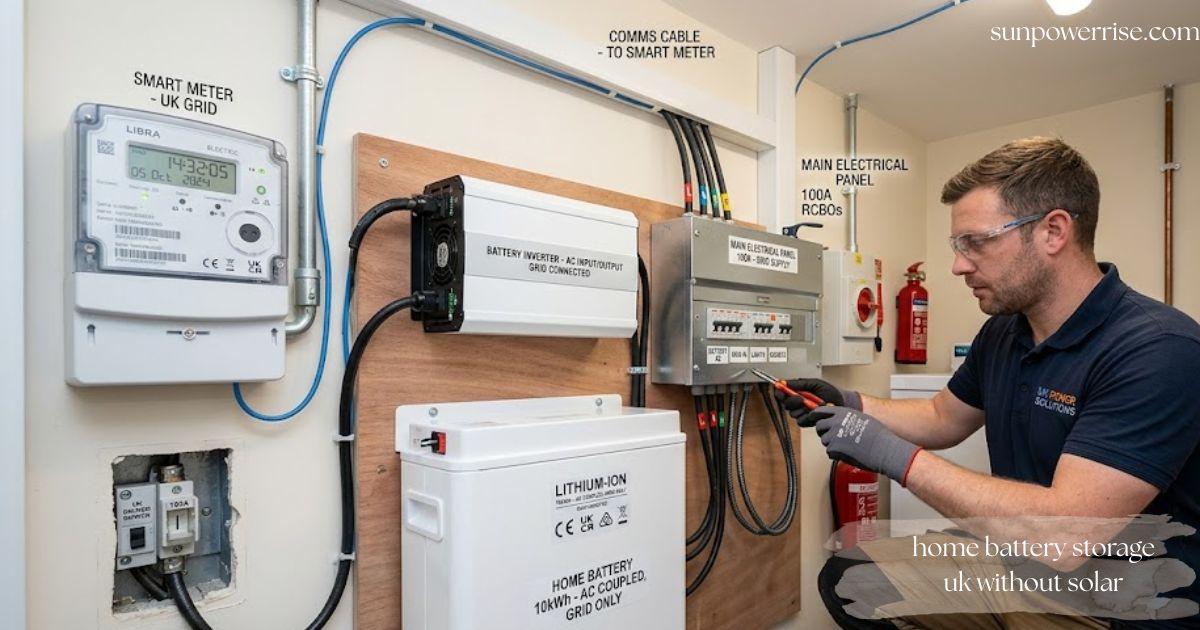
A home battery storage UK without solar setup connects straight into your main electrical panel and pulls power from the grid rather than from surplus solar, so a professional installer wires the unit, fits the inverter, and runs a comms cable/communication cable back to the supply meter.
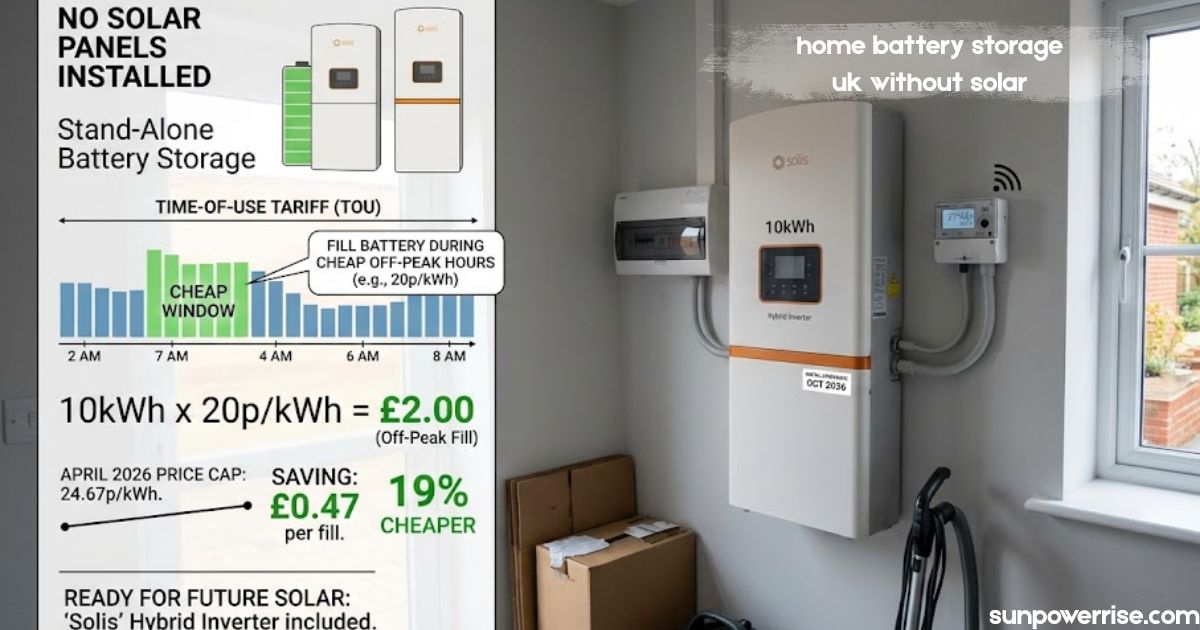
Most units bought today are AC-coupled, an all-in-one machine that handles both storage and conversion. The inverter itself converts Alternating Current from the grid into Direct Current (DC) for the battery, then flips it back to AC for household use.
The speed of this conversion process depends on the size of the hardware. Once fitted, the inverter manufacturer’s app lets you schedule charges and track usage in real-time, and some smart meters even send grid signals so the battery knows when off-peak hours begin.
Capitalising on UK Time-of-Use Tariffs
This is where UK homes start to see real value: sign up to a time-of-use tariff plan, also called a TOU or import tariff, and you can shift consumption into the cheap window.
A household on a daily off-peak rate of 20p per kilowatt-hour can fill a 10kWh battery in five hours, which is 19% cheaper than the April 2026 price cap of 24.67p per kWh.
These deals descend from Economy 7 tariffs, which trace back to 1978, though the roll-out of smart tech has widened the field, and it helps that most hybrid inverters are built-in, meaning a battery-only install today can accept solar panels later without swapping out the core equipment, a sensible, valuable partner relationship if your plans change.
Certifications, Exports, and Standalone Viability
It’s worth noting that battery energy storage systems (BESS) don’t earn export income unless the system carries Microgeneration Certification Scheme or Flexi-Orb certification for generating renewable electricity.
Between June 2024 and May 2025, 94% of UK solar installations paired panels with a battery, which shows how the market has traditionally worked, though households without a roof for panels, or those with an electric vehicle (EV) or heat pump, are increasingly choosing standalone setups through their own energy suppliers and wholesale electricity pricing.
All installed by a proper professional installer in your garage, following current guidelines, roughly one or two metres from the battery itself, with information flowing constantly to the grid and your phone.
Where the Savings Actually Come From
Arbitrage Is the Real Driver
The core saving here comes down to arbitrage: time-of-use tariffs price electricity far below the standard residential rate of 24.67p per kWh during off-peak windows, so filling the battery overnight.
Take Good Energy Heat Pump, priced as of June 2026, a 3,400kWh per year household (the national average) with a 9-10kWh battery, can save £396 a year using the off-peak rate of 14p per kWh between 5 am and 9 am and 1 pm and 4 pm.
Plus another £34 per year thanks to a standing charge of 48.01p per day versus 57.21p per day on Ofgem’s cap; on a battery costing £3,000 to £7,000, that works out to a payback period of 7.6 to 17.7 years, though your own figures depend on battery tariff, usage and battery scheduling through Octopus tariffs or similar.
Securing Backup Power and Preparing for Future Solar
Beyond bill savings, a battery earns its keep during a power cut: switch on EPS mode and it powers essential appliances like Wi-Fi, the fridge, lights within seconds, which matters if you work from home, have young children, or rely on medical equipment; skip that setup and the installer should confirm Emergency Power Supply is active, because without it the battery won’t help during a grid outage.
Storing your own cheap power also cuts reliance on the grid at the busiest, priciest moments, giving you more control and stability.
Because most modular battery systems let you increase storage and spread the cost, buying a typical home unit now doesn’t close the door on the future.
The Trade-Offs Worth Knowing
Nothing is free, though, and the biggest catch is that you’re still exposed to rising energy prices because every unit comes from the grid, not the sun, so national rate hikes and swings in wholesale electricity prices hit harder than they would a solar household.
Import tariffs built for battery-only homes are also thinner on the ground than dynamic tariffs designed for solar, which can leave you on flat-rate plans that don’t reward smart battery charging as well.
There’s simply no export income on offer you can’t sell power back through the Smart Export Guarantee (SEG) because that scheme demands an MCS-certified generation system, so every cheap unit you store still costs more than zero cost solar ever would, meaning a solar-plus-battery setups combo will usually halve bills further than a stand-alone system can.
Add in round-trip losses of around 90-95% efficiency, and a small slice of every cheap unit disappears in the cycle, though when the price gap is wide, the arbitrage still comfortably wins out.
And because the UK grid still leans on gas, off-peak grid power does little to shrink your carbon footprint you’re mostly shifting consumption away from fossil fuels, not cutting them, while a solar household draws on genuine renewable energy instead.
Battery Brands Worth Considering (No Solar Required)
A few names consistently come up when homeowners ask me for home battery storage UK without solar options:
- Tesla Powerwall 3 13.5kWh capacity, 11.5kW output, built-in hybrid inverter, and a 10-year warranty. A strong option for whole-home backup with a polished, easy-to-use app.
- Duracell Energy Dura16: A solid mid-range option known for reliable grid-charging performance and good build quality, well suited to households focused simply on cutting bills.
- Fox ESS Offers scalable, hybrid-ready systems at a competitive price, with strong app-based control, a good fit if you’re considering an EV or future solar addition.
A few others are worth a mention too, particularly given how much a battery-only setup depends on smart scheduling:
- Sigenergy A modular 5–48kWh range with AI-driven scheduling, useful if solar or an EV might be added later.
- FoxESS EP-series Featured on the Intelligent Octopus Flux approved list, offering strong value.
- AlphaESS SMILE (G3) Backed by a notable 10,000-cycle warranty.
Installers such as Solar4Good tend to handle these grid-charging-focused systems particularly well, since tariff integration and scheduling behaviour matter more here than they typically would on a standard solar-plus-battery job.
Grants and Financial Support for Battery-Only Systems
If you’re going battery-only, don’t expect a grant to cover the full cost outright but there is some support available:
- The Warm Homes Local Grant, administered through local authorities, funds energy efficiency measures for qualifying low-income households, including battery storage and solar panels, alongside the ECO4 scheme (running until December 2026).
- In Wales, the Warm Homes Programme and Green Homes Wales offer additional solar-related grants, though eligibility criteria are fairly strict.
- On the tax side, 0% VAT applies to standalone batteries and combined solar-and-battery systems through 2027 removing the standard 20% VAT from your total cost.
- If your mortgage is with Barclays, Halifax, or Lloyds, it’s worth checking their green home reward schemes, which can offer cashback of £500 to £1,000 once your system is installed.
FAQs
What is the best home battery for UK homes without solar?
Popular standalone battery options include the Tesla Powerwall, GivEnergy, and Growatt, all known for reliable performance and grid-charging capability.
Does a home battery without solar qualify for any UK grants?
Currently, most government grants and incentives are tied to solar installations, so solar-free battery systems may have limited funding support and always check the latest schemes.
Is it worth getting a house battery without solar?
Yes, a home battery can still be worth it. It stores cheap off-peak electricity from the grid and helps cut energy bills, giving you real savings and peace of mind.
Can I install a home battery without solar panels?
Absolutely, a standalone battery can be installed and charged directly from the grid, no solar panels required, offering backup power and energy flexibility.
How long will a 5kWh battery power a house?
A 5kWh battery can typically power essential appliances for around 4–6 hours, making it a handy backup during power cuts.