


When the rising cost of living starts to bite, it’s easy to feel isolated, unsure, and weighed down by a burden that seems too heavy to carry alone, especially when your income falls short and an energy debt grant application feels overwhelming but I always tell people they are not alone.
I’ve guided families and individuals through this exact moment, and the first thing I mention is the British Gas Energy Trust (BGET), sometimes searched for as the energy trust British Gas scheme, an independent charity and UK registered charity (charity number 1106218) that was set up in 2004 to relieve fuel poverty across England, Scotland, and Wales.
What Is the British Gas Energy Trust?
Overview & Core Mission
The British Gas Energy Trust is an independent grant-giving charity, funded by Centrica, the parent company of British Gas, though it answers to its own board of trustees rather than to any corporate customer service channel.
Its main aim is to tackle fuel poverty across England, Wales, and Scotland, and it exists for households facing financial difficulty, not for routine billing queries.
You do not have to be a British Gas customer to receive support; the charity funds grassroots organisations, community advice centres, and national money charities that place dedicated energy caseworkers in communities, offering one-to-one budgeting support, benefit entitlement checks, and practical support for anyone facing genuine emergencies.
How Grants & Direct Support Work
When a case is approved, the credits never land in your pocket; the money paid goes straight to the supplier, never to a bank account, and simply clears existing energy debt on the applicant’s account or electricity account.
This direct debt-relief grants approach is built to ease immediate financial pressure: it can clear unmanageable arrears built up on gas or electricity, and occasionally regional community projects funded by the trust hand out emergency fuel vouchers for prepayment meters or arrange energy-efficient white goods replacements for vulnerable residents.
Only the account holder can normally apply, though someone nominated and authorised in writing, a carer, say, may apply on their behalf.
Funding, Administration & Historical Impact
The trust is funded entirely by British Gas Trading Limited alongside a handful of partner organisations, yet it remains operationally independent, guided by an unpaid board of trustees who make the final award decision on every case.
Day-to-day processing is handled by Auriga Services, the appointed grants administrator since February 2020, which reviews applications, requests further evidence when needed, and notifies trustees once a file is ready to decide.
Since 2004, the charity has invested over £175 million and helped roughly 700,000 people, offering energy grants, non-repayable grants, and emergency fuel vouchers to households battling energy debt.
Grant Programmes & Wider Advice Services
Every British Gas Energy Trust grant is designed to fit real-life circumstances, and support comes through several grant programmes: the Individuals and Families Fund is open now, while the Energy Support Fund, which once offered up to £2,000, is currently closed under today’s eligibility rules.
You don’t need to be a British Gas customer to apply; people with other suppliers of domestic gas and electricity can qualify too, provided the arrears criteria and grant assessment conditions are met.
Criteria of BGET Eligibility
Account Requirements
Eligibility starts with geography and paperwork. To qualify for a BGET grant, you must live in England, Scotland or Wales, since Northern Ireland is not covered; anyone there should look at Bryson Energy or the NI Direct fuel-poverty schemes instead.
You need to hold a gas or electricity bill as the account holder, or be applying on behalf of one with written authorisation, and you should show proof of residence plus energy account details confirming residency.
The eligibility requirements also call for evidence of income, a recent energy statement, and confirmation you’re not linked to previous properties or sitting on closed accounts, and that the bill is genuinely in your name.
Financial Thresholds & Debt Limits
Money matters heavily here. Applicants generally need a gross household income under £20,328 and household savings, or savings below £1,000, kept beneath £1,000 overall, though current Trust guidance can flex these numbers depending on special circumstances.
For credit meter accounts, there’s usually a minimum arrears balance of £250, capped at £1,700 as the maximum, while prepayment meter accounts typically need arrears and energy arrears between £50 and £1,700.
This covers an active domestic energy debt balance and outstanding debt, whether it’s an outstanding balance with any supplier or a UK domestic supplier.
The Individuals and Families Fund stays a scheme open to everyone, regardless of supplier, though British Gas energy customers often get priority under current scheme rules. The trust checks your income and benefits carefully against these thresholds.
Guidance Evidence
Vulnerability broadens the door further. Households with three or more dependent children, dependent children generally, someone receiving Carer’s Allowance, or a person with recognised disability or disability-related benefits may qualify even above the income line, because vulnerability criteria exist for exactly this reason.
The trust also looks kindly on additional energy challenges tied to a cold home or an energy-inefficient home, especially where health and wellbeing are at risk, and it weighs caring responsibilities, a co-habiting partner’s situation, and other personal circumstances.
You’ll need supporting evidence for all of this, alongside proof you sought free money advice, debt advice, or money advice from a recognised agency within the last three months, details of your household finances and expenditure, and your previous grant history, since applying again within two years of an award normally makes you not eligible until the annual budget allows another round.
What Evidence and Documents Are Required
Proof of Income
Good paperwork speeds everything up, so gather your bills before you start. The trust wants to verify your income, so send three consecutive payslips or universal credit statements, plus benefit award letters no more than 12 months old, all as photocopies or scans, never originals.
Energy Bill & Account Details
Alongside your proof of income, attach a current energy bill or latest gas bill showing the account balance, account numbers, account holder information, meter point numbers (MPRN and MPAN), supplier name, tariff name, and a meter reading taken on the day of submission, plus details of any prior energy debt support, since this is how the assessor can assess application details against your electricity bill.
Next comes household expenditure: a monthly breakdown of rent or mortgage, food, transport, and other essential costs, ideally worked out with your adviser to show exactly what triggered the debt and how a grant help package would let you manage going forward.
Debt Advice Evidence & Personal Statement
Add three months of bank statements, or a PDF download from online banking, for every adult in the household, together with proof of any other debts such as credit cards, council tax arrears, or loans, and even a mobile phone contract balance, plus the outstanding balance on your gas or electricity account.
Debt Advice Evidence & Personal Statement
Finally, prove you’ve had proper guidance: give the agency name, adviser name, and contact details of whoever gave you independent money advice, along with the date received and an official budget summary sheet or reference letter from a recognised money adviser, dated within six months, as your debt advice evidence.
Round it off with benefit breakdown summaries and a short free-text explanation of your personal circumstances, written in your own words, since this evidence is what turns paperwork into a decision.
Apply for the British Gas Energy Trust Fund
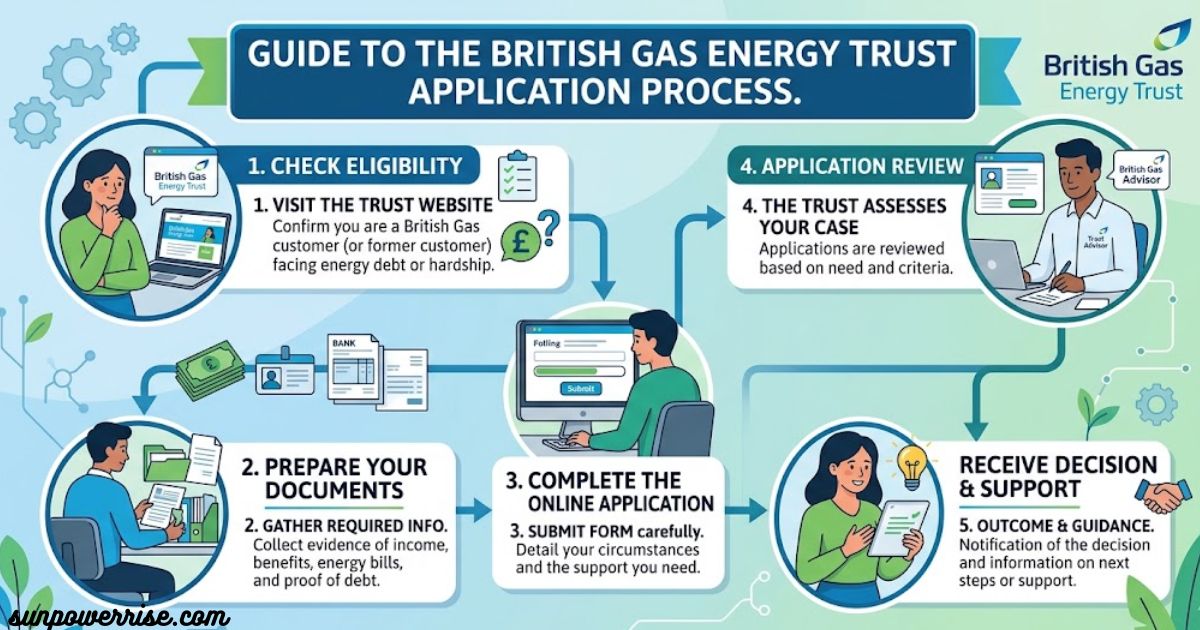
Applying is done entirely online through the official British Gas Energy Trust portal. Start by choosing to create an account on the application system, then select the grant pathway. The Individuals and Families Fund works whether you’re with British Gas or another supplier.
Enter your household finances, household expenditure, and income figures so they match your debt advice sheet, then upload clear readable photos or PDF copies of every required document, including your supporting documents covering energy debt.
Once you submit the form, keep the application confirmation details for future reference screenshot or record them, since assessment times can vary. Most applications are reviewed within several weeks once everything’s submitted and the money advice evidence checks out.
FAQs
What is the British Gas Energy Trust?
The British Gas Energy Trust is an independent charity that provides grants and support to households struggling with energy debt, helping them regain financial stability.
What is the eligibility criteria for the British Gas Trust fund?
Eligibility typically depends on financial hardship, energy debt owed to a supplier, and household income, even if you’re not a British Gas customer, you may still qualify.
How do I contact the British Gas Energy Trust?
You can reach the British Gas Energy Trust through their official website or helpline, where their support team guides you through the application process.
Can I apply for a fuel voucher online?
Yes, eligible households can apply online for a fuel voucher through the trust’s website, offering quick relief during urgent energy crises.
Is the British Gas Energy Trust legit?
Yes, it’s a registered, legitimate charity independent from British Gas’s commercial arm and dedicated to genuinely helping vulnerable families.