

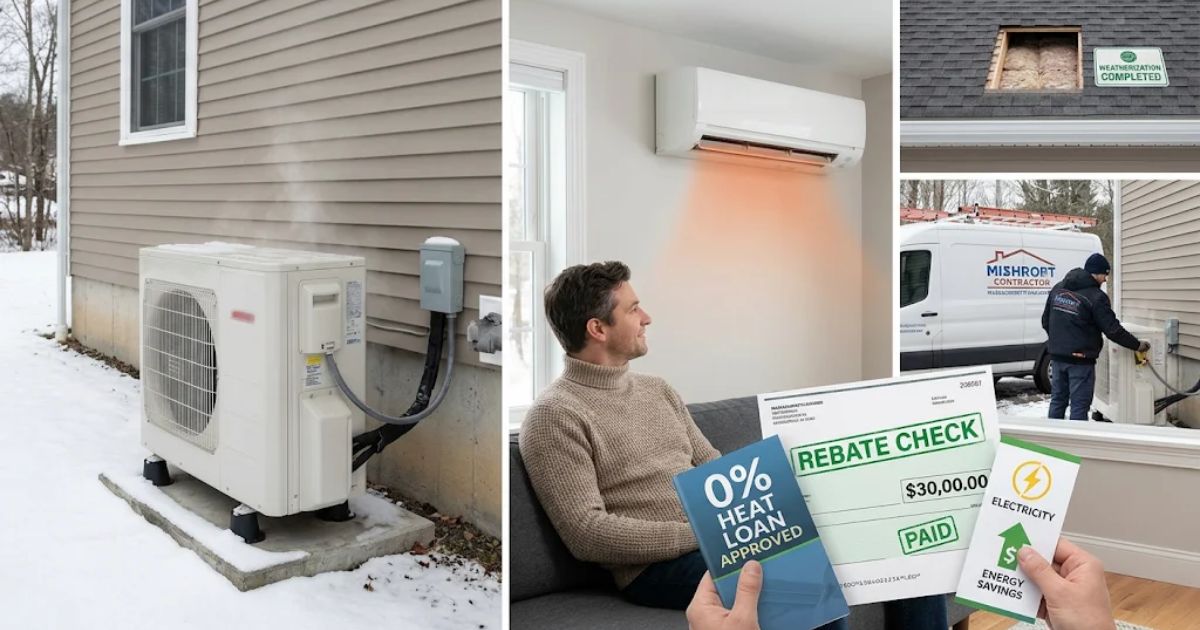
The Mass Save heat pump rebate program pays Massachusetts homeowners to replace fossil fuel heating with efficient electric equipment. Utilities fund the program, and it pairs cash rebates with a 0% HEAT Loan. This guide covers the money, the equipment rules and the contractor choices.
Homeowners often lose weeks because they buy equipment before they read the rules. When we compared program pages for this guide, we found older articles that quote outdated figures. Check every number against masssave.com before you commit to a purchase.
Who Sponsors the Mass Save Heat Pump Rebate Program?
The Sponsors of Mass Save are the Massachusetts utilities that serve your home. Eversource, National Grid, Cape Light Compact, Unitil, Berkshire Gas and Liberty Utilities each fund the program. Your bill shows whether you deal with a Mass Save Electric Sponsor, a Mass Save Natural Gas Sponsor, or both.
Look at your latest utility bill before you call any contractor. The application asks for your account details, so keep that number nearby. Knowing your sponsor answers a contractor’s first question.
Which Rebates Can You Claim for a Heat Pump?
What Is the Difference Between a Whole-Home and a Partial-Home Rebate?
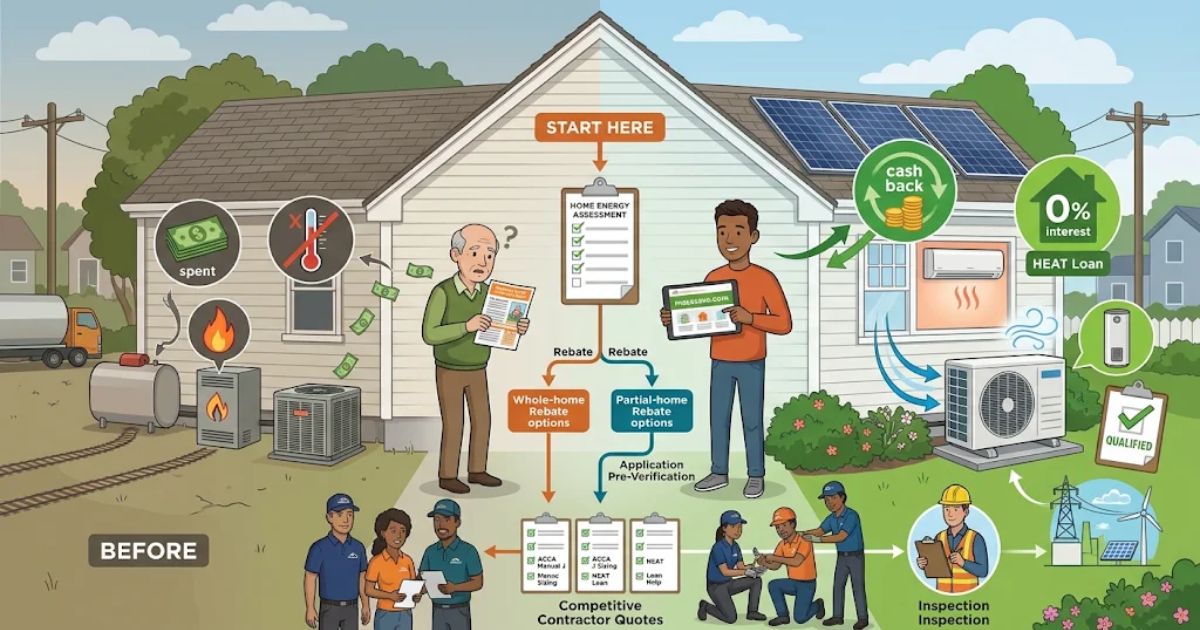
A whole-home rebate applies when the heat pump replaces your entire heating system. A partial-home rebate applies when the heat pump heats only part of the house and your old system keeps running. Mass Save also added a basic heat pump rebate tier.
Mass Save lists some amounts as a rebate per ton of capacity, so system size affects the payout. A supplemental rebate and instant point-of-sale incentives can also change what you pay at checkout. Ask each contractor to show the exact rebate math on the proposal.
Who Qualifies for Enhanced Incentives?
Enhanced incentives go to income-qualified households through income-based enhanced rebates. Eligibility depends on household income compared with the state median income, and moderate-income customers can qualify too. Some of these households can receive a no-cost heat pump option through turnkey services.
Ask Mass Save to confirm your income tier before you collect quotes. Your tier decides which rebate amounts appear on those quotes. Request that confirmation in writing.
Do Bonuses and Federal Incentives Stack?
Mass Save pages describe a weatherization bonus and a sizing bonus on top of base rebates. Federal programs sit outside Mass Save and follow their own rules. The federal tax credit and Inflation Reduction Act rebates do not appear on Mass Save’s pages.
Confirm the current status of federal incentives with a tax professional before you count on them. Endless Energy and 128 Plumbing mention these federal programs in their blog posts, but we have not verified current terms. Treat federal numbers as questions to check.
How Does the 0% HEAT Loan Work?
The 0% HEAT Loan gives Massachusetts homeowners 0% financing for qualifying heat pump projects. Borrowers repay the principal without interest charges. The HEAT Loan repayment term appears on the Mass Save loan page, so read it before you apply.
A loan can cover costs that remain after rebates. 128 Plumbing states that it helps customers with HEAT Loan paperwork, and Urban Heating & AC shares financing information. Ask any contractor you consider how they handle the loan forms.
Which Heat Pump Types Appear in the Mass Save Program?
An air source heat pump moves heat between the outdoors and your home, and it is the most common choice. A cold climate heat pump keeps heating at low outdoor temperatures. Other options include the ground source heat pump, also called a geothermal heat pump, and the air to water heat pump.
Layout matters too. A ductless mini-split serves rooms individually, a ducted heat pump or central air source heat pump uses ductwork, and a whole-home heat pump system covers the entire house. A hybrid heat pump or dual fuel heat pump pairs electric heating with a fossil fuel backup, and a heat pump water heater handles hot water.
Every system includes an outdoor unit and an indoor unit. Confirm with your installer which of these types earns which rebate. Write the answer into the proposal.
What Equipment Standards Must a Heat Pump Meet?
Mass Save checks equipment against the Qualified Products List (QPL), which includes ENERGY STAR Cold Climate models. Systems with controls also appear on the Integrated Control Qualified Product List. Verify your model there before you buy.
Gather the AHRI certificate, which shows the AHRI cooling capacity in BTU and tonnage, plus a photo of the equipment nameplate. Mass Save requires the serial number on applications starting October 1, 2026. Ask your installer which control your system needs, whether an integrated control, a dual fuel thermostat, a smart thermostat or a programmable thermostat.
Why Does Proper System Sizing Matter?
Proper system sizing keeps a heat pump comfortable and efficient. Installers run a heating load calculation, typically following ACCA Manual J, to match capacity to your house. An oversized unit cycles constantly, while an undersized one struggles on cold days.
The calculation uses the outdoor design temperature and the size of your conditioned space, and it treats unconditioned space and any new addition separately. Installers also set the switchover temperature where backup heat takes over, and they consider dehumidification and zoned heating. Ask for the calculation in writing, since skipping it means guessing.
How Does Weatherization Fit Into the Program?
Mass Save follows an efficiency first approach, so it wants you to seal the home before you add a heat pump. Sufficient weatherization can affect your rebate path, and the Whole-Home Heat Pump Verification Form supports whole-home applications. Check the current rules on masssave.com.
Start with a Home Energy Assessment, where an energy specialist recommends air sealing, weatherstripping and attic and basement insulation. Many homes also need ductwork sealing, including Aeroseal duct sealing. Skipping weatherization can mean a bigger system than you need.
Mass Save also offers a no-cost virtual consultation. A Mass Save Decarbonization Specialist leads the decarbonization consultation and maps your heating options. Book it early, since it shapes every quote.
Which Existing Heating Systems Can a Heat Pump Replace?
A heat pump can replace oil heating, propane heating, natural gas heating or electric resistance heating, including electric baseboard. It can also replace a boiler or furnace. Full replacement can end fuel deliveries for oil and propane homes.
Program rules ask you to displace existing heating system capacity, and some rebates require you to remove or disconnect old system equipment. Keep a backup heating system only if your rebate tier allows it. Urban Heating & AC states that it handles thermostat disconnection when an old system stays in place.
How Do You Apply for the Mass Save Rebate?
Submit a rebate application through the online application portal, and include a pre-verification form when your rebate path requires one. Attach supporting documentation, including the paid invoice. The rebate submission deadline for 2026 installations is February 28, 2027, according to current Mass Save pages.
Mass Save may run a verification inspection, and it picks some homes for a random inspection. Rebate processing time varies, so submit as soon as your installer finishes. Practice rebate scam safety by never paying a fee to unlock a rebate and by applying only through masssave.com.
Who Is Eligible for a Mass Save Heat Pump Rebate?
Eligibility starts with a residential electric account or residential gas account with a Mass Save sponsor. Your building must fall within 1–4 unit buildings, and multifamily homes in that range may qualify when each unit is individually metered. Mass Save lists further eligibility requirements on its site.
Mass Save allows one rebate per account, so plan the whole project before you apply. It also expects full-time winter occupancy, so seasonal homes need a closer look. Call Mass Save if your situation is unusual.
What Are the Safety and Environmental Benefits?
Electric heat pumps remove combustion from the heating process, which lowers carbon monoxide risk from your heating system. Replacing oil or propane also ends in-home fuel storage in your basement. Both changes simplify safety.
Heat pumps cut greenhouse gas emissions and support reduced carbon emissions as the grid adds clean energy. A net-zero-ready home starts with a tight envelope and electric equipment. Together, weatherization and a heat pump move you toward it.
Is a Heat Pump Worth It for Massachusetts Homes?
A heat pump delivers energy savings most often when it displaces expensive oil, propane or electric resistance heat. It also provides all-in-one heating and cooling, which adds year-round comfort. Your lower energy bills depend on your current fuel and usage.
Run the Heating Comparison Calculator for a heating cost comparison before you buy, and expect increased electric usage in winter. The Seasonal Heat Pump Rate offers lower electric rates November through April, so ask your utility whether you qualify. Cold-weather efficiency, low maintenance and home comfort add to the case.
An all-electric home with energy-efficient upgrades can shorten payback over time. Your rebates and fuel prices drive that timeline. Calculate it with real quotes, not averages.
What Should You Look for in a Heat Pump Contractor?
Look for a qualified contractor who works as a licensed and insured contractor, preferably in the Mass Save Heat Pump Installer Network (HPIN). Mass Save pages also reference the New England Heat Pump Accelerator (NEHPA). Ask contractors whether they follow its guidance.
Collect at least three contractor proposals, and compare equipment models, load calculations and rebate math. Prepare questions to ask your installer: who runs the load calculation, who files the paperwork and who attends the inspection? A clear answer tells you more than a low price.
Which Services Do Endless Energy, Urban Heating & AC and 128 Plumbing Offer?
Each brand offers the services listed on its own website, and Mass Save itself is a program, not a contractor. Endless Energy lists heat pump installation, heat pump replacement, heat pump repair and heat pump maintenance. Urban Heating & AC lists heat pump repair, replacement, installation and a heat pump tune-up.
Endless Energy also lists a maintenance agreement and HVAC line set work. Urban Heating & AC states that it helps identify QPL-compliant systems and guides rebates. 128 Plumbing states that it installs air source and ductless systems and checks equipment eligibility.
How Do You Maintain a Heat Pump After Installation?
Basic care keeps a heat pump efficient. Do air filter cleaning every month or two during heavy use, and book a tune-up each year. Small habits prevent service calls.
Keep outdoor unit clearance (snow and debris) by brushing snow off the cabinet. Hold a steady thermostat setting, because big swings push the system toward backup heat. These heat pump user tips cost nothing.
Why Use Our Website to Find a Provider?
Our website gathers the program rules, the contractor checklist and each brand’s stated services in one place. We list only what a brand’s own website confirms. That saves you hours of cross-checking.
Use it as a starting shortlist, then verify details with each provider. Mass Save changes its rules, so verify every figure. You finish with better questions and fewer surprises.
What Do Homeowners Ask Most About the Mass Save Heat Pump Rebate?
Does Mass Save install the heat pump?
No, Mass Save runs the program and pays the rebates. Contractors do the installation work. Choose one from the installer network.
What is the current rebate deadline?
Current Mass Save pages list February 28, 2027 for 2026 rebates. Changes start January 1, 2027. Confirm both dates on masssave.com.
Do I need weatherization first?
Mass Save promotes weatherization before heat pump installs. Some rebate paths rely on it. Book an assessment to find out.
Where Should You Start Your Search?
Start by confirming your sponsor, your income tier and your eligibility on masssave.com, then shortlist providers that match the checklist above. Our website makes that second step easy, because it brings the Mass Save Heat Pump Rebate Program in Massachusetts and each brand’s stated services together. Visit it, compare options and ask each provider our questions.