


The Belbin Team Role Inventory is a behavioural assessment tool created by Dr. Meredith Belbin to help people understand the roles they naturally play within a team.
I wish I had known about it the Monday I was handed a high-pressure project and had to lead a team of near-strangers because real talent rarely shows up in a job title, a polished suit, or a confident handshake; it shows up in how people actually think, work, and support one another under pressure.
That is where the Belbin team role inventory comes in, a framework built on years of research by Meredith Belbin, whose name sometimes gets shortened to Meredith Belin in casual conversation. His book, Management Teams: Why They Succeed or Fail, now in its second edition from 2004, grew out of studies he ran while at the Henley Management College.
Belbin Team Role Inventory
Belbin identified nine clusters of behaviour he called Team Roles, each Team Role carrying particular strengths and weaknesses that make an important contribution to the wider team.
Origins of the Belbin Framework
The concept of the team role itself started decades ago, when Belbin was working with a group of business managers and executives in the 1970s at a place called Henley Management College in Oxfordshire, England. He became interested in the makeup of teams, and in particular, he wanted to know what makes a winning team.
Through careful psychometrics, he put people into teams, had them play a kind of supercharged Monopoly, and discovered early on that every successful team needs a broad range of abilities to meet its needs.
Unlocking Team Potential
Every individual has the potential to thrive once you pinpoint their strengths and harness their full potential, and you won’t find that kind of insight sitting in job titles.
ou need to understand how people approach their work, their relationships, their measure of creativity, and the discipline they possess to get things done because when team members aren’t playing to their strengths, even a promising project turns into a nightmare.
Overview of the Nine Team Roles
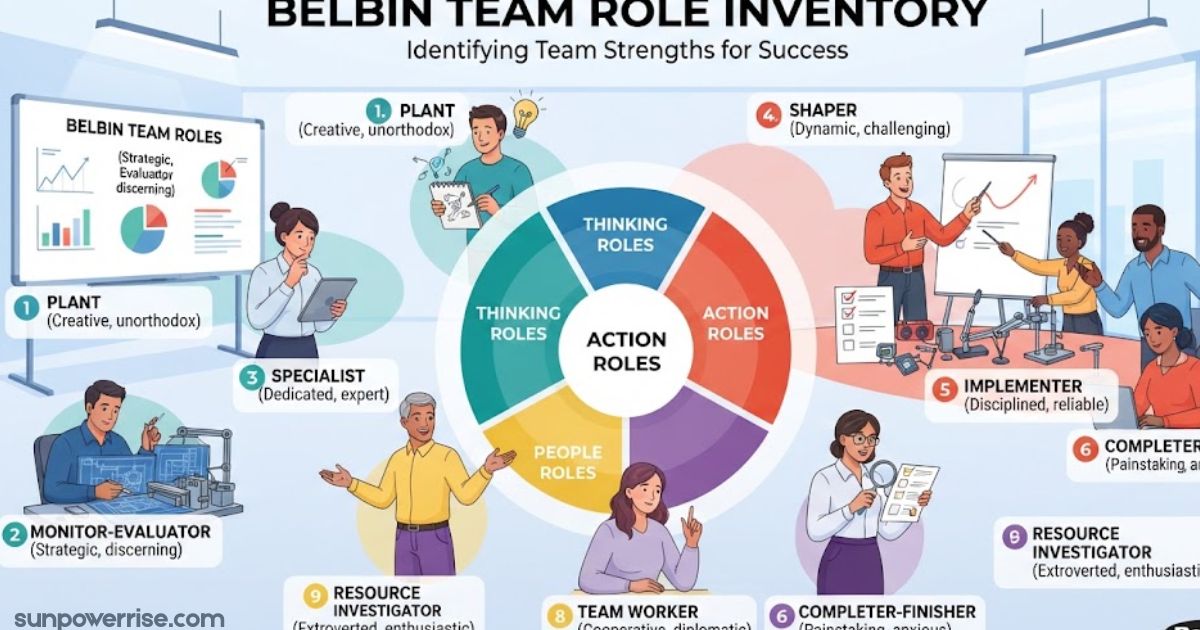
Studying the Apollo Teams and Team Delivery
Every management service eventually asks the same question: what makes some groups deliver and others stall? Belbin answered this by studying real management teams, later called Apollo teams, made up of the best performers and best achievers a company could gather.
On paper these looked like effective teams, yet their conflict-heavy group work often failed to work efficiently, and that surprising result pushed the research in a new direction.
Mapping Behaviours with the Belbin Team Role Inventory
What Belbin found was not a personality test in the usual sense; it was a map of real-world behaviour, the predictable patterns and manners people bring to a project.
Through the Belbin team role inventory, an online inventory, he grouped these into nine key clusters, later called nine roles, then nine basic team roles, and even nine team roles, after starting from an original set of eight.
Personality, values, inspirations, and experiences shape the variety of roles everyone carries inside them, and most people show strong preferences for only two or three of them at once.
The Three Core Categories and the Nine Roles
The key idea is simple: a role is not a fixed job, but a description of behavior that helps a worker’s sweet spots show up in the right place.
Belbin sorted these into three clear groups: people-oriented roles built around people skills, thought roles built around mental agility and thinking, and action-oriented roles built around action that gets things done.
The specialist, the plant, the monitor evaluator, the coordinator, the resource investigator, the team worker, the shaper, the implementer, and the completer finisher together form a panoramic three-dimensional ranking of how a group can reach an optimal performance level.
Achieving Balance and Shared Team Success
None of this replaces raw talent, yet a valuable, well-balanced set of Team Roles protects the individual strengths each member brings, helping efficient teams avoid the trap the Apollo teams fell into.
When people understand each other and stay open to feedback, the work becomes lighter, everyone starts to work effectively, and shared success follows naturally.
People-Oriented Roles
Every strong team needs people who keep it aligned, and that job usually falls to the team worker, the coordinator, and the resource investigator working side by side.
The team worker acts like the glue, the team glue, holding the group together when a difficult workforce plan threatens to pull everyone apart. This person is naturally diplomatic and flexible, and they help colleagues work together even when opinions differ.
The Coordinator
The coordinator guides the team, focuses on objectives before anything else, and clarifies goals so the whole group stays on track, acting like a natural team leader, one of many team leaders an organization can lean on.
Good coordinators are good-natured; they recognize talent in others, quietly develop talent over time, and know how to get resources fast when a plan stalls. Their only real risk is that they sometimes delegate everything and can slide into being manipulative if they are not careful.
The Resource Investigator
The resource investigator looks outward for fresh opportunities and explores opportunities that others might miss, staying enthusiastic even when a project drags on.
They are inquisitive and outgoing, quick to make contacts, and they keep developing contacts long after a project ends, which makes them a real connector inside any organization.
Their downside is that they can forget to follow up on promises, and when excitement takes over, they turn over-optimistic and start to lose interest in the activity at hand.
The Team Worker
A team worker, by contrast, provides support rather than chasing new contacts; this role reduces friction and helps cross-functional work stay steady when tension rises.
Team workers are perceptive about other people’s problems, and they build team cohesion because they listen more than they speak, making them a natural listener for the whole group.
They stay popular because they avoid confrontation, though this can leave them stuck holding uncommitted positions and looking indecisive at the exact moment the group needs decisions.
Role Interdependence
According to the Belbin team role inventory, none of these roles work alone. A coordinator relies on the resource investigator for outside information, while the team worker delegates tasks smoothly across the members of the team, keeping everyone functioning well together.
Roles like these also matter in real business settings, such as partnering with finance on a budget or operations on delivery.
Thought-Oriented Roles
Thinking roles keep a team sharp and future-focused, and three roles carry most of that weight: the plant, the monitor evaluator, and the specialist.
The plant is the creative problem solver of the group, the one who keeps producing fresh ideas, great novel ideas, and sometimes truly fantastic ideas that nobody else thought to try. Because this person often works alone while developing ideas, they can become sensitive to criticism and love praise a little more than most.
The Monitor Evaluator
A plant’s biggest weakness is that a brilliant idea can turn impractical the moment it hits real operation, especially when the plant ignores constraints everyone else can see.
That is exactly where the monitor evaluator steps in, playing the role of a calm analyst who is shrewd, objective, and endlessly analytical. They spend their time evaluating analyzing the pros and cons of every option, weighing feasibility, and spotting risks before the team members commit.
Strategic Analysis and the Challenges of Detachment
A good monitor evaluator acts as a critical thinker and strategic thinker, and they will happily challenge bias in a recruitment team designing a new selection process or testing innovative assessment methods. Their approach always tests ideas before anyone trusts them.
The trouble is that this same analyst can feel detached, struggle with motivating a room, and act reactive rather than proactive when energy is low.
The Specialist
The Belbin team role inventory lists the third thinking role, the specialist, who brings deep expertise and specialized knowledge to one specific area, and their contributed effort stays deeply committed to that one area, often in technical work most people cannot touch.
A specialist can make legal compliance feel completely watertight, for example, but the same focus means their contributions outside that lane stay limited, and other team members may see them as an expert who stays inside familiar limits and ignores other areas entirely.
Balancing Thought-Oriented Roles
This is why an innovator rarely works in isolation: without a specialist, ideas stay shaky; without a monitor evaluator, they stay impractical; and without honest review, a group can get bogged down and preoccupied with technicalities nobody asked about.
Every role here carries its own negative elements, yet each one is also genuinely smart and creative in its own way, which is exactly what a balanced team needs to move an idea from paper into practice.
Action-Oriented Roles
In the Belbin team role inventory, action roles exist to turn talk into results, and three of them do the heavy lifting: the shaper, the implementer, and the completer finisher, sometimes called the complete finisher.
The shaper brings drive, urgency, and momentum, keeps the group’s dynamic sharp, challenges the team to keep moving, and treats obstacles as something to push straight through with bold actions. This person is extroverted and courageous, but that same pushiness can come across as pushy, turn aggressive, argumentative, or competitive, and it can offend others without meaning to.
The implementer turns plans into workable processes, staying practical, disciplined, conservative, organized, and reliable even under pressure. Give them materials, responsibilities, and a set of actions and plans, and they rely on careful maps steps planning to get there.
The risk with an implementer is becoming resistant to change, even when a change project, such as rolling out a new HR system, clearly needs to adapt to reality; they can also stay inflexible and loves the plan more than the outcome itself.
The completer finisher, or complete finisher, makes sure every detail survives until projects completed truly means finished. They run data checks, focus on checking details, keep scrutinizes final results, and stay busy chasing deadlines long after everyone else has stopped.
This role protects quality, focuses on avoiding errors, and polishes final project work until it is genuinely finished rather than rushed or error-prone. Being a perfectionist, or acting perfectionistic, comes at a cost: they can turn anxious and become slow to delegate, holding onto testing long after a deadline or deadlines have passed.
FAQs
Is there a free Belbin test?
No fully free Belbin test exists officially, since the online inventory is a paid, licensed questionnaire but shorter, unofficial versions exist online to give you a rough idea of your role.
What are the 9 Belbin Team Roles?
The nine team roles are the plant, monitor evaluator, specialist, coordinator, team worker, resource investigator, shaper, implementer, and completer finisher together covering every team’s thinking, people, and action needs.
Is there a free download for the Belbin Team Role questionnaire?
The official Belbin Team Role questionnaire is not available as a free download; it must be purchased through Belbin’s own online inventory platform to get accurate, valid results.
What does the Belbin test measure?
It measures your natural behavior and preferences across nine team roles, showing which roles you thrive in, manage, and prefer to avoid at work.
What is the Belbin Self-Perception Inventory and what does it measure?
The Belbin Self-Perception Inventory is the core self-assessment tool that measures how you see your own behavior across the nine team roles, revealing your natural strengths and team contribution style.