

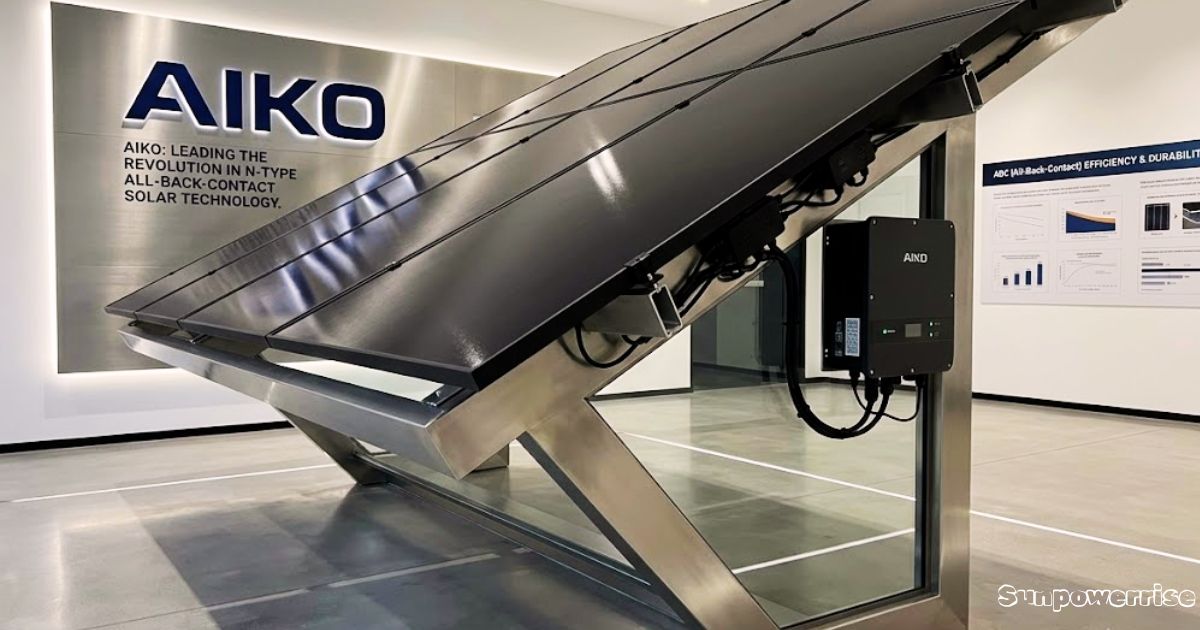
A growing number of people plan to install Aiko solar panels on UK roofs to take advantage of their premium quality. Known for a sleek design and industry-leading efficiency, they consistently top the guides for the best solar panels on the market, proving their exceptional performance.
Heading into 2026, new installations keep sparking the same market conversation between Ico Solar and Jinko Solar, two names that sit on opposite ends of a cutting-edge versus proven-track-record debate, one built around heat resistance and the other around decades of manufacturing reliability.
Aiko positions itself as a premium innovator chasing raw panel efficiency, while Jinko plays the role of the globally established veteran, leaning on manufacturing scale to deliver dependable performance across countless Australian rooftops, leaving homeowners to choose between paying more for top-tier technology.
Company Overview Of Aiko Solar Panels
Shanghai Io Solar Energy Company, better known simply as IO, only stepped into the Australian Market in 2024, yet it had already been quietly building its name since 2009, which makes it far more globally established than most newcomers.
On the other side of the world, Aiko has grown into a genuine solar technology company, producing some of the most advanced solar panels on the market today, built from a base in China with a global presence shaped by steady innovation, strong quality, and impressive energy efficiency.
Their solar cells and panels work equally well for homes and businesses, generating cleaner electricity and more affordable electricity without asking people to compromise on either efficiency or design.
What really sets them apart is their N-Type ABC technology, known as All Back Contact, which lets the panel pull more from the sunlight and squeeze out more power per square metre than older designs, all wrapped in a sleek, all-black appearance that suits modern roofs and promises reliable performance with genuine long-term savings.
Popular Panels
When I compared the 2P and 2S panels side by side, the difference was obvious: the 2P kept the traditional style panel look, while the 2S wore the all-black panel finish with that modern, sleek black frame that changes the entire visual appearance of a roof, thanks to the underlying ABC technology. The 2P reaches 460W with a maximum efficiency of 23.1%, placing it among the highest-rated panels available, while the 2S sits close behind at 440W and 22.1%.
Neostar 3S54
Aiko’s own lineup follows a similar pattern of steady upgrades: the Aiko solar panels Neostar 3S54 deliver 460W-475W at up to 23.8%, weigh around 21.1kg, measure 1762x1134x30mm, and use a mono-glass build with N-Type ABC cell technology that limits energy loss even under high temperatures or low-light conditions.
While its mechanical strength and long-term reliability keep power output steady and its power density helps you get more system capacity from limited roof space, improving overall installation efficiency.
Neostar 3S+54
Moving up, the Aiko solar panels Neostar 3S+54 offer 480W-490W at up to 24.5%, weighing 24.2kg, built with dual-glass for extra durability and moisture resistance that slows degradation and lifts energy yield.
Comet 2U72
At the top sits the Aiko Comet 2U72, producing 640W-670W at up to 24.8%, weighing 27.1kg and measuring 2382 × 1134 × 30 mm, ideal for large-scale residential or commercial systems that need serious generation capacity while using fewer panels to cut installation costs, with performance loss kept to almost nothing, roughly 1% first year and only 0.35% annually after that, all backed by dependable long-term reliability.
ABC (All Back Contact) Technology
The heart of both brands’ story is ABC technology, or all back contact, which moves the positive contacts and negative contacts to the rear of cells instead of the front.
This one change cuts down on shading, boosts sunlight absorption, and improves electricity conversion, while also removing the metal lines you normally see, since they become hidden contacts that quietly improve visual appearance.
Steady Power Through Harsh Elements
This same N-Type ABC cell technology avoids the traditional panel’s problem of front contacts blocking light, which raises light absorption and conversion efficiency, giving stronger power generation even in tough real-world conditions such as high temperatures, low light, or partial shading.
Good temperature coefficients and careful precision engineering keep a steady energy yield across changing solar conditions, and years of research and innovation in material science, module design, and manufacturing quality have pushed mass-produced modules to world-leading efficiency near 24%, setting new industry records.
Beyond the numbers, this distinct look, with its clear front surface, keeps energy production steady even with trees or antennas casting shadows, and the resulting structural design gives a premium, seamless, all-black finish with no visible front contacts at all.
Performance, Efficiency & Reliability
Independent labs matter here, and PV Evolution Labs, a respected independent testing body, named these panels top performers back in 2024, testing the very Australian models sold locally.
Interestingly, monoglass panels with a polymer back beat the dual glass panels in both hail testing and damp heat testing, which tells you that build style genuinely affects durability.
Pushing the Limits of Solar Efficiency
On the Aiko solar panels side, its N-Type ABC technology pushes sunlight conversion to a record module efficiency of 24.6%, protecting your roof space savings and lifting overall system performance, even through rough weather performance where it produces TOPCon panels-beating output, roughly 6 to 10% more power, and handles partial shading, high temperatures, cloudy days, and heatwaves better than most rivals.
Thermal Resistance
The temperature coefficient tells the rest of the story: Aiko’s -0.26% per degree Celsius gives it strong heat resistance compared with the Jinko series at -0.29%, which loses a bit more power under thermal stress, though Aiko’s edge comes at a premium price.
With maximum efficiency near 24% against Jinko’s flagship range of 22.6%, Aiko clearly wins on limited roof real estate, letting you hit your energy targets using fewer panels, though Jinko still makes sense on a large, unobstructed roof.
Degradation Rate
Every panel loses some power over time, but the degradation rate tells you how fast. Aiko’s maximum degradation rate sits near 3.5% per year after the second year, and by comparison, other panels can lose 5 to 7%, making Aiko solar panels noticeably more efficient across the market.
This holds up because of first-class materials and innovative cell design that resist micro-cracks and support reliable performance for decades, backed by a genuinely low degradation rate of less than 1% in the first year and just 0.35% annually afterwards, which keeps power output and capacity close to their original power even after 25 to 30 years of lifespan, helping offset that higher initial price over time.
Warranty
A strong 25-year product warranty paired with a 30-year performance warranty shows real confidence, and that performance warranty only works because of the panel’s low degradation rate, which promises that after 25 years, the panel should still deliver 90.6% of its original capacity, ranking among the best-performing options on the market today.
Pricing
Price-wise, Aiko solar panels sit in the mid-to-premium range of the market, so it will never be the cheapest panel, but you are paying for advanced technology, higher efficiency, and long-term reliability rather than a basic build.
Compared with budget-friendly brands, the cost is higher upfront, yet the stronger energy output and low degradation rates mean you generate more from the same space, which lowers electricity generation costs and shrinks your energy bills faster over time.
Against other high-efficiency brands using TOPCon or PERC technology, Aiko usually matches or beats them on equal performance and better performance, often landing at a similar or slightly lower lifetime cost, while Jinko panels, priced around 145 to 180 dollars, sit cheaper upfront than Aiko Solar panels, which ranges from 195 to 240 dollars, giving Jinko a faster financial break-even point even though long-term degradation can even the score.
FAQs
What makes Aiko solar panels different from standard panels?
They use N-Type ABC (All Back Contact) technology, which hides the contacts on the rear of the cell for higher efficiency and a sleek all-black look.
How efficient are Aiko solar panels compared to Jinko?
Aiko reaches up to 24.6-24.8% efficiency versus Jinko’s flagship range of around 22.6%.
Which panel has better heat resistance, Aiko or Jinko?
Aiko performs better with a temperature coefficient of -0.26%/°C compared to Jinko’s -0.29%/°C.
What is the degradation rate of Aiko solar panels?
Aiko panels degrade less than 1% in the first year and only about 0.35% annually afterward, well below the market’s typical 5-7%.
What warranty do Aiko solar panels come with?
A 25-year product warranty and a 30-year performance warranty, guaranteeing 90.6% capacity after 25 years.