

When exploring the facts about solar panels, it becomes clear how solar power has quietly become part of everyday life across the UK. After spending years reading about panels, comparing installers, and talking to homeowners who’ve made the switch, I’ve picked up a few things that surprised even me.
Below, I’ve pulled together the most interesting insights, written in plain language, so you can see exactly why this technology has taken off the way it has.
Facts About Solar Panels
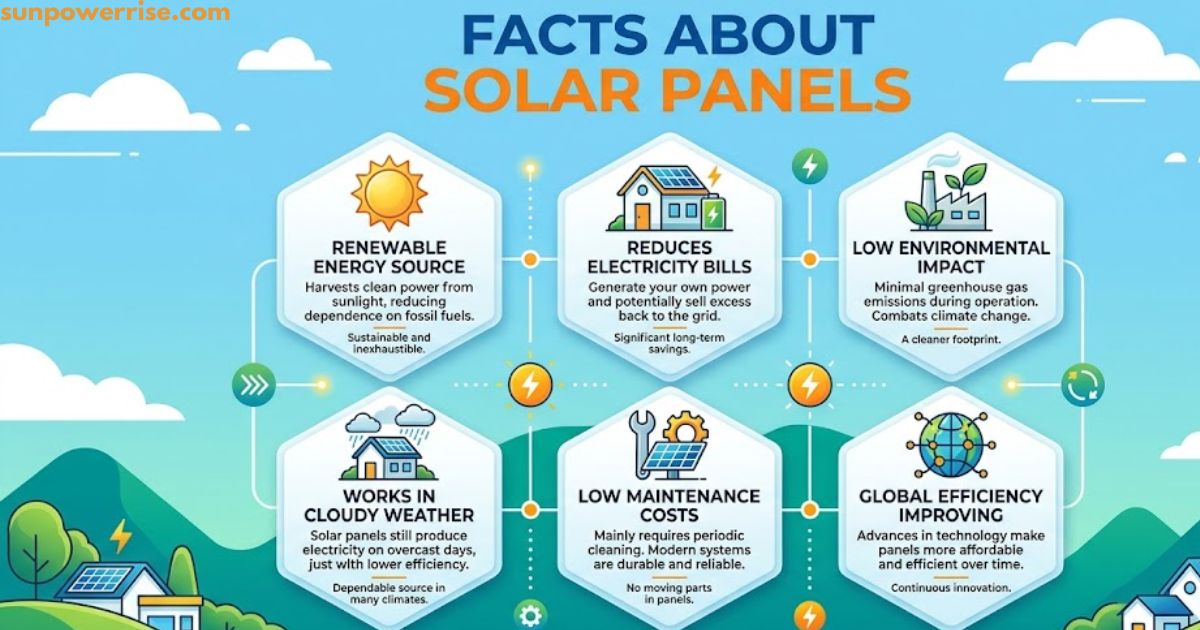
One of the most impressive facts about solar panels is that they turn daylight into clean electricity, even on cloudy days. From space stations to transparent windows, solar energy keeps evolving fast.
With costs down 99% since 1977, renewable energy has never been more affordable, powerful, or accessible for UK homes today.
Solar Panels Work on Daylight (Not Just Direct Sunlight / Work in Winter Too)
Many people think solar photovoltaic panels only work under sunny weather, but that’s a common misconception. In truth, PV panels turn daylight into electricity using photon particles, so direct light and indirect light both count, even on cloudy days or in the United Kingdom’s grey skies.
My own solar PV setup still produces a steady energy output through shorter days in winter, and I’ve learned to maximise output by running the dishwasher and large appliances in the morning rather than the evenings, since direct sunlight and ambient daylight both help fill the panels through the day.
History of the Solar Cell
The story of solar cells goes back further than most people realise. In 1883, a New York inventor named Charles Fritts coated selenium with a thin layer of gold to build the earliest PV cells, but it took until 1954 for Bell Labs, also known as Bell Laboratories, to create the first commercially viable solar cell made from silicon.
Those early viable solar cells only ran small electrical devices, yet solar technology has come a long way since the 1970s, and data from the National Renewable Energy Laboratory in 2022 shows just how far efficiency has climbed, turning sunlight into a genuine renewable electricity source.
Solar Panels in Space
Solar power isn’t limited to rooftops here on Earth; it also keeps things running in space. The space industry first turned to solar cells back in the 1950s, and today the International Space Station, often shortened to ISS, along with many satellites and every spacecraft on a long mission, relies on sunlight captured in the vacuum of space, free from atmospheric interference.
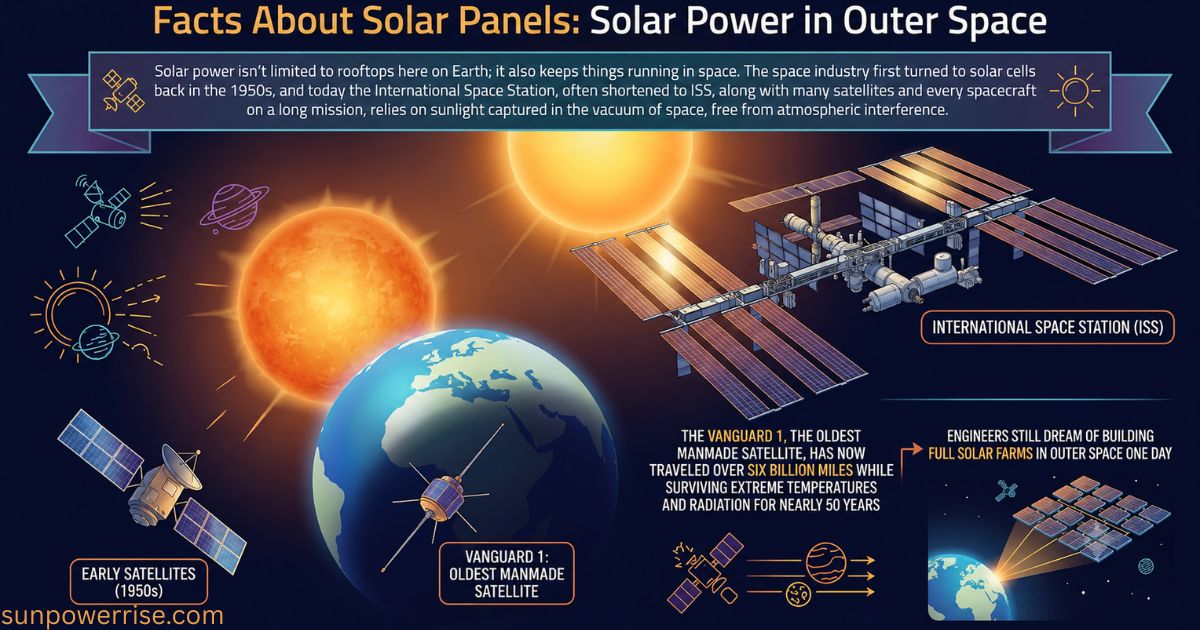
Vanguard 1, the oldest manmade satellite, has now travelled over six billion miles while surviving extreme temperatures and radiation for nearly 50 years, and engineers still dream of building full solar farms in outer space one day.
Solar Panels Increase Home Value
A solar installation doesn’t just cut your bills; it also lifts your home value. Studies show a well-planned system can raise resale value and property value by thousands of pounds, though the exact figure depends on your location.
Buyers like the idea of a future-proofed property with cheaper energy bills and a regular income from selling spare power, and with modern solar designs offering a sleek option and a modern aesthetic, your neighbours will notice, and any potential buyer will see the appeal straight away.
UK Government Solar Incentives (Smart Export Guarantee)
Government support has made solar even more attractive for households across the country. Back in April 2022, the UK Government cut the reduced VAT rate on solar from 5% down to 0%, dropping VAT entirely to boost energy efficiency, and this deal stays in place until March 2027.
Even though the old Feed-in Tariff scheme has ended, the Smart Export Guarantee now offers a payment for energy exported back to the National Grid, so solar owners still get rewarded for the power they don’t use.
Most Solar Panels Contain Silicon
Since the 1950s, silicon has been the backbone of most solar cells, valued for its strong semiconductor properties that make electricity generation possible. It’s worth noting this mineral isn’t the same as silicone, the rubbery material some people confuse it with.
Manufacturers shape purified silicon into ingots before slicing them into wafers, producing monocrystalline solar panels, usually the black panels, and polycrystalline solar panels, typically the blue panels, and while researchers keep testing alternative materials, none has yet matched silicon’s blend of efficiency, durability, and cost-effectiveness.
Solar Panels Will Provide 25% Of The World’s Electricity By 2050
According to the International Energy Agency, also known as the IEA, solar power is set to cover 25% of world electricity needs by 2050.
This forecast, released in 2022, marks a huge jump from 2021, when solar met just 3.72% of global electricity demand, and it’s one of many striking solar energy statistics worth watching in the years ahead.
Global Solar Panel Production Has Skyrocketed
Solar panel production has grown at an astonishing pace to keep up with rising global demand for renewable power. In 2022, output reached around 379 gigawatts, or 379 GW, which is roughly 1.25 times bigger than UK electricity consumption back in 2021.
Picture an aerial shot of a large solar farm stretching across green fields and rolling countryside, and you get a sense of just how much land and effort now goes into meeting that demand.
Most Solar Panels Are Made In China
The International Energy Agency, or IEA, reports that Chinese manufacturers handle over 80% of global solar PV production, with most of the industry based in China. This concentration has helped push down solar panel costs, but it comes with risks too.
The pandemic and its related lockdowns caused serious supply issues worldwide, and aggressive pricing practices have squeezed both US manufacturers and European manufacturers, reshaping patterns of solar Energy Consumption Across The Globe.
You Can Get Solar Panels That Look Like Roof Tiles
If you want something more discreet than standard panels, solar tiles made to look like ordinary roof tiles are now on the market. Offered in sleek designs that protect the aesthetics of a property, they’re especially handy for listed buildings and homes in conservation areas, where planning permission for regular panels often gets refused.
The catch is that efficiency sits lower, usually between 10-20% compared with 18-24% for standard panels, and they come at a higher price.
There Are Transparent Solar Panels
One of the most exciting developments in renewable energy technology is the arrival of transparent solar panels, which let sunlight pass through while still generating power.
Built from specialised materials that absorb the invisible spectrum, including ultraviolet and infrared light, these panels can fit into windows, building facades, and even smartphones without ruining the aesthetics or functionality of the surface.
A handful of real examples already exist in the UK, such as a bike shelter in Cambridge, a bus stop in Canary Wharf, and Gloucestershire County Council Hall, though efficiency and cost both need to improve before this becomes mainstream.
Someone Once Invented A Solar Bikini
Not every solar invention is practical, and the solar bikini proves it. In 2011, New York designer Andrew Schneider built a piece of swimwear fitted with 40 tiny PV film strips and a USB connection, originally hoping it could power a mini fridge for chilled beers at the beach.
It couldn’t quite manage that, but it did charge small electronic devices, making it both a fashion statement and a genuinely portable power source.
Solar Panels Can Endure Extremely High Temperatures
Solar panels are built to cope with high temperatures, typically holding up to between 65-85°C thanks to heat-resistant materials and built-in ventilation that clears excess heat. If things get too hot, panels may pause temporarily rather than suffer permanent damage, which speaks to their overall durability.
That’s why huge solar farms thrive in tropical climates and scorching desert regions, including the Mohammed Bin Rashid Al Maktoum Solar Park, located just 50 km south of Dubai.
You Can Now Have Pink Or Patterned Solar Panels
Solar panels no longer have to look plain black or blue. Using special dyes, coatings, and materials, speciality panel manufacturers can now produce pink solar panels and other patterned solar panels, giving homeowners far more design flexibility and better aesthetic integration with their property.
These coloured panels tend to cost more and lose some efficiency due to greater light reflection, pushing up the price, but companies like the Dutch startup Soluxa and the Italian firm Peimar are leading the way in colourful solar.
There Are Roads Made From Solar Panels
Among the more experimental facts about solar panels, building roads out of solar panels has sounded good on paper but rarely worked well in practice.
The Wattway solar road, built across a rural road in Normandy, France in 2016, used resin-covered solar panels for electricity generation, but the French government’s €5 million project turned into a flop.
The panels cracked, created constant noise under traffic, and proved inefficient at producing power. A similar project in Jinan, China, fared no better, with stolen panels reported within a week of opening in 2017.
FAQs
What are some interesting facts about solar panels?
Solar panels run on daylight, not just direct sun, and even work in space on the International Space Station. Solar energy costs have dropped 99% since 1977, making it one of the most affordable renewable energy sources today.
How long do solar panels last?
Most solar panels come with a 25-year warranty and can keep generating electricity for decades with very little maintenance. A solar power plant itself can stay useful for 40 years or more.
Do solar panels work in winter?
Yes, solar panels are powered by ambient daylight, not just direct sunlight, so they keep producing electricity through shorter winter days, just at a lower output.
Are solar panels made of silicon?
Yes, most solar panels rely on silicon, valued for its strong semiconductor properties, though manufacturers are exploring alternative materials like copper for the future.
Can solar panels increase my home’s value?
Yes, a solar installation can raise your resale value by thousands of pounds, while also cutting energy bills and boosting your property’s modern aesthetic.