

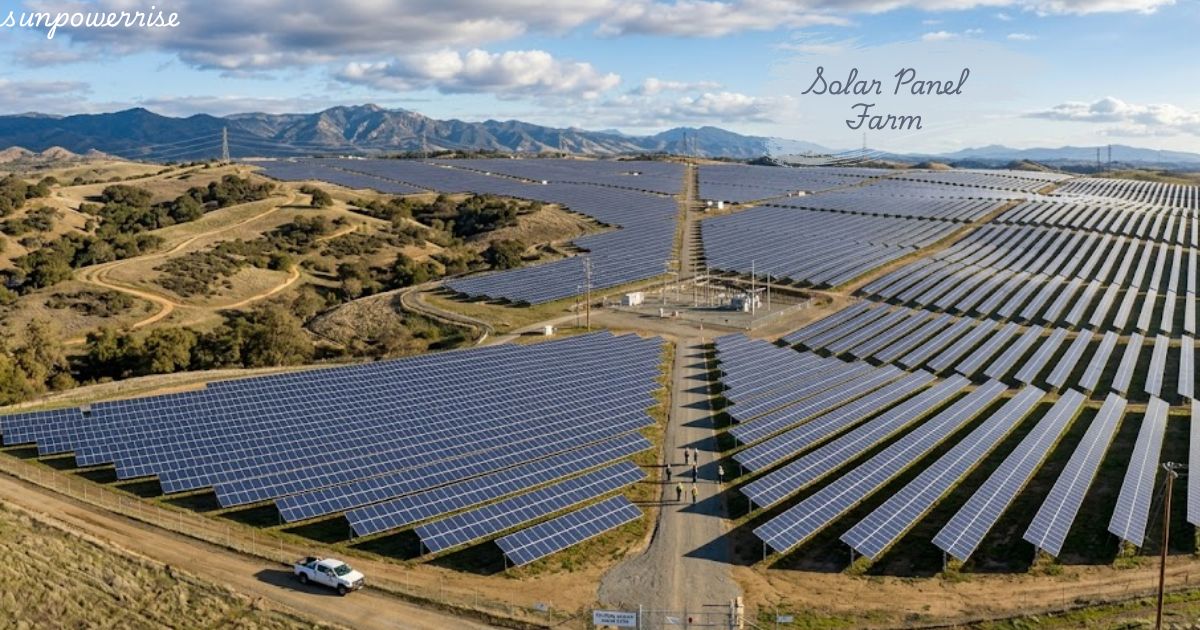
I walked past a solar park last spring and noticed sheep grazing calmly between the rows, and that small scene told me more about how solar panel farms actually work than any brochure ever could.
Across the UK, these sites turn sunlight into electricity using rows of PV panels spread over acres of rural areas and farmland.
With more than 1,000 solar farms already standing, including well-known names like the Llanwern Solar PV Park at 75 MW and the Shotwick Solar Park at 72.2 MW, the country now holds roughly 13 GW of capacity.
A Quick History Of Solar Panel Farms In The UK
Back in the early 2010s, solar panel farm developments began appearing across the country, pushed along by government incentives like the Feed-in Tariff, or FiT scheme, launched in 2010, and growth stayed strong from 2011 through 2015 as large-scale installations came online one after another.
Around 2016, government subsidy reductions, including the end of the Renewable Obligation Certificate, slowed things down, yet falling solar technology costs kept the industry growth ticking over at a gentler pace, and from 1 January 2020, the Smart Export Guarantee, or SEG tariffs, stepped in as a smaller but still useful renewable electricity incentive.
The 2020s have brought a fresh wave of large-scale projects, with 25 large-scale solar facilities applying for development consent orders, known as DCOs, from the UK government to build nationally significant infrastructure, or low-carbon infrastructure, worth another 11 GW of extra capacity, all feeding into national solar capacity targets of 70 GW by 2035.
Components Of A Solar Panel Farm
Every working site leans on a handful of core parts, starting with solar panels for sunlight capture, plus mounting systems for panel angling and reliable sunlight exposure. Inverters then switch direct current, or DC, into alternating current, or AC, so the power can reach homes and businesses, while batteries hold onto excess electricity for grid export and help smooth out intermittent solar energy.
Behind the scenes, cabling and electrical infrastructure carry the current from panel to power grid, supporting electricity distribution, and monitoring systems, along with control systems, keep an eye on performance optimisation and overall efficiency, tying the whole set of solar farm components together.
Types Of Solar Farms
The bigger category, utility-scale solar panel farms, exists mainly for grid supply, and developers usually strike power purchase agreements, known as PPAs, with utility companies, selling power at wholesale prices before it reaches end customers through normal grid distribution; these sites typically start at 1 MW.
On the other end sit community solar farms, run by local communities or cooperatives, and they focus on affordable electricity and locally generated electricity for their members rather than the wider grid. This model lets ordinary individuals and property owners take part in solar power even when their own roof or land will not stretch to a full install.
Land Requirements & Suitability for Solar Panel Farm
A 1MW plot usually needs somewhere between four acres and five acres, a 5MW site needs roughly 25 acres, and a 50 MW array can swallow 300 acres, since the rough rule is six acres for every megawatt and 1 MW of power; the country’s biggest example, Cleve Hill in Kent at 373MW, shows what a large build looks like once panel positioning, access routes, inverters and battery storage all need room to sit.
According to Solar Energy UK and Carbon Brief, ground-mounted solar across the UK covers about 230 square kilometres, which is only 0.1% of the country, about 0.5% of all farming land, and roughly a fifth of the space taken up by golf courses.
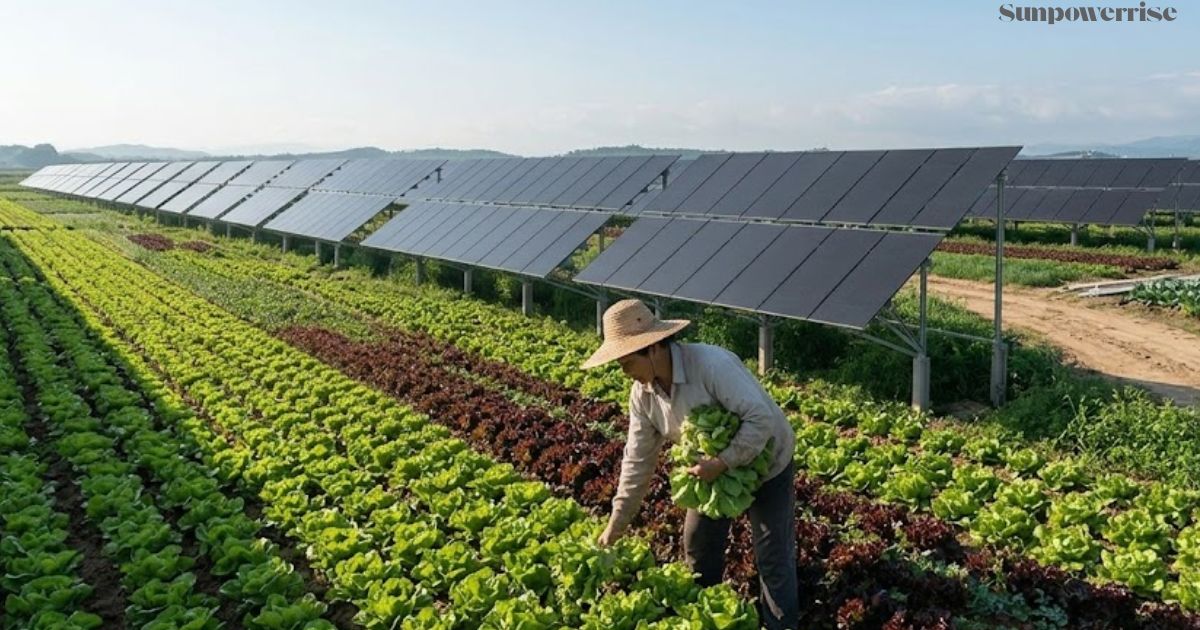
And the best plots tend to be brownfield sites, unused industrial land, plain industrial land, commercial land, or low-grade agricultural land rated Grade 3b, Grade 4 or Grade 5, rather than the higher grade Grade 1 or Grade 2 fields kept for serious agricultural production and crops.
Good land suitability means flat land, ideally south-facing land that is gently sloping land too, with strong sunlight exposure, solid solar exposure, minimal shading and low shading from trees, buildings or other structures, a firm stable surface, working infrastructure access with usable roads, and nearby grid connections through a substation or a direct grid connection to keep grid connection costs in check.
Solar developers must also run environmental impact assessments covering environmental impact, local impact, visual impact on the landscape, noise near residential areas, conservation value, wildlife habitats, biodiversity and ecological concerns.
Initial Setup Costs and Maintenance
Money talks in this industry, and a 50 MW solar panel farm on 300 acres costs around £1 million per megawatt of capacity, so investment for that one site lands near £50 million, with the final maintenance costs shaped by solar farm size, location, panel specification and technology.
Rough industry figures put annual upkeep at about 1% of startup costs, or around £12 per kW of installed capacity, which works out to roughly £500,000 to £600,000 per year for that same 50 MW example.
Need Planning Permission for a Solar Farm
Getting planning permission is a firm step in any solar panel farm development, and while some rooftop installations slide under permitted development, ground-based farms always face an approval requirement, no matter their generating capacity.
Anything under 50 megawatts, or MW, goes through the local planning authority, or LPA, while anything bigger needs development consent from the Secretary of State for Energy Security and Net Zero, since these count as nationally significant infrastructure projects, or NSIPs.
Reviewers weigh up environmental impact, land use classification and visual aesthetics as core assessment factors, and readers wanting more depth can check our separate Planning Permission for Solar Panels article.
Biggest UK Solar Panel Farms Draw Equal
There are currently 18 solar PV projects online in the UK sitting right at 69.9MWp capacity and 49.9MW export capacity, a size that is no accident, since it sits at the very top edge of local approval before triggering the NSIP regime.
This same size shows up again and again through the planning pipeline and construction pipeline, because many developers view a full development consent order, or DCO, as pricier and slower than routes under the town and council planning act, or TCPA, so projects in the 50-150MW range often get judged as poor on cost-effectiveness.
New 2026 legislation will lift the NSIP threshold to 139.9MWp and 99.9MW export, and once that lands, more schemes should move through planning portals past today’s local authority planning threshold.
A fresh look at the 10 biggest solar farms shows just how quickly the list of biggest solar sites changes, since older rankings turn into out-of-date information almost overnight.
Cleve Hill Solar Farm, 373MW
Quinbrook Infrastructure Partners reached construction completion and began commercial operations at the 373MW Cleve Hill Solar Park at the start of July 2025, on a site in Kent where construction started back in 2023.
During the commissioning phase in May, electricity exports peaked at 0.7% of UK national power demand, a strong sign for a single solar power project.
As the first nationally significant infrastructure project, or NSIP, of its kind, this solar storage plant carries the country’s largest project financing package tied to a battery energy storage system, or BESS, and once finished, it will stand as the UK’s biggest co-located solar plus storage project.
Llanwern Solar Farm, 75MW
The Llanwern Solar Farm, commissioned in 2020, held the UK’s biggest solar farm title right up until Cleve Hill took over, and its 75MW capacity in Newport still makes it a serious PV project. NextEnergy, the current site operator, runs daily matters.
While NextPower UK ESG, a solar infrastructure investor, signed a sleeved PV power purchase agreement, or PPA, with Anglian Water Services in October 2024.
That 20-year deal counts as an inflation-linked contracted revenue agreement, covering 90% of the electricity and any Renewable Energy Guarantees of Origin, known as REGO certificates, tied to the project.
Shotwick Solar Farm, 72MWp/51MW export
Built by British Solar Renewables for owner Foresight, the Shotwick Solar Farm sits in Flintshire, Wales, and went up in just six weeks of construction back in 2016.
Its 72MWp generation capacity faces a 51MW export restriction, and the plant traces back to joint development by WElink, Compton Group and China Triumph International before Foresight Solar Fund stepped in through a 2017 acquisition.
A power purchase agreement signed at completion lets the nearby UPM Shotton Paper Mill draw as much as 100% of its electricity demand straight from the site during peak generation times.
Scurf Dyke Solar Farm, 71MWp/50MW export
Owned by FP Lux Group, the Scurf Dyke Solar Farm was built by BayWa.re and switched on in 2023, though the planning permission trail runs back to 2020, before JBM Solar handed the construction phase over to BayWa.re in 2021.
In July 2024, power firm Statkraft signed a ten-year PPA covering the plant, which also includes an adjacent 8MW BESS near Driffield in the East Riding of Yorkshire. That combined deal shows how storage and generation now travel together on newer sites.
RAF Lyneham Solar Farm
Bluefield Solar’s RAF Lyneham Solar Farm switched on in 2015, marking an early piece of the Cabinet Office’s plan to fit solar onto government-owned sites nationwide.
British Solar Renewables won the EPC bidder role on a project first shaped by AMEC Environment & Infrastructure. When the farm came online, people widely viewed it as the largest UK solar site of its time.
Larks Green Solar Farm
Larks Green went live in 2023 through Cero Generation and Enso Energy, and it holds a genuine first, since it became the first UK site to reach the higher voltage transmission network rather than a normal local distribution network.
Late in 2024, the plant added a 49.5MW, 99MWh co-located BESS, turning it into the first transmission-connected facility of its kind. With a full 120MW grid connection in place, commercial manager Patrick O’Connor told Energy-Storage. news that the setup removes any real export capacity competition between solar and storage.
Medebridge Solar Farm
Enviromena’s Medebridge Solar Farm in Essex came online near the end of August 2025, backed by what the firm calls the UK’s biggest solar Corporate Power Purchase Agreement, or CPPA, signed with an educational institution. From 1 September, the site began feeding the University of Manchester under a 10-year CPPA, expected to cover around 65% of the university’s total electricity demand.
Burwell Solar Farm
The Burwell solar power plant in Cambridgeshire switched on in 2023 under EDF Power Solutions, one of the firm’s earliest UK sites to reach that stage after it took the project over from AGR in March 2021 through a straightforward site acquisition.
South Farm Solar Park
Voltalia’s South Farm PV power plant began running in June 2023, and the firm landed a CPPA with the City of London Corporation, a deal it called a first-of-its-kind deal since it links a renewable power generator directly with a public governing authority rather than a private buyer.
Gonerby Moor Solar Farm
The Gonerby Solar project, brought online this year, was picked up by Sonnedix from Lightsource bp in December 2022 as part of a wider portfolio covering five sites worth 300MW combined capacity, with Ameresco handling EPC services for the plant in Lincolnshire.
Growth And Expansion Potential Of Solar Farms In The UK
The UK solar panel farm industry has bold government targets behind it, aiming to lift solar capacity to 70 GW by 2035 as part of wider net zero plans and energy security plans, and Great British Energy wants to turn Britain into a clean energy superpower by 2030, building investor confidence for the capital allocation needed to fund the net zero transition.
The Labour government has already backed new solar farm developments, approving three sites within three days of taking office across Suffolk, Cambridgeshire, Lincolnshire and Rutland, adding 1.35 GW between them, and beyond that, 20 applications sit in the large solar farms pipeline, worth another 11 GW if approved.
Supporting programmes include the Solar Taskforce set up under the previous government to focus on installation cost-cutting, skills boosting and jobs boosting, along with grid access improvement, alongside a push for rooftop solar and ground-mounted solar on underused agricultural land, a plan the Sunak government extended to commercial buildings, schools, warehouses and car parks as fresh solar installation sites.
FAQs
How much land do you need for a solar panel farm?
It depends on scale; a 1MW site needs around four to five acres, while a 50 MW farm can need up to 300 acres. As a rule of thumb, plan for about six acres per megawatt.
Do you need planning permission to build a solar farm?
Yes, always. Farms under 50 MW go through the local planning authority, while larger ones need development consent from the Secretary of State as nationally significant infrastructure projects.
What is the biggest solar farm in the UK?
Cleve Hill Solar Farm in Kent, at 373MW, is currently the UK’s largest, having overtaken Llanwern Solar Farm (75MW) after coming online in July 2025.
How much does it cost to build and maintain a solar farm?
Setup typically costs around £1 million per megawatt, with annual maintenance running about 1% of that initial investment.
How does the UK plan to grow its solar capacity?
The government aims to hit 70 GW of solar capacity by 2035, backed by initiatives like Great British Energy and the Solar Taskforce to speed up approvals and grid access.