

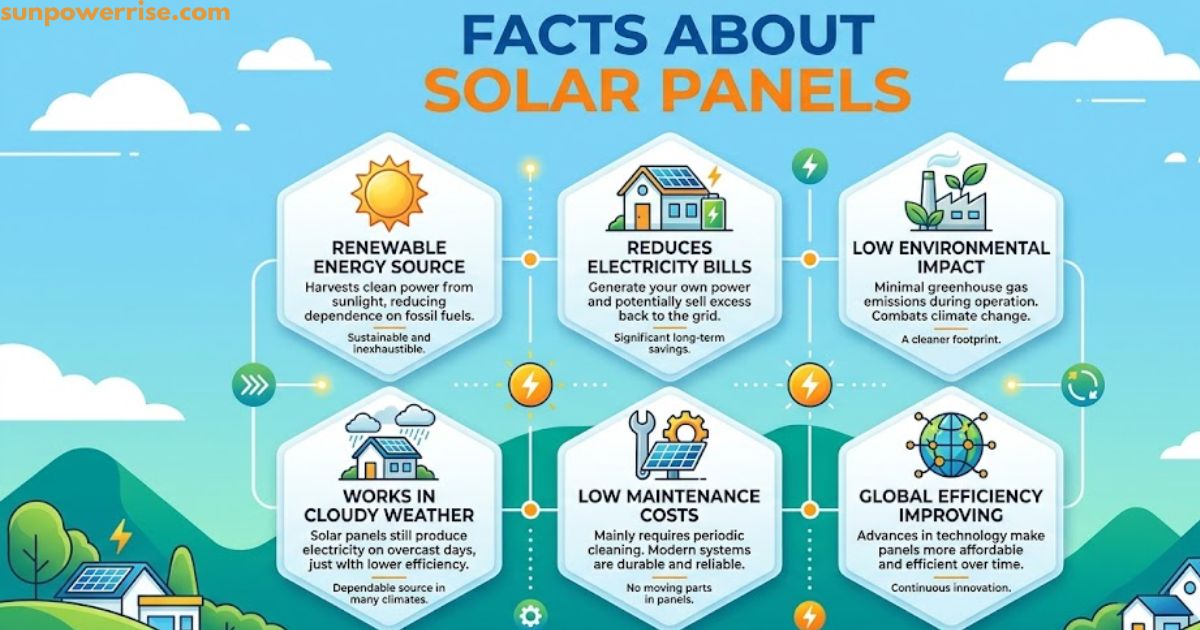
The facts about solar panels begin with solar energy, a renewable energy source because the sun rises every day. It also qualifies as clean energy, since panels make electricity without burning anything. Many writers call it an inexhaustible energy source and the most abundant energy resource on Earth.
People often repeat that Earth receives more energy in an hour than used in a year. Scientists measure the incoming flow in terawatts of solar energy. The National Renewable Energy Laboratory and the International Energy Agency (IEA) publish data that track how fast people capture it.
How Does Sunlight Become Electricity?
Sunlight becomes electricity through the photovoltaic effect inside solar cells (PV cells). Photons strike the silicon and shake electrons free, and an electric field inside each cell pushes those loose electrons in one direction. That flow forms the current your home can use.
Each cell produces direct current (DC), but your outlets deliver alternating current (AC). A solar inverter converts one into the other, and microinverters do the same job panel by panel. I prefer microinverters on partly shaded roofs, because one weak panel then drags down only itself.
Which Materials Go Into a Solar Panel?
Most panels rely on silicon, which manufacturers refine from silica into purified silicon. They grow silicon ingots, slice them into a semiconductor wafer, and wire the wafers into cells. A metal frame, glass casing, and wiring then protect and connect the finished panel.
Thin silver lines on each cell collect current, and rising silver costs push some makers toward copper as an alternative to silver. Thin-film designs use selenium or indium instead of thick silicon wafers. Solar panel manufacturing depends on a global supply chain, and China holds most of the world’s solar panel production capacity.
How Do Monocrystalline and Polycrystalline Panels Differ?
Monocrystalline solar panels use one silicon crystal and usually reach higher efficiency, while polycrystalline solar panels blend many crystal fragments and cost less. The single crystal gives electrons a cleaner path through the cell. Installers wire either type into solar panel arrays on a roof or in a field.
A perovskite-silicon tandem panel stacks two materials, and each layer captures a different slice of the solar spectrum. Lab cells of this design have passed 30 percent efficiency, well above the roughly 20 percent of standard modules. Commercial products still trail those lab results.
What Unusual Solar Technologies Exist Beyond Rooftops?
Transparent solar panels, solar roof tiles, and solar windows and building facades let a building generate power without a visible rack of modules. Coloured solar panels and patterned solar panels give architects room to match a design. These products cost more per watt, so they suit special projects.
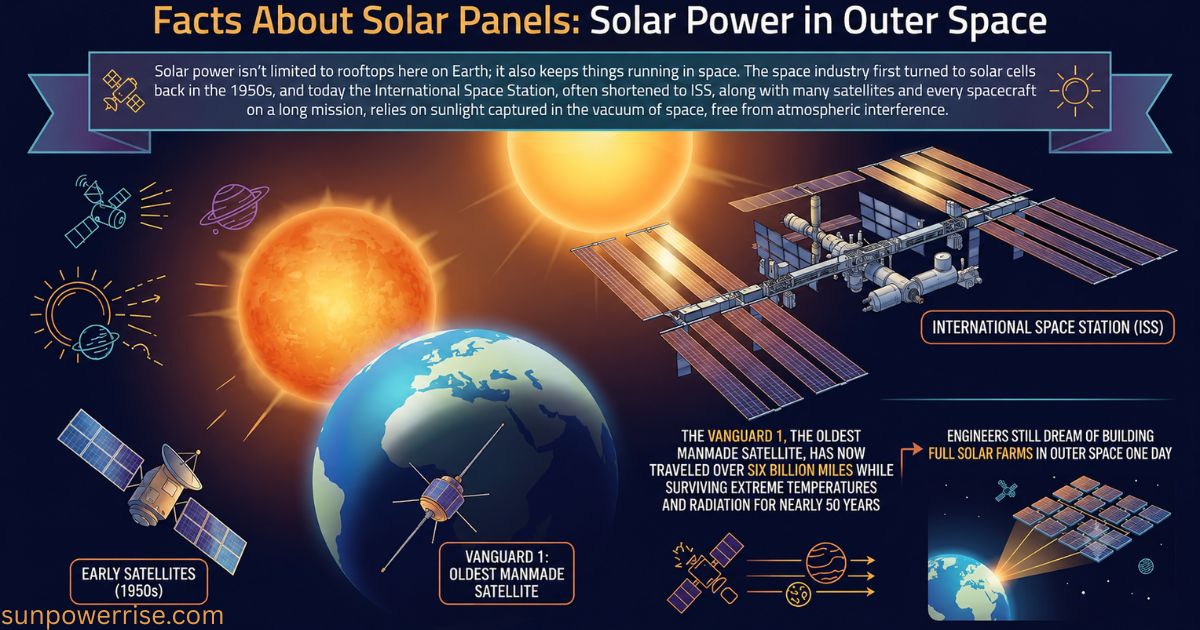
Engineers have also tested a solar road, a solar car, and even a solar bikini that charges a phone. Artists have built solar-powered art installations that glow at night on daytime charge. Satellites depend on solar panels in space, and the International Space Station carries some of the largest arrays ever flown.
How Big Can a Solar Farm Get?
A solar farm covers acres of ground with rows of panels that sell power to the grid. Utility-scale solar projects now reach gigawatt size, and solar capacity gets counted in megawatts and gigawatts. Bhadla Solar Park in India and Gonghe Talatan Solar Park in China both appear on lists of the largest solar farm in the world, although published capacity figures disagree.
Solar thermal power plants use mirrors rather than cells, and Ivanpah, a Mojave Desert solar plant in California, delivers 392 megawatts that way. Crescent Dunes in Nevada adds molten-salt energy storage so it keeps making steam after sunset. Dubai’s Mohammed Bin Rashid Al Maktoum Solar Park mixes both approaches, while smaller plants run as grid-connected PV systems.
What Is Agrivoltaics and Why Does Dual-Use Solar Help?
Agrivoltaics combines farming or grazing with solar panels on the same land. This dual-use solar approach eases the land use debate, since sheep graze between the rows and shade-tolerant crops grow underneath. Farmers also earn lease income.
The Wilderness Society, a conservation nonprofit that sells no solar products, urges developers to site public lands solar on ground that already has disturbance. The Bureau of Land Management oversees many of those western sites, and the Department of Energy funds related research. I find that guidance useful when I read developer plans.
Who Discovered the Photovoltaic Effect and When?
Edmond Becquerel made the 1839 discovery of the photovoltaic effect at age 19 while experimenting with electrodes in a conductive liquid. Charles Fritts built a selenium cell in 1883, and Russell Ohl patented a silicon cell in 1941. Bell Laboratories then announced the first viable silicon solar cell (1954).
The Vanguard satellite carried solar cells into orbit in 1958, and NASA later made solar power standard on spacecraft. The history of solar energy reaches further back, because Roman greenhouses trapped sunlight and Roman sun rights protected access to light under law. Reports also mention the first UK solar panels at the University of Sussex and a village billed as the world’s first solar-powered village.
Is Solar Better Than Fossil Fuels for the Climate?
Yes, solar beats fossil fuels on emissions, because panels generate pollution-free electricity while they run. Coal and natural gas release greenhouse gas emissions, including carbon dioxide (CO2), and those gases drive climate change and global warming. Solar still has a carbon footprint from manufacturing, but its life-cycle emissions stay far below those of fossil fuels.
Energy payback time measures how long a panel takes to produce the energy used to make it, and it usually runs between one and four years. Solar panel recycling recovers glass, aluminium, and silicon, and researchers also study the impact on wildlife at large sites. Sustainable energy and green energy labels fit solar well, and countries that build it gain more energy independence from imported fuel.
How Well Do Solar Panels Perform and How Long Do They Last?
Solar panel efficiency describes the share of light a panel converts, and most modern modules sit near 20 percent. That sunlight-to-electricity conversion peaks under direct sunlight, yet indirect light and daylight still deliver solar radiation to the cells. Panels respond to light rather than heat, so cloudy-day performance drops without disappearing.
Heat actually lowers output, so check a panel’s high-temperature tolerance on its datasheet. Panels reach optimum operation in cool, bright weather. Fixed vs sun-tracking panels also differ, because trackers follow the sun and often lift yearly output by around 25 percent.
Panel degradation trims output by roughly half a percent each year, and quality makers back their modules with a 25-year warranty. Because panels have no moving parts, they need minimal maintenance, mostly periodic cleaning. A solar panel lifespan of 25 to 30 years is typical, and energy output per square foot keeps falling slowly over that time.
How Much Can Home Solar Savings Reach?
Home solar savings depend on your electricity bills, your roof, and the price of power where you live. A 4kW system, a common size for a home solar system, produces roughly 3,400 kilowatt-hours a year on a south-facing roof in the UK. Your payback period then depends on installation cost and how much of that power you use yourself.
Solar battery storage holds excess energy for the evening, and the National Grid takes whatever you cannot store. The Smart Export Guarantee requires larger UK suppliers to pay for feeding energy back to the grid. Some owners treat the grid as a bank for excess energy, though the rates rarely match what you pay to buy it.
Rooftop solar can also power a solar-enabled EV charger, so your electric vehicle charging runs on midday sunshine. In England, many rooftop installations need no planning permission, but listed buildings and conservation areas face extra rules. Ask your council before you sign anything.
What Should You Look for in a Solar Installer?
Look for a solar installer that offers written quotes, clear equipment details, and recognised certification such as MCS in the UK or NABCEP in the United States. A good solar photovoltaic installer also explains warranties and monitoring before you sign. I ask every installer to show recent jobs on roofs like mine.
Compare at least three written offers, because prices and equipment vary. Group buying can lower costs, and solar buyback schemes or energy incentives can change the maths. Treat any quote that skips the equipment brand as incomplete.
Which Brands Help You Find a Solar Provider?
Renewable Energy Hub runs a directory of UK renewable energy companies where you compare quotes from local installers. SunSave lists a savings calculator, a free consultation, roof visualisation, and solar and battery system design. Switch Together arranges group buying for solar PV, battery storage, and heat pumps with vetted installers.
Chariot Energy serves Texas with electricity plans and lists virtual power plants, renewable energy certificates, and solar buyback, and it says it helps Texans use solar without installing panels. MET Group trades and supplies energy and builds solar plants in Hungary and Spain. Enel names Enel Green Power as its clean energy producer.
Each brand offers the services listed on its own website, so read those pages before you contact anyone. None of these sites lists a repair service, so ask about maintenance in writing. I would rather you verify that than assume it.
How Fast Is Solar Growing and What Does It Cost?
Solar is the fastest-growing energy source in the world, and the solar photovoltaic installer role ranks among the fastest-growing jobs in United States labor forecasts. Solar industry jobs span manufacturing, installation, and sales, so the sector keeps hiring. That growth explains why more providers now compete for your roof.
The cost of solar has fallen sharply, and unsubsidized solar now ranks among the cheapest new electricity sources in many countries, according to the IEA. Solar supplied roughly 7 percent of global electricity in 2024, a small electricity generation share that keeps climbing. New renewable capacity leans heavily toward solar, and global solar PV production rises every year.
What Fun Solar Facts Surprise Readers?
Sunlight reaches Earth in about eight minutes and twenty seconds, which settles the eight-versus-ten-minute disagreement across websites. Scientists describe wind as a form of solar power, since the sun heats the planet unevenly and moves air. Teachers use solar energy facts for kids because they turn abstract physics into a clear picture.
Estimates of the land needed to power the world vary widely, so I treat any single figure with caution. Solar energy statistics also shift with the year and the source, which is why I check primary data. Verify every number before you publish it.
What Are the Most Common Questions About Solar Panels?
Do Solar Panels Work in Winter?
Yes, panels work in winter, though shorter days cut output. Cold air helps efficiency, while snow cover blocks light until it slides off. Expect clearly lower production in northern countries.
How Often Do Panels Need Cleaning?
Rain handles most dirt, so one or two cleanings a year usually suffice. Bird droppings and leaves need prompt removal because they shade cells. Follow the manufacturer’s instructions and use a soft brush with water.
Is Solar Worth It?
Solar pays off when your roof gets good light and you use much of the power yourself. Compare quotes, check the warranty, and calculate your payback period before you commit. Your own electricity bills tell you more than any average.
Where Can You Find Reliable Solar Providers and Facts?
This site gathers the checks, brand details, and facts in one place, so you can find Understand the Sun! 27 Fantastic Facts About Solar Energy and Solar Panels without juggling seven separate tabs. Visit our website to compare providers by the services each one clearly lists, and read every brand’s own page before you decide. Our guide is the easiest place to find a trustworthy installer and more facts about solar panels.