

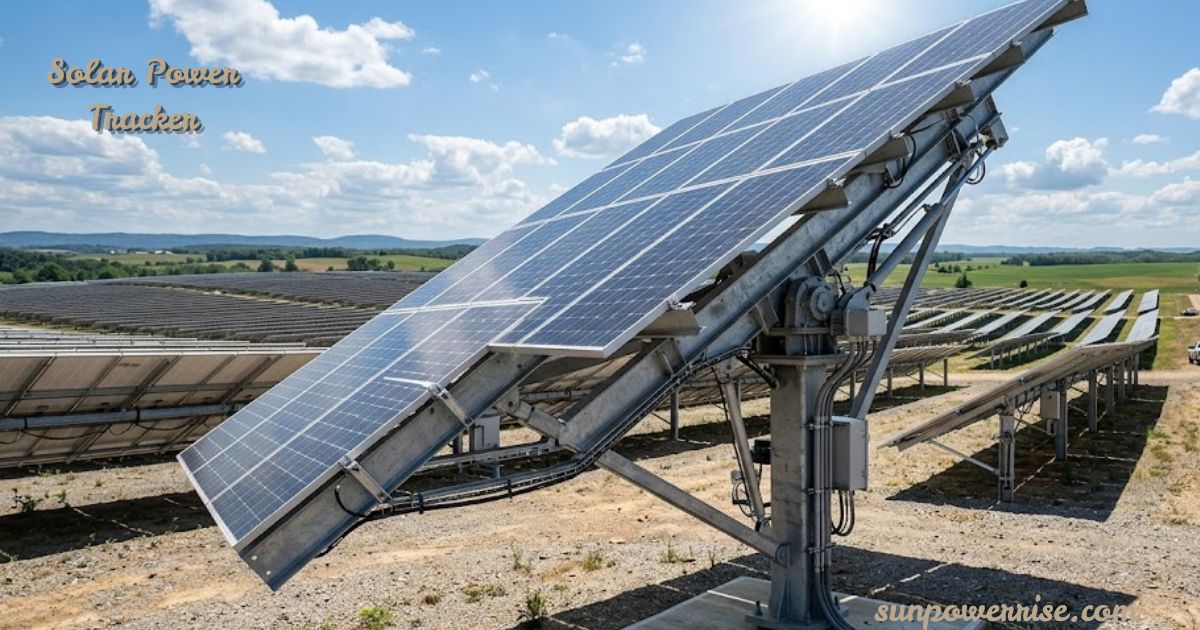
When people across the north east start asking us about clean energy, the solar power tracker is usually the first thing that grabs their attention.
We’ve spent years helping both homeowners and local companies install a proper solar system, and we count ourselves among the longest-serving trusted solar installers in the area, who understand solar inside and out, whether that means a full setup for a business or a simple residential solar system for a family home.
What Is A Solar Power Tracker?
A Solar power tracker is a device that lets you tilt solar panels to follow the sun across the day, rather than leaving them fixed at one angle. It’s usually bolted straight onto the racking beneath the PV module, and it tracks the sun’s path so the panel keeps facing the light for longer.
Because of that added cost, Solar power trackers tend to show up on large-scale jobs, commercial projects and utility projects rather than typical residential homes.
The advantages are still worth knowing about even if a tracker isn’t right for your roof: by keeping solar panels angled toward the sun, a tracker is genuinely maximising generation across the whole day.
It’s also worth remembering that some setups use mirrors and lenses instead of tilting the panel itself, which is how concentrating photovoltaic systems capture and focus sunlight onto a smaller receiver.
How Do Solar Power Trackers Work?
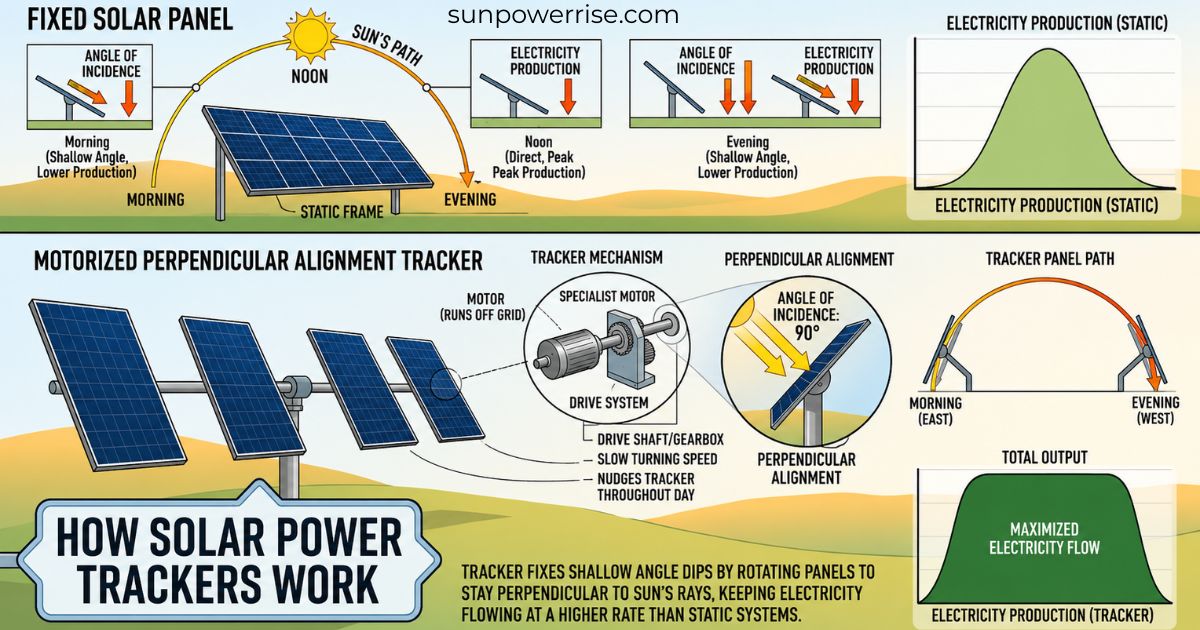
Picture a fixed solar panel: the sun moves across the sky all day, so the angle of incidence on that flat panel keeps changing, and electricity production dips whenever the light hits at a shallow slant.
A tracker fixes that by rotating the panel so the rays stay perpendicular to the surface, which keeps electricity flowing at a higher rate than any static system could manage.
A specialist motor, usually running off the grid, handles the slow turning speed needed to nudge the Solar power tracker round throughout the day.
Sensor and Astronomical Guidance Systems
There are two main ways a tracking system figures out where to point. Some rely on solar radiation sensors that react to the actual position of the sun in real time, while others follow a pre-programmed path built from astronomic predictions worked out in advance.
The sensor route can struggle at dawn and in cloudy conditions, when the light is weak or scattered, so most setups pair those sensors with a backup tracking system that falls back on the pre-set orientation whenever readings go quiet.
Maximising Yield Across Applications
This matters for solar farms, rooftop systems, and any businesses chasing better output, because the extra sunrays captured each day translate directly into extra energy.
Large businesses and individuals alike benefit from the boost in production, since a solar cell simply performs better when it isn’t fighting a varying angle all day.
Whether it’s a household topping up its own supply or a solar farm feeding power to nearby businesses, the underlying goal is the same: capture more of the sunlight on offer.
Single Vs Dual Axis Solar Power Tracker
A single axis system moves in one direction only. Picture the axis running roughly north-south, letting the frame tilt from east to west as the sun rises at sunrise and drops away at sunset; this is what most people mean by a single axis tracker.
A dual axis system goes further, adding a second axis so the frame can also shift north-to-south. That second movement accounts for seasonal variations in the sun’s angle, since the sun sits higher in summer and lower in winter depending on where you are on the globe.
Active Tracking and Cost Considerations
Most of these setups count as active trackers, meaning they use motors or hydraulic cylinders to physically change direction rather than relying on the weather.
The extra range of motion on a dual-axis unit makes it more accurate at chasing the sun’s position across every season, which keeps PV panels performing well year-round regardless of climate.
That said, this kind of performance comes at a price; dual-axis units are generally more expensive than single-axis ones, and both cost more than doing nothing at all.
Manual and Passive Tracking Alternatives
Not every tracker is motorised. Manual trackers skip the electronics entirely and simply need a person to reposition them by hand through the day, which keeps them cheap but limits production compared with active trackers.
Passive Solar power trackers take a middle path, using a gas fluid inside the frame that expands when it gets warmer on the sun-facing side, gently pulling the unit round to match the sun’s angle, a clever bit of physics, though still less precise than a motor-driven dual-axis system.
Solar Solutions With Mypower
At Mypower, supplying and installing solar panels across several industries has been the focus since 2010. That covers everything from industrial solar panels and agricultural solar panels through to commercial solar panels, all aimed at securing cheaper electricity while cutting carbon footprint.
The bulk of what gets installed comes from Trina and Q-Cells, two award-winning names known for high-quality panels built on genuine research and designs. That background shows up in day-to-day performance, which is really the whole point of choosing established manufacturers in the first place.
Kirchner Dual Axis Solar PV Tracker
A well-engineered biaxial tracking system keeps dual-axis photovoltaic tracking systems locked onto the optimum angle to the sun at every point in the day, and that optimum solar alignment only happens because of a precise astronomical control built specifically for the job.
Paired with quality solar PV panels and an inverter package, this kind of engineered product sits among the best available today, backed by service standards that match any other top-tier PV company.
Sizing, Electricity Supply, and Electrical Wiring
A properly sized solar installation should supply electricity year-round and slot straight into your existing electricity supply.
Depending on system sizing and total demand, panels can cover your needs entirely at certain times of day and year, which is where connections and electrical wiring work matter, since every solar PV tracking module setup depends on getting the wiring right from the start.
Enhanced Energy Yield
That kind of engineering delivers an additional yield of up to 45% over fixed-mount installations, and the same holds against comparable fixed-mount photovoltaic system setups, other fixed-mount PV installations, and standard photovoltaic installations more broadly.
A performance chart tracking a sonnen_system unit over a full 24 hrs period shows the gap clearly against a static array of the same size.
Core Technical Features
Main technical features worth highlighting include the biaxial tracking system itself, an astronomical control based on local coordinates, centralised monitoring over the internet, the built-in safety concept safeguard, feasible building integration, an additional yield of up to 45%, a track-back function to stop cross-shading, a 20-year warranty depending on the service agreement, and full compatibility across every panel brand on the market.
Uplift From A Solar Power Tracker
Looking at a typical London installation, a fixed 10kwp array produces noticeably less than the same system on a tracker at almost every hour except midday, when a fixed system happens to sit at its best angle anyway.
Across the darker months, January brought in 343kwh on the fixed system versus 406kwh on single-axis tracking, an 18% uplift, while dual-axis pushed that to 495kwh, a 44% jump. February followed a similar pattern: 478 fixed against 587 single axis (23%) and 648 dual axis (36%), and by March the numbers had climbed to 772, 930 (20%), and 980 (27%) respectively.
Q2 and Peak Summer Energy Production
Spring and summer kept the trend going. April delivered 1,023 fixed, 1,220 single axis (19%), and 1,278 dual axis (25%); May reached 1,262, 1,537 (22%), and 1,695 (34%); and June posted 1,185, 1,416 (19%), and 1,603 (35%).
July, the sunniest stretch, saw 1,214 fixed climb to 1,504 on single axis (24%) and 1,692 on dual axis (39%), showing just how much extra energy a tracker pulls in during long summer days.
Temperature Efficiency
Most of that boost comes from the improved angle hitting PV cells through the day, but there’s a second, quieter effect too: panels run more efficiently when the temperature drops in cooler air, so catching the early morning and late evening sunlight precisely when a tracker earns its keep near mornings and evenings adds a bit more on top.
It’s worth noting real-world figures can beat these numbers; a solar power tracker installed back in 2011 that we’ve since checked in on has performed even better than the season-by-season table suggests, likely because actual demand patterns line up neatly with when trackers perform best.
FAQs
Which solar tracker is the best?
The best solar tracker depends on your needs. Dual-axis trackers offer maximum efficiency, while single-axis trackers are more affordable and low-maintenance for most homes.
How do I track my solar panels?
You can track your solar panels using a motorised tracking system that follows the sun’s movement, boosting energy output throughout the day.
What is a solar tracker?
A solar tracker is a device that orients solar panels to follow the sun, capturing more sunlight and generating more power like giving your panels their own eyes to chase the light.
How much does a solar tracker cost?
A solar tracker typically costs between $500–$3,000 depending on size and type, with dual-axis models priced higher for greater precision.
Is a solar tracker worth it?
Yes, a solar tracker can be worth it. It boosts energy production by up to 25–35%, helping you get more value from every ray of sunshine.