

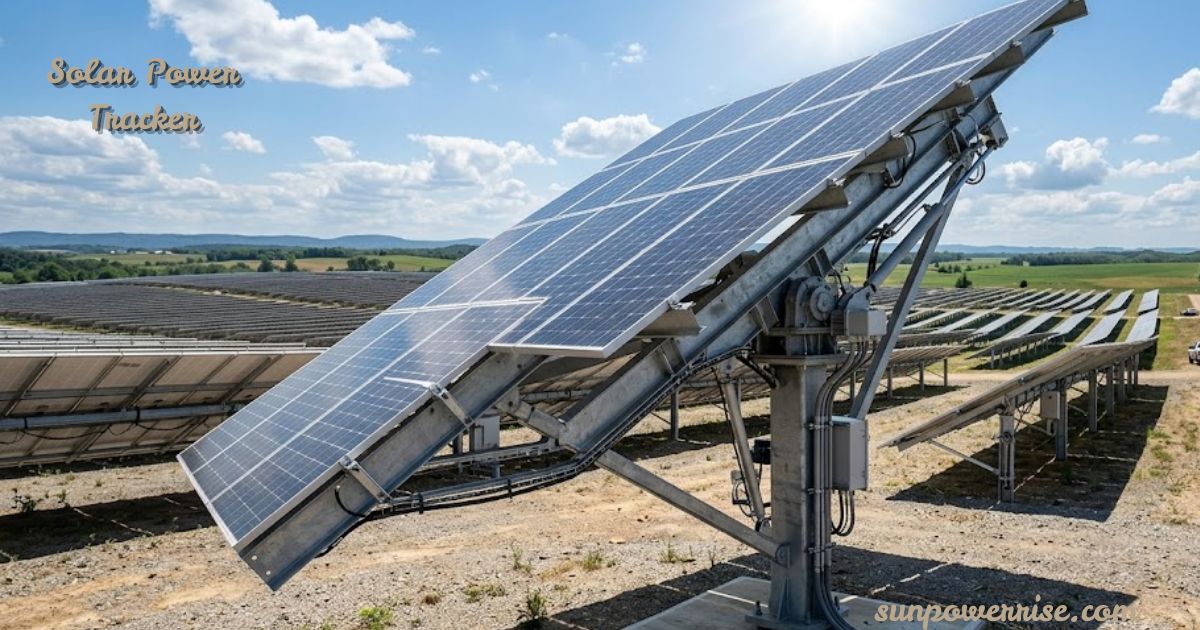
A solar power tracker is a motorised or fluid-driven mount that tilts solar panels throughout the day so they keep facing the sun directly, instead of sitting fixed at one angle. Because the panel stays closer to perpendicular with the sun’s rays for longer, a tracked system typically produces 20–45% more electricity over a year than the same panels bolted to a static frame the exact gain depends on whether it’s a single-axis or dual-axis unit, and on your latitude.
Trackers show up mostly on solar farms, commercial rooftops and large ground-mount installs rather than on the average home, for reasons we’ll get into below.
We’ve spent years helping homeowners and local businesses across the north east get solar installed, and the tracker question comes up constantly usually from someone who’s seen a spec sheet quoting a big percentage uplift and wants to know if it’s worth paying for. The honest answer is: sometimes, and we’ll walk through exactly when.
How Do Solar Power Trackers Work?
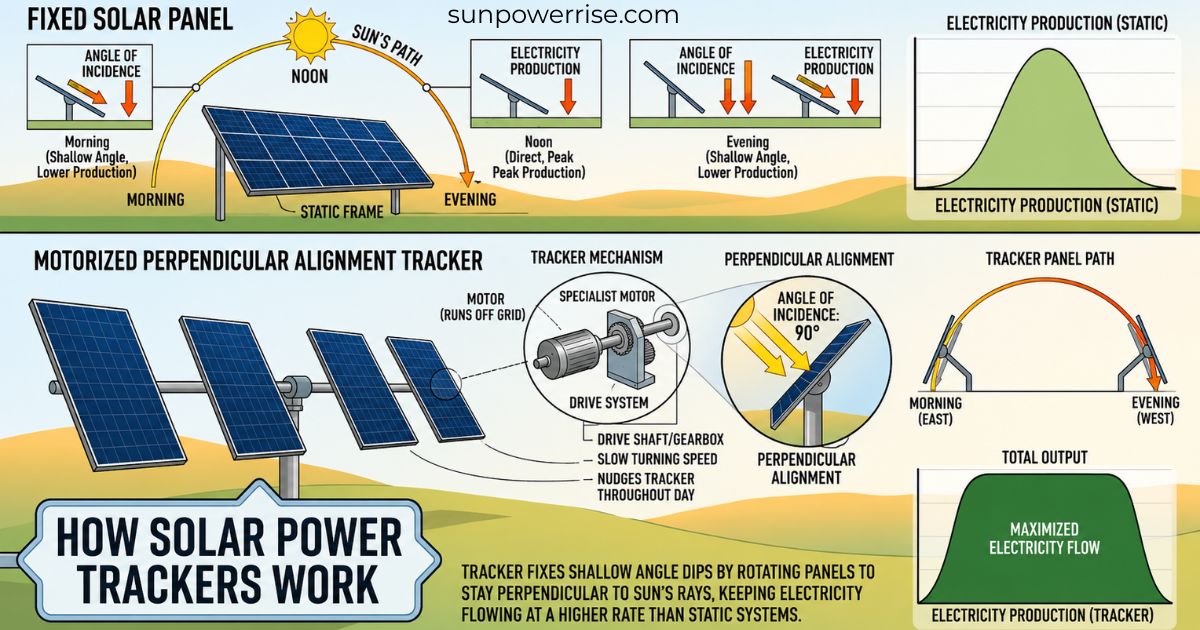
A fixed panel only sits at its ideal angle to the sun for a few minutes a day. The rest of the time, light hits it at a slant, and output drops. A tracker corrects for this by slowly rotating the panel to keep the sun’s rays as close to perpendicular as possible, which is what drives the extra output.
Most active trackers figure out where to point in one of two ways: light sensors that read the sun’s real-time position, or a pre-programmed astronomical path calculated from your exact location and the time of year. Sensors can get confused at dawn or in overcast conditions, so the better systems pair sensor input with the pre-set astronomical path as a fallback, switching between the two automatically.
Single-Axis vs Dual-Axis Trackers
A single-axis tracker moves one way typically east to west, following the sun from sunrise to sunset. A dual-axis tracker adds a second axis so the panel can also tilt north-south, correcting for the sun sitting higher in summer and lower in winter. That extra axis is why dual-axis systems squeeze out more energy year-round, but it also roughly doubles the mechanical complexity, which shows up directly in the price.
Most trackers on the market are “active,” using motors or hydraulic rams to physically move the frame. Manual trackers do exist you reposition them by hand a few times a day which keeps upfront cost low but limits the gain. Passive trackers use a sealed fluid that expands on the sun-facing side and pulls the frame round as it heats, a neat bit of low-tech engineering, though less precise than a motor-driven system and slower to respond in cold weather.
How Much Does a Solar Power Tracker Actually Cost?
This is the part most tracker guides skip, so here are real numbers. In the UK, single-axis tracking typically adds around £0.85 per watt on top of your panel cost for a 3kWp system that works out to roughly £2,500–£3,000, or about a third of the total system price.
In the US, trackers are more commonly priced per panel, usually $500–$1,000 each; a typical 15–25 panel residential array would add $7,500–$25,000 on top of standard installation costs. Dual-axis units sit further up that range again, given the extra motor and second axis.
On top of the purchase price, budget for ongoing upkeep: moving parts need servicing, so annual maintenance on a tracked system tends to run a few hundred pounds or dollars a year, against next to nothing for a fixed array.
Tracker vs Simply Buying More Panels
Here’s the comparison that actually settles most people’s decision, and it’s worth doing before anything else. Panel prices have fallen roughly 6–8% a year since 2010, while a tracker’s mechanical cost hasn’t dropped nearly as fast.
That means the maths that once favoured trackers has flipped: for most homes, the 20–35% output boost a tracker delivers now costs more than simply fitting 20–35% more panels in fixed position. If your roof or plot has spare space, adding panels is usually the cheaper route to the same extra output, with none of the moving parts to maintain.
Trackers earn their keep when that option isn’t available where land or roof space is genuinely limited, where you’re off-grid and need every extra percentage of output to meet demand reliably, or on larger commercial and utility sites where even a modest percentage gain translates into a meaningful amount of power and the land/installation cost favours squeezing more out of less space.
Is a Solar Power Tracker Right for Your Home?
Most rooftops simply aren’t built for one. Tracking hardware is heavy, needs a ground or pole mount with clearance to rotate, and in the UK is more likely to trigger a planning permission requirement than a standard fixed array worth checking with your local authority before you commit. That’s the real reason trackers cluster on ground-mounted commercial and utility projects rather than family homes, not just the added cost.
Real-World Yield: A London Case Study
To show what the uplift actually looks like month by month, here’s data from a 10kWp installation we’ve tracked in London, comparing a fixed array against single-axis and dual-axis tracking. In January, the fixed system produced 343kWh against 406kWh on single-axis (an 18% gain) and 495kWh on dual-axis (44%). February: 478kWh fixed vs 587kWh single-axis (23%) and 648kWh dual-axis (36%). By March: 772kWh, 930kWh (20%) and 980kWh (27%).
The pattern held through spring and summer. April: 1,023kWh fixed, 1,220kWh single-axis (19%), 1,278kWh dual-axis (25%). May: 1,262kWh, 1,537kWh (22%), 1,695kWh (34%). June: 1,185kWh, 1,416kWh (19%), 1,603kWh (35%). July, the sunniest month, saw fixed output of 1,214kWh climb to 1,504kWh on single-axis (24%) and 1,692kWh on dual-axis (39%).
Part of that gain is the obvious one better angle, more direct light. But there’s a quieter second effect: panels run more efficiently in cooler air, so the extra light a tracker captures in the early morning and evening, when temperatures are lower, adds a small additional bump on top of the angle advantage alone.
Core Features to Look For
If you’re comparing tracker units, the features that matter most are: a biaxial (dual-axis) mechanism if you want maximum yield; astronomical control calibrated to your exact coordinates, rather than sensor-only; remote monitoring; a track-back function that prevents panels from shading each other at low sun angles; and a warranty of at least 20 years, since you’re buying moving parts that need to survive two decades outdoors.
FAQs
Which solar power tracker is the best?
The best solar power tracker depends on your needs. Dual-axis trackers offer maximum efficiency, while single-axis trackers are more affordable and low-maintenance for most homes.
How do I track my solar panels?
You can track your solar panels using a motorised tracking system that follows the sun’s movement, boosting energy output throughout the day.
What is a solar tracker?
A solar tracker is a device that orients solar panels to follow the sun, capturing more sunlight and generating more power like giving your panels their own eyes to chase the light.
How much does a solar tracker cost?
A solar tracker typically costs between $500–$3,000 depending on size and type, with dual-axis models priced higher for greater precision.
Is a solar tracker worth it?
Yes, a solar tracker can be worth it. It boosts energy production by up to 25–35%, helping you get more value from every ray of sunshine.