

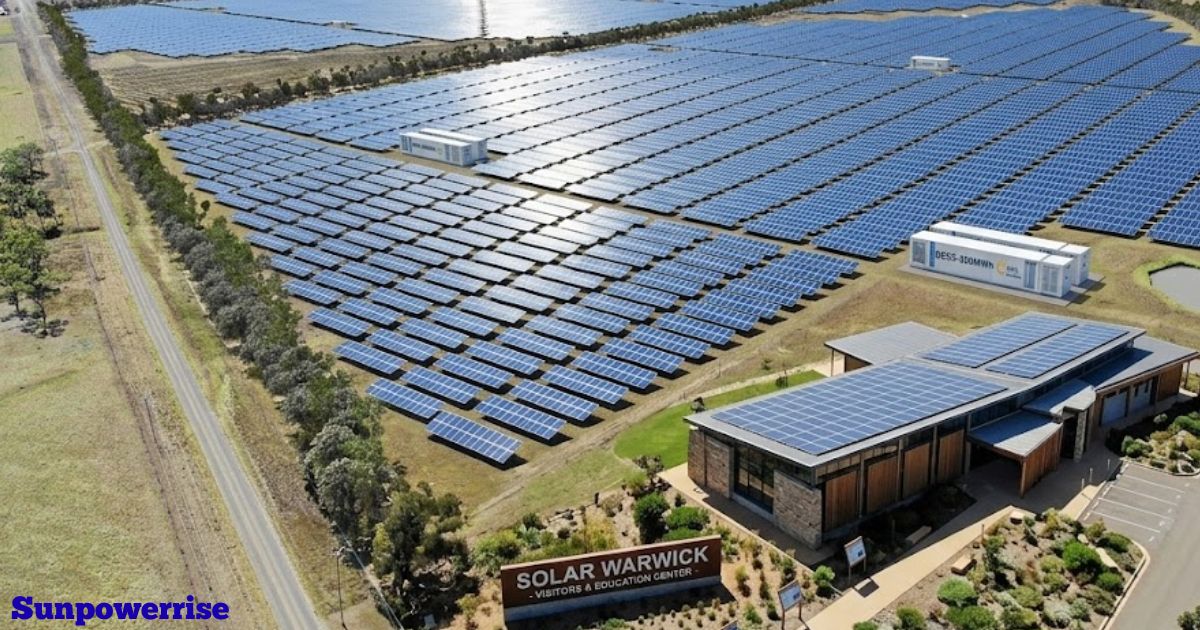
My visit to the Solar Warwick site left me amazed, because the University of Queensland turned the opening of this 64-megawatt solar farm into one of the most exciting projects the Vice-Chancellor has led in eight years, calling it fantastic proof of integrated thinking and knowledge leadership toward a better world.
Solar Warwick
Every year, this Solar Warwick Farm system will produce 160 GWh of clean power, with rows of solar panels stretching almost 300 kilometres if you lined them up end to end, helping UQ move closer to its goal of achieving net-zero emissions through renewables.
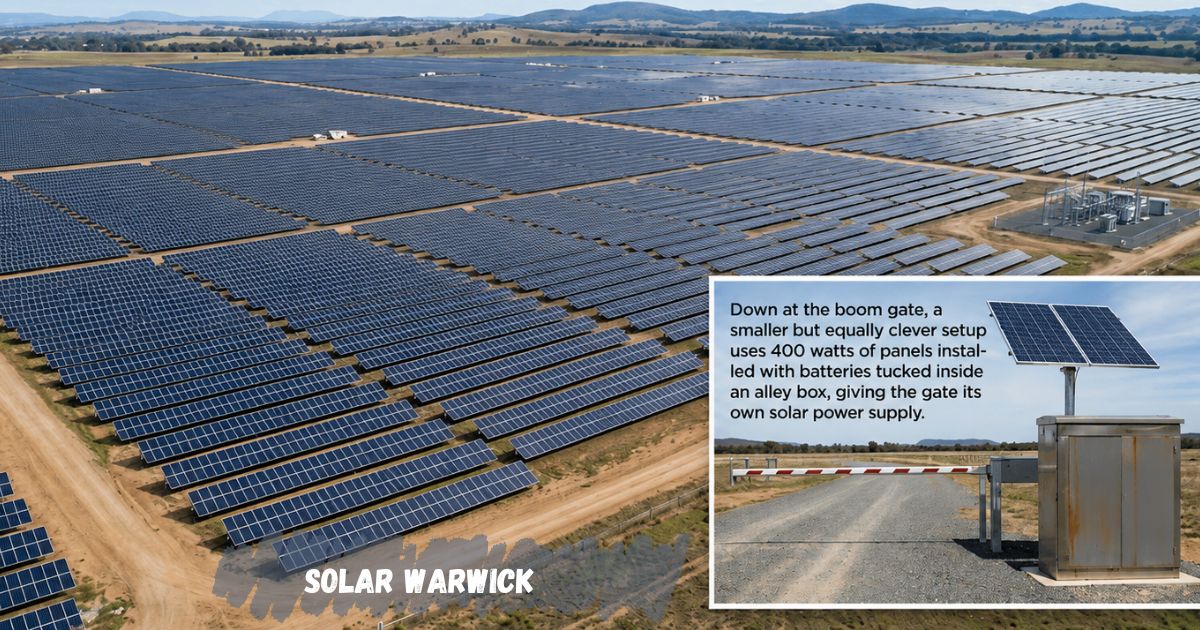
Down at the boom gate, a smaller but equally clever setup uses 400 watts of panels installed with batteries tucked inside an alley box, giving the gate its own solar power supply.
History & Background of UQ Solar Projects
UQ has come a long way since 2011, when the first installation appeared on a multi-story car park at 1.22 megawatts, quickly becoming the largest rooftop solar installation in Australia for years, alongside solar panels placed on the Heron Island research station.
Gatton Solar Farm followed in 2015 at 3.3 megawatts, then the built Solar Warwick Farm arrived in 2020, covering an area of 150 hectares at 64 megawatts.
This size includes 200 thousand panels arranged into 2500 tracker rows, each row part of the tracker rows network spread across the site.
System Design & Tracking Technology
The system design at Warwick relies on single-axis tracking technology and single-axis trackers built with NX Horizon and true capture system technology, letting engineers track the sun as it rises in the east each morning and sets in the west each evening.
Researchers at Gatton Solar Farm researched solar tracking technologies and TrueCapture technology, gathering learnings about the costs of infrastructure against energy yield, and concluded single-axis trackers were the best option because these high-tech, smart technology panels stow before a storm, stow flat overnight to cut shading and wind damage, and track each other to enhance performance and generation.
This compromise brings real benefits to the national energy market, where pricing volatility often peaks during morning and evening shoulder periods, so the constructed system helps optimize outputs at this location while supporting further research.
Energy Market Participation & Net Zero Goal
The university set a big, bold goal of 100 renewables, and the solar fund behind Solar Warwick Farm at 64 megawatts became an active participant in the energy market as a true energy generator, no longer just paying a monthly bill.
UQ sites now sell energy into the grid at the same price and buy back power to capture excess revenue, offsetting the combined energy demand and energy usage across the day while easing the cost of energy through surplus solar and surplus solar energy sold at peak times.
Once the sun sets, UQ turns to energy storage technologies such as batteries and hydrogen to offset the higher cost of power needed during the evenings.
Research Potential
Because UQ owns and operates this asset, the research potential at Warwick feels almost limitless, and any researcher can dream up a project, whether that means setting up a cloud cam to forecast clouds or studying how solar panels affect output across the site.
Data here is never commercial-in-confidence, because UQ likes to share freely with students, staff, researchers, and international collaborators who all get access for their own studies. Integrating 64 megawatts into the grid brings real challenges, yet that significant hurdle turns Warwick into a living laboratory for everyone involved.
Long-Term Asset & Community Impact
The Solar Warwick Farm stands as a 30-year asset, sending electricity into the grid and operating for 30 years while positively impacting the local Warwick community.
The visitor centre will also stand for 30 years, and every dollar this solar farm saves for UQ can flow straight into teaching and research, creating a lasting positive impact. I’ve watched similar projects elsewhere, and few deliver value this steadily, this quietly, for three decades straight.
Agrivoltaics
From the initial design work, Laura and her woolly residents, the sheep, became part of the plan, with livestock roaming this solar farm site to optimise use of the land.
This agricultural space brings mutual benefits, since grazing sheep keep grass down while the facility gets accepted more easily by the surrounding farming community.
Future Outlook for Utility Solar in Australia
Utility solar in Australia faced real challenges before 2018, but growth has been ramping up exponentially ever since. With immense sunlight across the country, Australia sits ideally positioned to become a powerhouse for solar generation, and I foresee solar infrastructure expanding fast over the next decade.
The future of solar utilities looks bright, and I stay confident this momentum will only continue to build.
Panel Maintenance & Cleaning
Panel maintenance matters because dirty panels sitting in shade, covered by dust, or blocked by bags floating through the air space will lose capacity fast, and covering just 10 percent of the surface can drop charging capacity by 70 percent.
Washing the face of the panels with normal water, a little detergent, and a soft bristle brush like the one used on car paint keeps them clean, followed by a light wash of clean water to rinse away any residue.
The fixtures stay waterproof and soldered, so there’s no need to get the back wet, which makes the whole setup pretty maintenance-free.
Boom Gate Solar Power System & Adjustment
At the Solar Warwick site, this rig gives the boom gate its own solar panel power supply, with panels installed on bars offering three positions so you can adjust the angle by season without needing an angle finder, thanks to pre-drilled holes already lined up at a predetermined spot.
For workplace health and safety, this two-person job means backing bolts out with high tensile bolts using a 19mm deep socket and a driver on your cordless drill or tek gun, while someone stays with the panel in windy conditions near the road, then wind bolts back in once you reach 38 degrees for winter or an 86 degree angle for summer, sitting flat toward the road either way.
This system also runs on 400 watts of panels and batteries tucked in an alley box; gt hinges with nylon bushes keep it secure, just like on the heaviest gates, while switching to window mode maximises charging capacity and prevents swinging issues even when the wind picks up a job you repeat four times a year.
FAQs
How big is the Solar warwick Farm?
The Solar warwick Farm spans 150 hectares and generates 64 megawatts of power using over 200,000 solar panels.
Why does UQ use single-axis tracking technology at Warwick?
Single-axis tracking gives the best balance between infrastructure costs and the extra energy gained by following the sun from east to west.
How does Solar Warwick Farm help UQ reach net zero emissions?
The 64 megawatt farm offsets more than 100% of UQ’s combined energy demand, supporting the university’s 100% renewables goal.
How long will the Solar Warwick Farm operate?
The farm is a 30-year asset, sending electricity to the grid and generating savings that fund UQ teaching and research.
How often does the boom gate solar panel need adjusting?
The panel angle should be adjusted four times a year to match seasonal changes from 38 degrees in winter to 86 degrees in summer.