

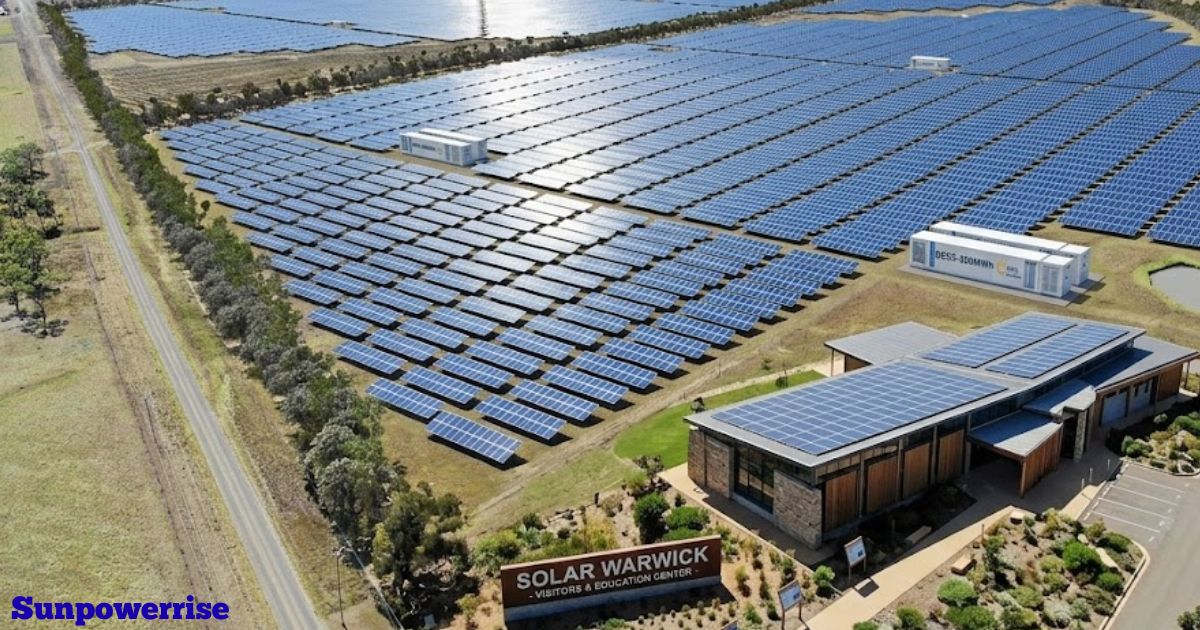
Solar Warwick is a 64-megawatt solar farm owned and operated by the University of Queensland (UQ), built on roughly 150 hectares near the town of Warwick in Queensland, Australia.
It began operating in 2020 and generates about 160 gigawatt-hours of clean electricity a year. It is the biggest step in UQ’s plan to run entirely on renewable power. It is also a research site, a grazing paddock for sheep and a 30-year investment in the local community.
The Scale in Numbers of Solar Warwick
The site holds around 200,000 panels, mounted on 2,500 tracker rows. Laid end to end, those rows would stretch close to 300 kilometres. That output helps UQ move toward net-zero emissions and cut the amount it pays for grid electricity.
At the opening, UQ’s Vice-Chancellor described it as one of the most rewarding projects of his eight years in the role. He presented it as proof that research, operations and leadership can work together toward a better future.
How UQ Got Here
Warwick is the latest in a series of UQ solar projects.
2011: A 1.22 MW system went onto a multi-storey car park. It was Australia’s largest rooftop solar installation for several years.
Heron Island: Panels were also installed at the university’s research station.
2015: The Gatton Solar Farm followed at 3.3 MW.
2020: Solar Warwick arrived, at nearly twenty times the size of Gatton.
Single-Axis Trackers
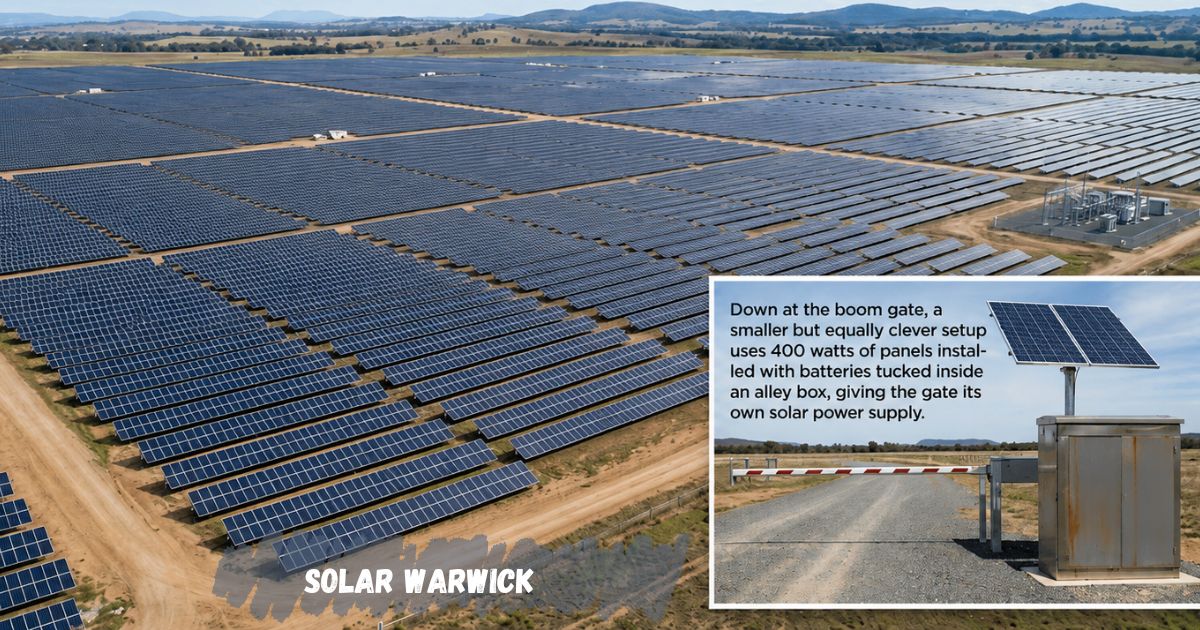
Solar Warwick uses single-axis tracking, built on NX Horizon trackers with TrueCapture software. The panels follow the sun from east in the morning to west in the evening instead of sitting at a fixed angle.
UQ researchers tested several tracking options at Gatton first. They compared infrastructure cost against extra energy yield and concluded that single-axis trackers offered the best balance. The system also protects itself: panels tilt to a protective position ahead of storms and lie flat overnight to reduce wind stress and shading between rows. The trackers coordinate with one another so the whole array performs better together.
Tracking also suits the electricity market. Prices in Australia tend to spike in the morning and evening shoulder periods. A tracking array produces more at those times than a fixed one, so it earns more when power is most valuable.
Playing in the Energy Market
Before Solar Warwick, UQ was simply a customer paying a monthly bill. Now it is an energy generator as well. Backed by a dedicated solar fund, the farm sells power into the grid, and UQ’s campuses buy power back at the same price. This lets the university offset its combined demand across the day, and surplus solar sold at peak times brings in extra revenue.
Solar cannot cover the hours after sunset, so UQ is looking at batteries and hydrogen to supply evening power and avoid the higher prices then.
A Living Laboratory
Because UQ owns the asset outright, researchers face few barriers to using it. Projects could include a cloud camera to forecast shading, or a study of how weather and panel layout affect output across the site.
The data is not locked behind commercial confidentiality. Students, staff and international collaborators can all use it. Connecting 64 MW to the grid is a real technical challenge, and that challenge is part of what makes the site useful for research.
Sheep on the Solar Farm
Livestock were part of the design from the start. Sheep, including a flock associated with a staff member named Laura, graze between the rows and keep the grass down without mowing. Farmers nearby also tend to accept the project more readily, because the land stays in agricultural use.
A 30-Year Community Asset
The farm is planned as a 30-year asset, feeding the grid for three decades. A visitor centre on site is planned to last just as long. Every dollar the farm saves UQ can go back into teaching and research, so the benefit reaches the university and the Warwick community for a long time.
Keeping Panels Clean and Working
Solar panels lose output quickly when they are dirty, shaded or blocked. Dust and debris blowing across the surface can hurt performance. In smaller systems, shading just 10 percent of the surface can cut charging capacity dramatically, by as much as 70 percent in some setups.
Cleaning is simple: Wash the face of the panel with clean water and a little mild detergent.
Use a soft-bristle brush, the kind you would use on car paintwork. Rinse with clean water to remove any residue.
The fixtures are waterproof and soldered, so the back of the panel does not need washing. The whole system needs little maintenance.
The Solar-Powered Boom Gate
Solar Warwick also includes a smaller system at the boom gate. It runs on 400 watts of panels, with batteries housed in an alley box, so the gate has its own power supply.
The mounting bars have three pre-drilled positions, so the panel angle can be changed by season without any measuring tools. Adjusting takes two people, for safety.
One person removes the high-tensile bolts with a 19 mm deep socket on a cordless drill or tek gun, while the other holds the panel steady, which matters in wind near the road. Once the panel is at the right angle, the bolts go back in. The angles are 38 degrees for winter and 86 degrees for summer, and the panel faces the road either way.
Hinges with nylon bushes keep the gate secure, as on heavy-duty gates. Switching to “window mode” maximises charging and stops the panel swinging in strong wind. The job is repeated four times a year.
Where Utility Solar Is Heading in Australia
Australian utility-scale solar struggled before 2018, but growth has accelerated since. With abundant sunshine, the country is well placed to become a major solar generator. Projects like Warwick show how universities can generate power, test new technology and feed the results back into the industry.
FAQs
How big is the Solar warwick Farm?
The Solar warwick Farm spans 150 hectares and generates 64 megawatts of power using over 200,000 solar panels.
Why does UQ use single-axis tracking technology at Warwick?
Single-axis tracking gives the best balance between infrastructure costs and the extra energy gained by following the sun from east to west.
How does Solar Warwick Farm help UQ reach net zero emissions?
The 64 megawatt farm offsets more than 100% of UQ’s combined energy demand, supporting the university’s 100% renewables goal.
How long will the Solar Warwick Farm operate?
The farm is a 30-year asset, sending electricity to the grid and generating savings that fund UQ teaching and research.
How often does the boom gate solar panel need adjusting?
The panel angle should be adjusted four times a year to match seasonal changes from 38 degrees in winter to 86 degrees in summer.