

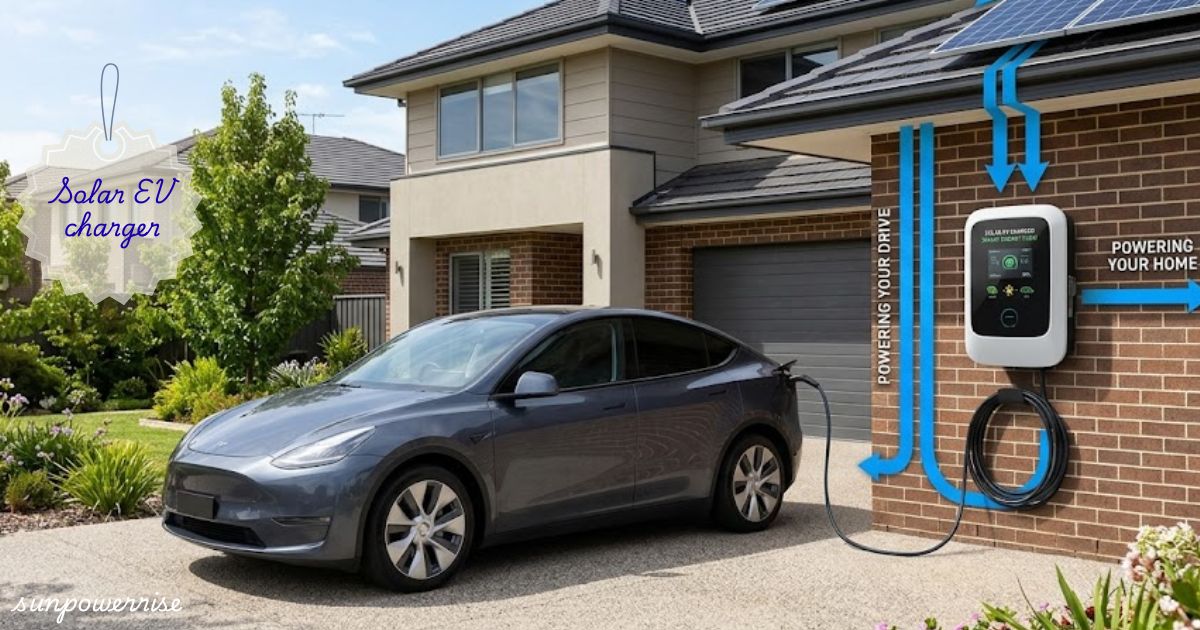
A solar EV charger sounds like a small device, but it changes how a house runs. This guide walks through the real practicalities and limitations of using solar energy for your EV, without any misconceptions or hype.
There is a real difference between just plugging in at night and running a true solar-powered EV charging setup. A basic solar PV system can produce excess solar energy that either gets sold back to the grid or stored in a home battery storage system.
Even portable options exist, like the Go Sun EV solar charger, which is roughly the size of a small box, about 4 ft wide and 6 in tall, sometimes described as 5 in off the roofline.
What Is A Solar EV Charger?
At its core, a solar EV charger takes whatever power your panels generate electricity for and sends it straight to your electric vehicle’s battery instead of wasting it.
Normally, your house uses that power first, running everything from your lights and TV to your kettle and toaster, and only the leftover solar energy goes toward charging.
Without an export tariff or storage, any surplus solar would otherwise sit unused, so this setup effectively turns waste into free miles.
There is one catch worth knowing about solar ev charger is the minimum power required to start a session is 1.44kW, so once your house needs are met, your system must still clear that bar, or some chargers pause charging while others quietly draw a small amount of energy from the grid to cover the shortfall.
Your results always depend on solar panel placement and the number of solar panels installed, so if you are still deciding, it is worth reading our in-depth guide on solar panel installation before committing.
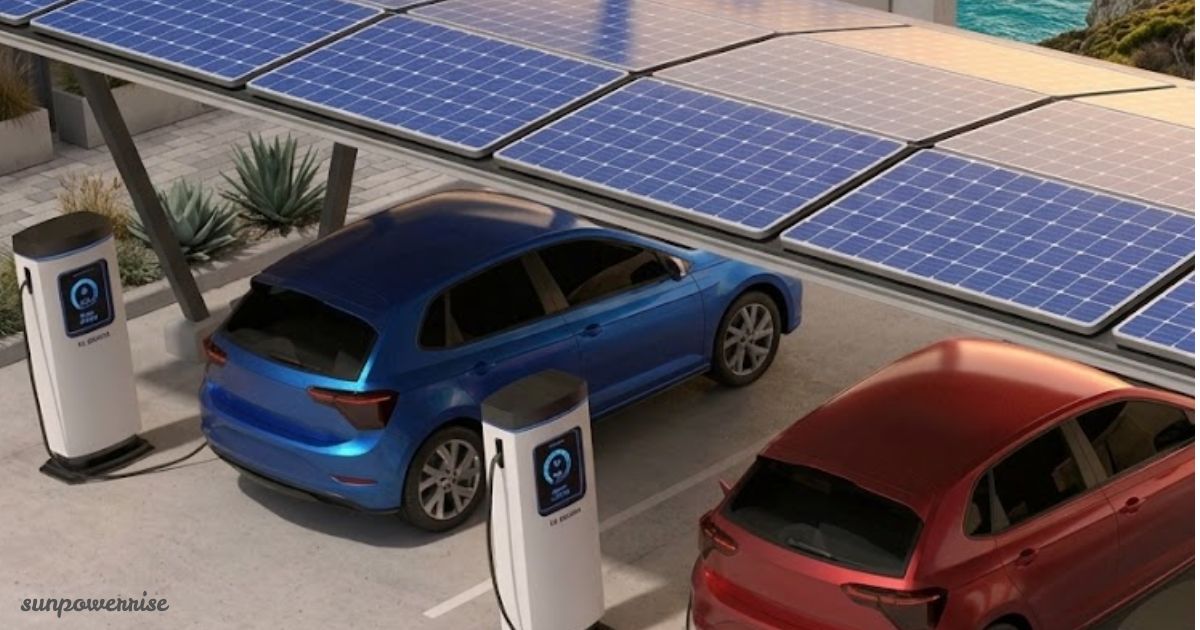
Go Sun EV Solar Charger
The Go Sun EV solar charger mounts directly onto standard roof crossbars, folding out to about 20 ft long when fully open yet staying compact when closed.
Inside sits a 1500W lithium iron phosphate battery built to store sunshine until it is ready to dispatch energy into your car through the built-in inverter, with the EVSE cable tucked neatly inside the case.
Rapid One-Minute Deployment
Setup time of solar ev charger runs about one minute: unlock the case, lift it on the gas strut, begin unfolding solar panels, connect the cable, and turn on charging.
If the weather turns windy, adding the wind deflectors and getting them clipped takes just an extra minute, and I usually pull out the extension to keep the array flat, since a hatchback roofline needs that adjustment to properly absorb sun from a flat perspective.
Off-Grid Versatility Beyond EVs
This unit clearly targets people who believe in a solar-powered future and want real clean tech, starting with EV owners but stretching well beyond them.
Its 110-volt household outlet that works for off-grid life too, whether that means a van, an overlanding rig, a truck, or a Jeep, all backed by an 1100-watt solar array paired with that same battery for genuine pound-for-pound solar-powered punch.
Mileage Math & Daily Range Yield
On range, I want to cut through the naysaying early: this setup realistically delivers about 500 miles of free solar energy per month just from the sun hitting the vehicle itself.
That works out to around 20 miles a day, similar to making a gallon of gas daily, and used across roughly 80% of the year, it adds up to about 7,000 miles of range in a year, which comfortably covers the average electric car’s typical 17 miles a day and meets most annual driving needs.
Robust Security & Theft Deterrence
Theft comes up constantly, so here is the honest answer: it is far easier to steal the whole vehicle than to pry this device off the roof.
The case locked shut uses a genuinely durable lock that resists tampering; everything stays bolted down, and hand tools struggle to cut metal here, while a built-in GPS tracking device working much like an Apple AirTag helps recover the product if it ever disappears.
Realistically, theft stays minimal, since this attracts far less attention on a sidewalk than a kayak or bicycle would from passing tweakers.
Drag Penalty vs. Solar Dividend
On aerodynamics and weight, mounting this on the roof of vehicles adds roughly 5 in extra height above a standard roof rack or roof bars, which remains negligible during normal driving around town below 50 mph. At highway speeds, expect closer to a 10% hit on energy consumption, which makes it less ideal for long road trips.
R&D Validation & Backer Incentives
This is a durable, effective, and secure product from a team pushing genuine solar-powered mobility. Backers can even join through Start Engine to invest in Go Sun and earn a reward of one unit for a $5,000 investment, supporting what the company calls the world’s first company built around the footprint of vehicle design and true solar-powered independence.
Can A Solar Panel Charge An Electric Car?
Yes, a solar panel can genuinely put power into an electric car, but timing is the real catch most people overlook. Solar panels work like a fuel pump that only opens during the daytime, so if you plug in during the evening or overnight, you are often pulling from the grid instead of your roof. Grid electricity fills that gap unless you have proper energy storage at home.
When I assumed my panels would cover my charging no matter what time I plugged in. Once I understood how power generation actually works, I realised a battery storage system was the missing piece for true EV owners who want full electricity independence.
Charge An Electric Car From House Solar Panels
Daytime charging of your EV can be done through a household solar panel, but it is not always an efficient way. Daily solar production shifts constantly; on a sunny day, a 4kW system might generate 16 kWh, good for roughly 40–50 miles of EV range, but cloudy days cut that output fast.
Most UK EVs carry batteries sized between 40–60 kWh, so a single daytime solar charge rarely fills a larger battery on its own. Evening charging without a storage battery simply pulls energy from the grid, plain and simple.
Are Solar Panels Enough To Charge An Electric Car?
Whether solar panels are truly enough depends heavily on your setup and your everyday driving habits. A short daily commute of about 20–30 miles fits comfortably within a modest solar system, but longer drives usually demand grid top-ups or a much larger solar system paired with battery storage.
Without stored power, most of your solar power simply feeds daytime home usage things like lighting and appliances, rather than reaching your EV battery. This is the core idea behind energy self-consumption, and it explains why two homes with identical panels can have completely different charging results.
How Many Solar Panels Do You Need To Charge An EV?
This is a fair question, and honestly, a rough guide helps more than exact math. For 20 miles of daily EV use, you need roughly 6 kWh, which usually means 2–3 panels rated around 250–300W each; for 40 miles, expect 12 kWh from 4–6 panels; and for 60 miles, plan on 18 kWh covered by 6–8 panels.
These numbers are estimates, and actual output always depends on roof orientation, shading, and the current season. Winter months produce noticeably less, so I always tell UK homeowners to build in a buffer rather than cutting it close on energy needed and solar panels required.
Can An EV Be Charged With Solar Panels Without The Grid?
Yes, but only with real home battery storage in place. Many brands of solar ev charger offer solar prioritisation, meaning they favour solar availability first, plus dynamic load management that balances home energy use automatically.
Smart scheduling lets you time charging around solar output peaks or cheaper electricity tariffs, but without a battery, you are stuck with only daytime charging or straight grid usage after dark for your EV charging.
FAQs
Can solar panels really charge an electric car?
Yes, solar panels can charge an EV, but timing matters since most charging happens at night while panels only generate during the day. Without battery storage, evening charging still pulls from the grid.
How many solar panels do I need to charge my EV?
It depends on your daily mileage: roughly 2–3 panels cover 20 miles a day, while 6–8 panels support 60 miles. Actual output varies with roof orientation, shading, and season.
Do I need a home battery to charge my EV with solar power?
Not strictly, but without one, you’re limited to daytime charging only. A battery lets you store excess solar energy and use it for night-time charging.
What is the minimum solar output needed for EV charging?
Most solar EV chargers need at least 1.44kW of surplus power to start a session. If output drops below that, some chargers pause while others draw a small top-up from the grid.
Which solar EV charger is best for tight budgets?
The Vchrgd Seven is the most affordable option, starting around £324 without installation, and still offers solid solar charging capabilities despite its basic design.