

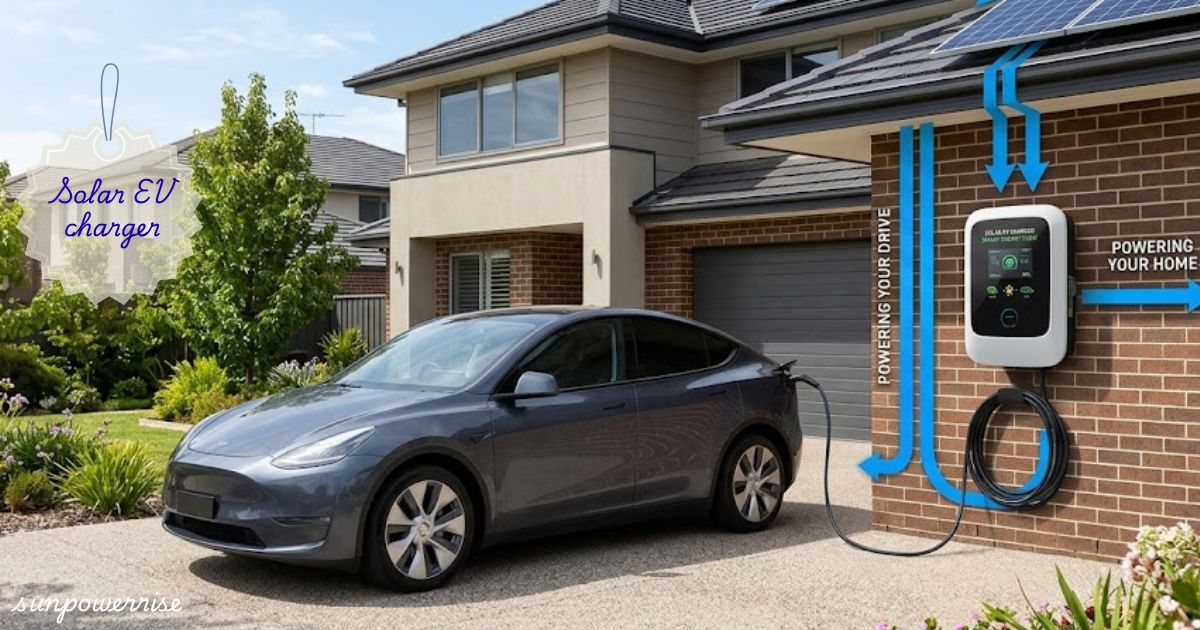
A solar EV charger is a home charging setup that sends electricity from your solar panels directly into your electric car instead of the grid, either by routing surplus solar power through a standard charger and inverter, or by using a dedicated solar-aware charger that automatically detects when your panels are producing more than your house needs and diverts that excess into your car.
In practice, it turns power that would otherwise be exported to the grid (often for as little as a few pence per kWh) into free miles.
This guide walks through what that actually looks like day to day: how much you really save, when solar charging works well and when it doesn’t, how much kit you need, and where a portable solar EV charger fits in all without the hype.
How Solar EV Charger Actually Works
Your solar panels generate electricity throughout daylight hours. Your house uses some of that automatically lights, kettle, fridge, whatever’s running and only the leftover, or “surplus,” is available for anything else. Without a solar-aware charger, that surplus either gets exported to the grid for a small payment or sits unused if you’re not on an export tariff. A solar EV charger’s whole job is to catch that surplus and put it into your car instead of letting it go elsewhere.
Most chargers built for this use something called a CT (current transformer) clamp, fitted to your meter tails. It constantly measures how much electricity is flowing between your house and the grid, and tells the charger to speed up or slow down the charge rate in real time to match whatever surplus solar is available. This is what “solar diversion” or “solar prioritisation” actually means in charger spec sheets it’s not magic, it’s just a feedback loop between your meter and your charger.
One limit worth knowing: most chargers need a minimum of around 1.44kW before they’ll start a charging session at all. Once your house’s own usage is covered, your panels have to clear that bar too, or the charger either pauses or quietly tops up the shortfall from the grid. This is one of the more overlooked practicalities of running one of these setups.
The Go Sun EV Solar Charger A Real-World Look
Beyond fixed home chargers, there’s a genuinely different category: portable solar EV chargers you mount on the vehicle itself. The Go Sun EV is one example, and it’s worth walking through because most guides on this topic never touch portable options at all.
It mounts onto standard roof crossbars and unfolds to roughly 20 feet when deployed, while staying compact when closed. Inside is a 1500W lithium iron phosphate battery that stores solar energy and dispatches it to the car through a built-in inverter, with the EVSE cable stored inside the case.
Setup takes about a minute in practice: unlock the case, lift it on the gas strut, unfold the panels, connect the cable, and charging begins. In windy conditions, clipping on the wind deflectors adds another minute or so, and on a hatchback roofline it’s worth extending the array flat so it can properly catch the sun.
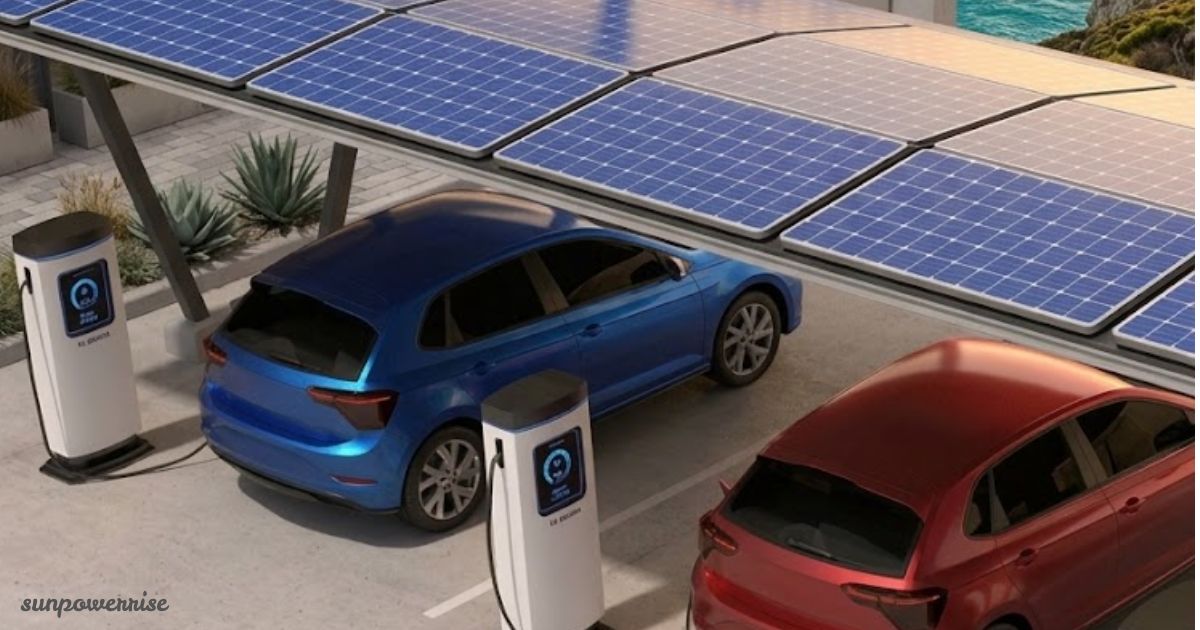
It’s aimed at people who want genuine off-grid solar capability, not just EV owners the 110-volt household outlet works for van life, overlanding, or as backup power, backed by an 1,100-watt array and that same battery.
On range: realistically, this delivers around 500 miles of free solar-generated range a month directly to the vehicle about 20 miles a day, used across roughly 80% of the year, adding up to around 7,000 miles annually. That comfortably covers the average EV’s typical daily mileage.
On theft: it’s genuinely harder to remove than to steal the car itself. The case locks shut with hardware that resists basic hand tools, and a built-in GPS tracker (similar in concept to an Apple AirTag) helps with recovery if it does go missing. It also draws far less attention on the street than something like a bike or kayak would.
On drag: mounting it adds roughly 5 inches of height over a standard roof rack. Below 50mph that’s negligible. At motorway speeds, expect around a 10% hit to energy consumption, so it’s less suited to long road trips and better suited to daily local driving.
Can Solar Panels Actually Charge an Electric Car?
Yes but timing is the real catch. Solar only generates during daylight, so plugging in overnight without a home battery means you’re charging from the grid, not your roof, regardless of how many panels you own. A 4kW home system might produce around 16kWh on a good day enough for roughly 40-50 miles of range but that drops fast on cloudy days, and most UK EV batteries (typically 40-60kWh) won’t fill from a single day’s solar generation alone.
Is It Actually the Cheapest Way to Charge?
This is the part most homeowners never get told: charging directly from solar often isn’t the cheapest option, even though it feels the most virtuous. If you’re on a Smart Export Guarantee tariff, you might earn somewhere in the region of 15p/kWh for exported solar. Meanwhile, EV-specific overnight tariffs like Intelligent Octopus Go offer rates as low as roughly 7p/kWh.
If your export rate beats your cheap overnight rate, you’re often financially better off exporting your solar and charging on the cheap tariff instead while still using your panels to offset daytime household use. It’s not a universal rule (tariffs and personal usage patterns vary), but it’s a genuine trade-off worth running the numbers on before assuming “solar charging = maximum savings.”
How Many Panels Do You Actually Need?
As a rough guide: 20 miles of daily driving needs about 6kWh, typically 2-3 panels around 250-300W each. 40 miles needs roughly 12kWh (4-6 panels). 60 miles needs around 18kWh (6-8 panels). These are estimates actual output depends on roof orientation, shading, and season, and winter generation drops noticeably, so build in a buffer rather than sizing to the bare minimum.
Charging Without the Grid
It’s possible to run largely grid-free, but only with a home battery. Many solar-ready chargers offer solar prioritisation and dynamic load management, letting you schedule charging around solar peaks or off-peak rates. Without storage, you’re limited to daytime solar charging or grid power after dark there’s no way around that physics.
FAQs
Can solar panels really charge an electric car?
Yes, solar panels can charge an EV, but timing matters since most charging happens at night while panels only generate during the day. Without battery storage, evening charging still pulls from the grid.
How many solar panels do I need to charge my EV?
It depends on your daily mileage: roughly 2–3 panels cover 20 miles a day, while 6–8 panels support 60 miles. Actual output varies with roof orientation, shading, and season.
Do I need a home battery to charge my EV with solar power?
Not strictly, but without one, you’re limited to daytime charging only. A battery lets you store excess solar energy and use it for night-time charging.
What is the minimum solar output needed for EV charging?
Most solar EV chargers need at least 1.44kW of surplus power to start a session. If output drops below that, some chargers pause while others draw a small top-up from the grid.
Which solar EV charger is best for tight budgets?
The Vchrgd Seven is the most affordable option, starting around £324 without installation, and still offers solid solar charging capabilities despite its basic design.