

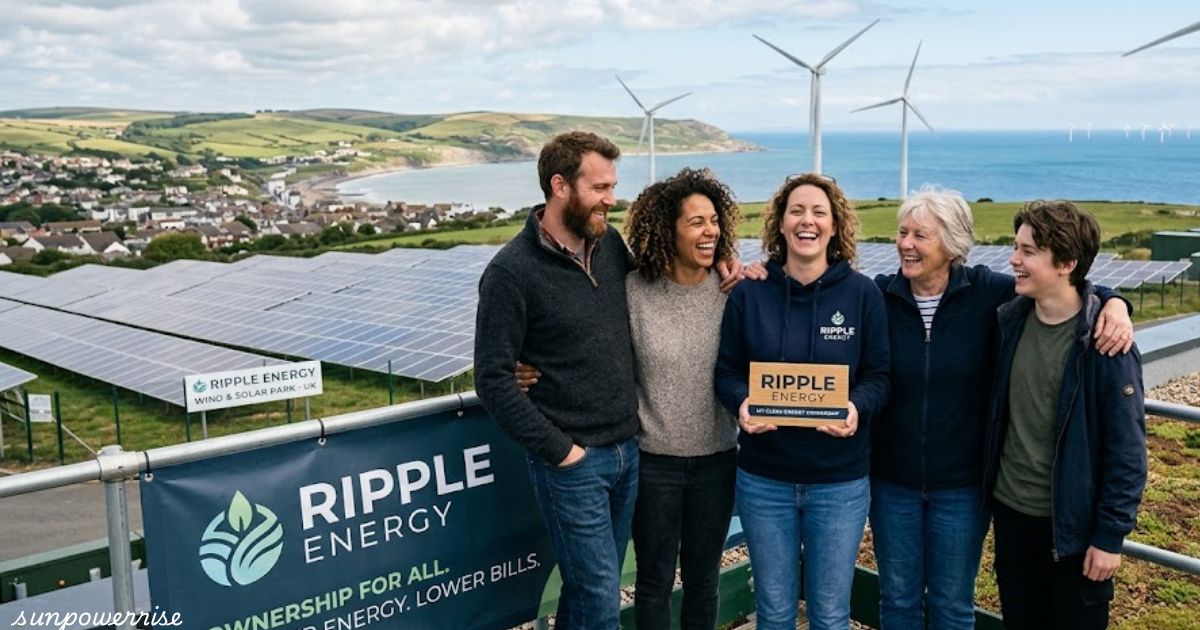
The business model behind Ripple Energy always depended on steady management fees covering operating costs, but lower-than-expected revenue hurt this plan badly. Just weeks before the appointment of administrators, chief financial officer Will Dodd left the platform, leaving British consumers wondering whether their money stayed safe somewhere in the system.
Coop4 members felt the impact hardest, since a source confirmed they reported the misappropriation of funds to Action Fraud after accounting discrepancies surfaced in late 2024, and the company faced mounting pressure from creditors as cash flow issues worsened.
About Ripple Energy
Ripple started as a UK-based company with one goal: making renewable energy ownership available at an affordable price for anyone hoping to help the planet while cutting energy bills.
It offers a smart alternative to the steep upfront cost of installing your own solar panels, and since 2017, CEO Sarah Merrick’s mission has centred on keeping green energy ownership simple, affordable, and accessible.
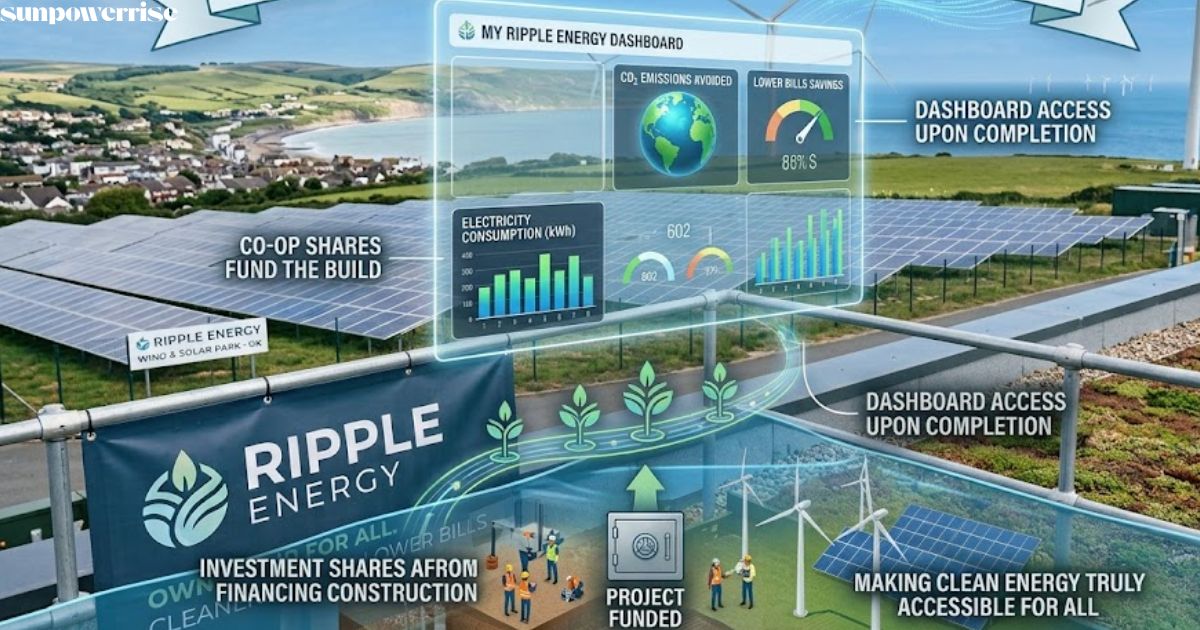
When you buy shares in a Ripple Energy project, whether a solar park or wind farm, you join the Ripple co-operative and effectively own a piece of that renewable energy project.
That investment funds the construction of the wind farm or solar park, which Ripple manages from start to finish. Once the project completes and starts generating electricity, you get access to a personal dashboard tracking your electricity consumption, CO2 output, and running savings.
As a cooperative operating in the renewable space, Ripple’s broader vision stays focused on making clean energy ownership truly accessible.
Separate Entities Mean Investment Should Be Safe
The flagship site, Graig Fatha in South Wales, still spins its single wind turbine for 905 people, staying fully operational even after the Ripple news broke.
Similarly, the Kirk Hill wind plant in Ayrshire kept generating power without disruption, giving shareholders some reassurance that construction projects like Derril Water Solar Farm and Whitelaw Brae Wind Farm wouldn’t collapse overnight.
Kane Watkinson, a Coop3 member, described a rough 30 days of silence before the Derril Water board finally reached out about the plant’s status.
On 20 April, 1st Energies contacted former Ripple customers after buying the technology platform out of administration for £75,000 plus VAT, though details about what exactly changed hands among the co-op boards stayed murky.
Chair Ben Reade pushed hard to reassure everyone that the coop remained structurally separate, insisting the project showed excellent progress toward energisation by late spring.
Simon Peltenburg, the ex-chief project officer, joined the board on a contractor basis to keep momentum going, and the group set up separate communication channels away from the old system, urging community coop investors to register on a newly established page.
The administrator’s report listed £77,963.63 owed to Derril Water, making it the only named creditor in the whole document, and honestly, that level of transparency helped calm nerves better than any generic assurance could.
Ripple Projects
Graig Fatha Wind Farm, the flagship project near Coedely in South Wales, launched in March 2022 and features one 2.5-megawatt wind turbine. Its 900 owners, sometimes counted as 905 people, saved an average of £977 in 2023, and Merrick called it a huge success for boosting UK energy security while cutting reliance on fossil fuels.
The Kirk Hill Wind Farm, located in Ayrshire, west Scotland, launched in early 2024 with eight turbines rated at 2.35 MW each, generating up to 18.8 MW, enough to power roughly 20,000 homes, and drawing in 5,600 members.
Derril Water Solar Park, sited in north-west Devon, England, arrived in summer 2024 with 70,000 panels producing 42 megawatts peak, enough for about 14,000 homes.
Ripple plans multiple projects every year and hopes to launch its first project outside the UK by 2025. Both Kirk Hill and the original Graig Fatha site remained operational and unaffected, having gone live back in 2020, even while later projects stayed under construction.
Investment Costs
Your Ripple investment trims energy costs based on the size of your home, your energy consumption habits, and how much you commit upfront. Merrick explained that savings track closely with future electricity prices, meaning higher prices boost your potential project savings, and covering 100% of usage could save you up to 25% on yearly bills. Push that to 120% of your annual electricity consumption and you’ll typically bank around £200 per year.
The Ripple Energy share price rises with the size of the project you want to own, so the Ripple Energy calculator helps estimate costs upfront.
A three-bedroom home using 2,700 kWh annually might need 1,102 Watts for about £1,902, plus an arrangement fee and the standard £25 reservation fee outlined in the share offer document. Any surplus electricity rolls straight into future bills, and your shareholding locks in wholesale cost of electricity benefits for the full operational lifetime of 40 years.
Breaking down a kilowatt hour, you typically pay 35 pence, split between 15 pence in wholesale cost and 20 pence covering network, transmission, government policy, and VAT.
Ripple estimates production costs at just 2.3 pence, leaving a margin of 12.7 pence that gets shared with members as real savings, though this doesn’t touch the retail price’s non-generation costs.
Return On Investment
The payback period hinges heavily on the wholesale price of electricity for your chosen project; higher prices mean a shorter payback period, while lower ones stretch it longer.
Comparing a typical growth investment, putting £1,000 in at a 4% annual interest rate for 40 years with compound interest yields £4,939 using any standard online calculator.
Since Ripple pays monthly rather than compounding, it resembles an income investment more closely, returning roughly £1,600 in monthly payments plus your original investment back, for a total return near £2,600.
Ripple also factors in residual ownership, meaning the notional decreasing value of the park reduces your share by about 3% per year, hitting zero by year 33, though payments continue through year 40.
Under this model, that same £1,000 lands closer to £2,239 in real terms. Interestingly, Graig Fatha investors from 2020 actually saw better-than-expected overall returns thanks to rising wholesale electricity prices, though a policy change affecting renewables pricing could reverse that trend for wind and solar alike.
How Do I Invest In Ripple
Getting started means paying a £25 reservation fee to choose a project and hold your spot in the queue. Next, you’ll want to read the share offer document carefully, covering costs, fees, and terms, before you decide how much to invest, up to 120% of your annual household consumption.
Then you buy your share, a one-off cost to join the project co-operative that funds ongoing construction.
You’ll also need to check your energy supplier, switching to a Ripple partner like Octopus or E.ON Next if needed, before you can enjoy the benefits.
Once the project turns operational, tracking your electricity generation and bill savings through your member’s dashboard becomes second nature, with surplus power that simply rolls over.
The recent public share offer for Derril Water solar park closed on 16th of May, drawing 7,000 people to its webinar amid genuinely high demand, so I’d always urge proper due diligence and a careful read of the share offer documentation, since your minimum investment of £25 stays unregulated and carries real money at risk, unlike a standard bank account.
Is Ripple Energy A Good Investment?
If you genuinely care about renewable energy and feel open to switching energy suppliers, then investing in Ripple could suit you well, though your real return on investment shows up as potential savings on electricity bills over time rather than a lump sum.
Merrick suggests reading about existing members and their experiences as one of the best ways to judge fit, alongside every project’s individual offer document and factor to consider for that individual project.
The Kirk Hill Share Offer document offers a solid example, and Ripple backs it all up with a frequently asked questions section on its website, plus a live support function and contact form for anyone still unsure.
Buying More Shares
Good news: your Ripple investment stays tied to you as an individual, not your address, so moving home never disrupts anything, though you should notify your new energy supplier so the benefits transfer smoothly to your new electricity bills.
Merrick confirmed members can’t directly sell shares, but they can withdraw membership, and Ripple will try to match that request with other members looking to increase ownership; memberships can’t be withdrawn until two years of operation have passed, though a handful have exited early after moving abroad.
Buying more works similarly, since you can purchase more shares through your Ripple account dashboard, though availability depends entirely on project capacity and whether a new project or extra watts become available.
Demand from existing investors can create a long wait for limited shares in new wind and solar projects. If you’re moving house, the investment moves with you automatically, though transfer to another person only happens after death, letting you nominate up to four beneficiaries.
Withdrawal of your entire holding remains possible with Ripple board agreement and a spot on the waiting list, though your share ownership declines naturally as capital gets paid back, dropping to about 70% of original value after 10 years and roughly 40% of original value after 20 years; withdrawal simply isn’t allowed during the first two years of operation.
Energy Supplier Partners
Joining stays possible even without one of the approved partners, though you must switch energy supplier before the energisation date so your electricity counts toward your bill.
Ripple gives unbiased information on its supply partners and tariffs, letting you make an informed choice without pressure toward any particular option, and the whole switching process works smoothly online.
Energy providers partnering with Ripple keep growing, with more expected to join soon, and each month, a payment item appears on your bill reflecting offsetting electricity consumption.
The size of payments naturally varies, climbing highest in summer thanks to peak generation, based on the Derril water site’s generation profile; a July payment can run five to six times higher than a December payment, even though your household electricity consumption stays fairly constant year-round, something worth real consideration before you invest.
Next Steps
Before you invest, take real time to weigh your own circumstances, any tax implications, and what you’re hoping to achieve over the long run.
Renewable energy projects genuinely offer a rare chance to support lower electricity bills while contributing to a sustainable future. Use the Ripple energy calculator to get a personalised estimate of potential savings based on your specific circumstances and everyday energy usage.
FAQs
What has happened to Ripple Energy?
Ripple Energy entered administration in March after serious accounting discrepancies and mounting cash flow issues, leaving many cooperative members anxious about their investments.
What is Sarah Merrick doing now?
Sarah Merrick, founder and CEO of Ripple Energy, built the company’s mission around affordable, accessible green energy ownership; her current role post-administration remains unclear from available reports.
What is Ripple Energy?
Ripple is a UK-based cooperative that lets British consumers buy shares in renewable energy projects like wind farms and solar parks to enjoy cheaper green electricity.
Who bought Ripple Energy?
1st Energies bought Ripple out of administration on 20 April, paying £75,000 plus VAT, though this appeared to cover mainly the technology platform.
Is Ripple a good investment?
Ripple can be a worthwhile investment for environmentally motivated people seeking long-term savings, though recent insolvency concerns mean careful due diligence matters more than ever.