

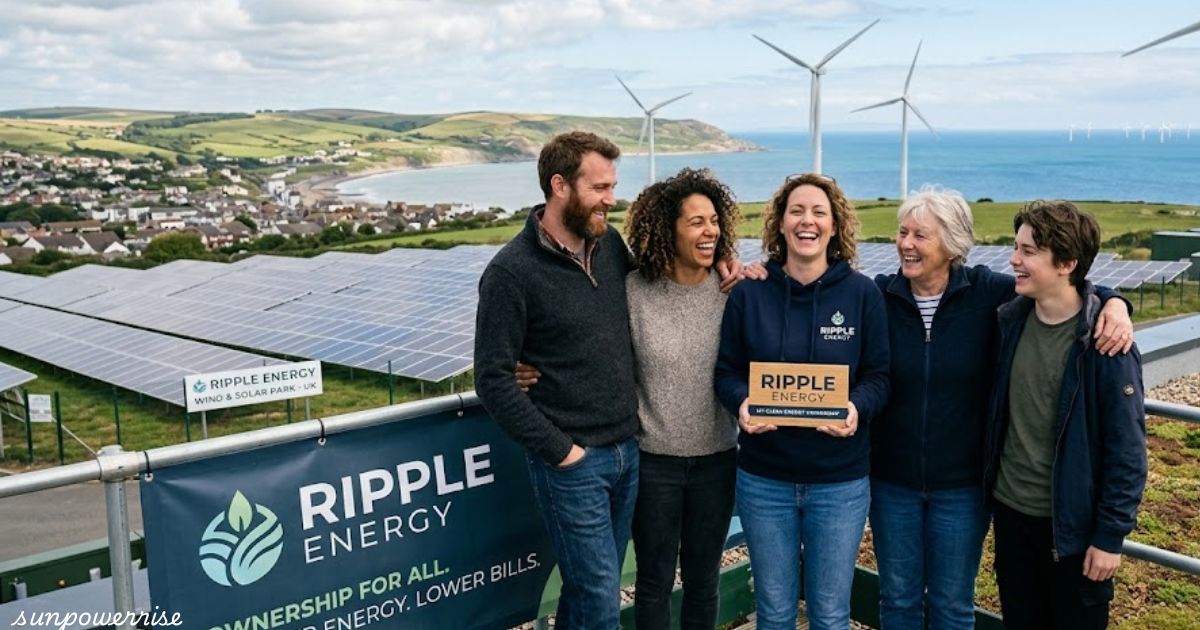
Ripple Energy is a UK cooperative that lets households buy shares in wind farms and solar parks so they can own a slice of renewable power and bank the savings on their energy bills. Founded by Sarah Merrick in 2017, it built three live projects Graig Fatha, Kirk Hill and Derril Water before the company behind the platform collapsed into administration in March 2025.
The wind farms and solar parks themselves didn’t disappear; they’re owned by separate cooperatives, not by Ripple Energy Limited. But the company that managed them, took the fees, and ran the member dashboard did go under, and that’s left thousands of investors trying to work out what’s actually theirs, what’s at risk, and what happens next.
About Ripple Energy
The pitch was simple: rooftop solar isn’t an option for renters or anyone without a south-facing roof, so Ripple let people buy a stake in a large-scale wind or solar project instead.
Members joined a co-operative tied to a specific site, and once that site started generating, their share of the output was credited against their electricity bill through a partner supplier like Octopus or E.ON Next. It was pitched as roughly 75% cheaper than installing your own panels, and it genuinely built a loyal following of tens of thousands of members across three projects by the time things went wrong.
What Actually Happened
The business depended on management fees from the co-ops covering its running costs, and that revenue came in lower than projected for too long. Behind the scenes, things had been fraying for a while: accounting discrepancies surfaced in late 2024, and members of the fourth cooperative tied to the still-under-construction Whitlaw Brae wind farm reported suspected misappropriation of funds to Action Fraud after the irregularities came to light.
Pressure from creditors mounted as cash flow kept deteriorating, and just weeks before administrators were called in, chief financial officer Will Dodd left the company, which did nothing to settle investors’ nerves.
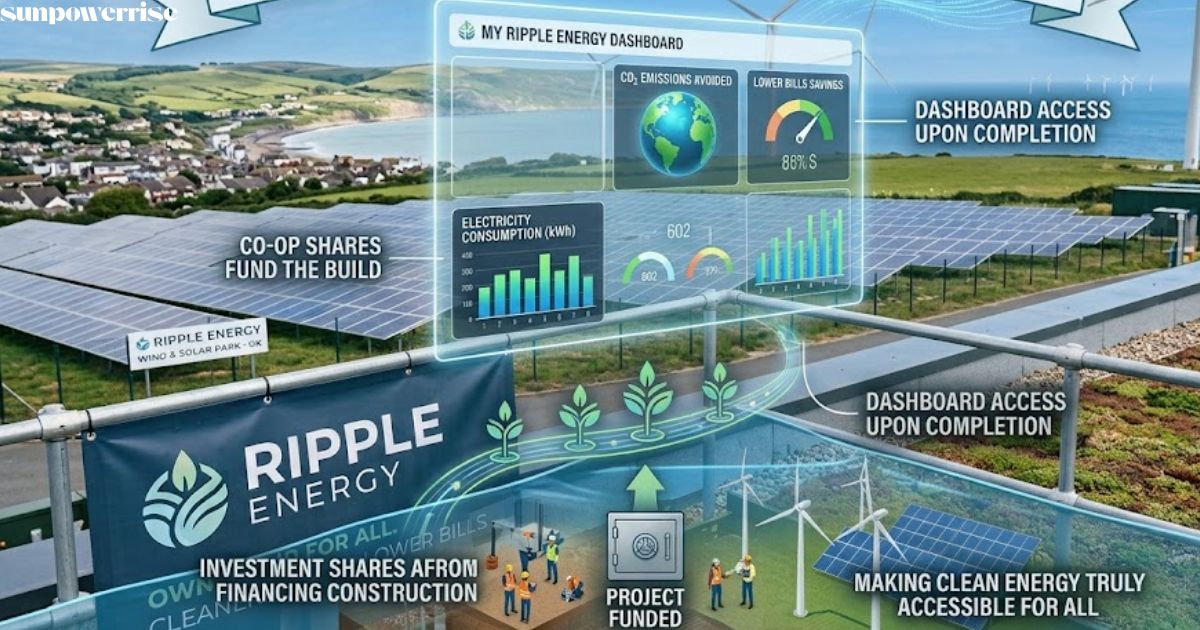
Begbies Traynor was formally appointed administrator on 17 March 2025. Within a few weeks, on 3 April 2025, the administrators completed a sale of the company’s technology platform and certain other assets to 1st Energy Technologies Limited. Reports of a £75,000-plus-VAT price tag for that deal have circulated, though the administrators’ own paperwork doesn’t itemise it that way, so treat that figure cautiously until it’s confirmed in an official filing. What is confirmed is that 1st Energy began reaching out to former Ripple customers shortly afterwards, in mid-to-late April, to explain what the handover meant for their accounts.
This is not a closed case. Begbies Traynor has since published a formal proposals document (May 2025) and two further progress reports, the most recent dated May 2026 meaning the administration has now run for well over a year, considerably longer than the roughly 12 months these processes typically take. Anyone relying on older coverage of this story is working with stale information.
Were the Wind Farms and Solar Parks Affected?
Largely, no and this is the one piece of reassurance that’s held up. Graig Fatha, the flagship single-turbine site in South Wales, kept turning for its roughly 905 owners without interruption. Kirk Hill in Ayrshire did the same. Because Ripple Energy Limited never owned these assets, it only managed them on behalf of separate co-op boards; their insolvency didn’t automatically drag the wind farms down with it.
That didn’t mean a smooth ride for everyone, though. One Derril Water investor, Kane Watkinson, has described roughly a month of near-total silence from the board before anyone explained what was actually happening to the solar park’s construction timeline.
Derril Water’s chair, Ben Reade, has since pushed back hard against the uncertainty, insisting the project was still on track for energisation and standing up a new, independent communications channel so members weren’t relying on Ripple’s old systems. Former Ripple chief project officer Simon Peltenburg joined the Derril Water board on a contractor basis to keep the build moving. For what it’s worth, the administrators’ own report lists just one named creditor tied to the site roughly £78,000 owed to Derril Water, which, while not nothing, is a far smaller exposure than many investors feared.
Whitlaw Brae is the exception worth knowing about. Unlike the other three projects, it wasn’t included in the 1st Energy asset sale, and it remains the one site where the path forward is genuinely unresolved; it’s also the project tied to the Action Fraud report mentioned above. If you’re invested here, don’t assume your position mirrors Graig Fatha or Kirk Hill members; it doesn’t yet.
What Should You Actually Do Now?
If you’re a creditor meaning Ripple owes you money it hasn’t paid you’ll need to file a proof of debt with the administrators, though as an unsecured creditor you’ll be near the back of the queue and a payout, if there is one, could take a long time. If you paid by credit card and the amount was over £100, Section 75 of the Consumer Credit Act makes your card provider jointly liable, so that’s usually your strongest route to recovering money directly rather than waiting on the administration.
Debit card payments can sometimes be recovered through a standard chargeback claim with your bank, and PayPal payments can be disputed within 180 days of the transaction. It’s also worth knowing that your personal data was transferred to 1st Energy as part of the asset sale standard practice in an insolvency, and legal under UK GDPR, but worth being aware of if you’re wondering why a new company suddenly has your details.
The Original Investment Model, Briefly
For anyone newer to this story: investing meant paying a £25 reservation fee, reading the share offer document for your chosen project, then buying enough capacity to cover up to 120% of your annual household electricity use; a typical three-bedroom home might buy around 1,100 watts for under £2,000.
Savings came from the gap between the wholesale cost of the electricity your share generated and the much higher retail price you’d otherwise pay, credited monthly and skewing toward summer months when generation peaked. Shareholdings weren’t sellable outright, only withdrawable after two years of operation, with value declining gradually over the project’s 40-year life as capital was paid back.
That model worked well for early investors, particularly those in Graig Fatha who benefited from rising wholesale prices after 2020. Whether it survives in its current form under new ownership is the open question every existing member is now watching closely and one this page will keep tracking as the administration progresses.
FAQs
What happened to Ripple Energy?
Ripple Energy Limited, the company that managed the co-op projects, went into administration on 17 March 2025 after revenue fell short of what was needed to cover its running costs, compounded by accounting discrepancies and mounting creditor pressure.
Are the wind farms and solar parks still operating?
Yes. Graig Fatha and Kirk Hill kept generating power without interruption throughout the administration, because the sites are owned by independent cooperatives, not by Ripple Energy Limited itself.
Who bought Ripple Energy’s technology platform?
1st Energy Technologies Limited acquired the platform and certain other assets from the administrators on 3 April 2025, and began contacting former members shortly after to explain the transition.
Is my money safe if I’m a Ripple Energy investor?
Your shareholding in a specific co-op (like Graig Fatha or Kirk Hill) is generally unaffected, since those entities are separate from Ripple Energy Limited. However, any money owed directly by Ripple Energy such as unpaid refunds or fees — is handled through the administration process, where unsecured creditors are paid last, if at all.
What’s different about the Whitlaw Brae project?
Whitlaw Brae wasn’t included in the 1st Energy asset sale and remains unresolved. It’s also the project connected to a misappropriation report filed with Action Fraud, making it the one site investors should watch most closely.
How do I try to recover money I’m owed?
If you paid by credit card and the amount was over £100, Section 75 of the Consumer Credit Act may let you claim directly from your card provider. Debit card payments can sometimes go through a bank chargeback, and PayPal payments can be disputed within 180 days. Otherwise, you can file a proof of debt as an unsecured creditor in the administration.
Is Ripple Energy still a good investment going forward?
That depends on how the administration resolves and who ends up managing the co-ops long-term. Early investors, like those in Graig Fatha, have seen solid returns so far, but the model’s future under new ownership is still an open question as of the latest 2026 progress report.