

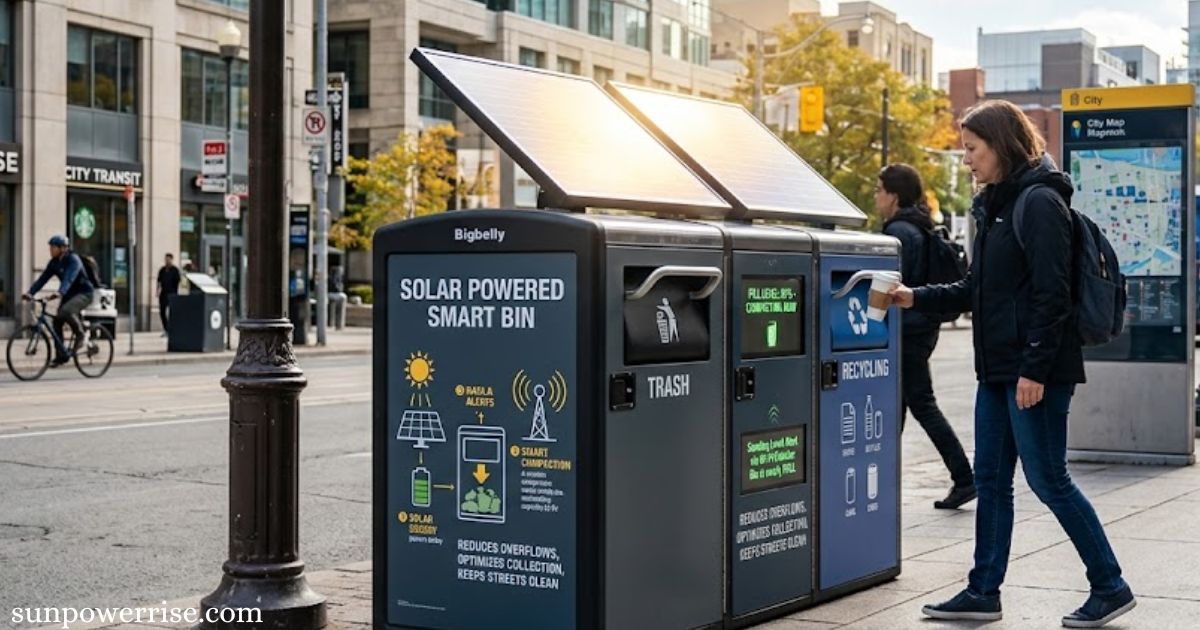
Solar bins use energy captured from the sun to run a built-in compactor, quietly crushing rubbish down as it piles up while a sensor keeps track of how full the container is. So what do solar bins do differently from a standard one?
That single combination of free power plus self-compaction lets one solar bin do the job of five to eight ordinary street bins, and it’s why councils across the UK are swapping them in one street at a time.
I’ve spoken with waste teams who say this shift saves real time on the street, especially where fly tips and graffiti already stretch their day thin. Big brands like Bigbelly bins and Big Belly Bins now sit in key visitor locations such as parks, town centres, and even inside a National Park.
What Do Solar Bins Do
A single unit can hold up to five times more rubbish than an old-style bin of the same footprint, which is the whole reason councils send collection crews out far less often.
The savings ripple outward too fewer journeys mean less fuel burned and less pollution from the collection vehicle itself.
Every unit works quietly in the background: a solar panel on top feeds power into an internal system that compacts waste and checks its own fullness without anyone opening the lid.
Once a bin nears capacity, it sends an alert to the cleansing team, who can then keep an eye on the whole network remotely instead of guessing which bins need a visit.
What happens when there’s no sun?
This is the part most bin suppliers gloss over. A fully charged solar bin typically keeps running for around three to four weeks on stored battery power alone, though the exact figure depends on how often the compactor fires and how heavily the bin gets used.
In practice, this means a stretch of grey British weather isn’t going to strand a bin mid-cycle; the battery buffer is built with exactly that in mind.
Trial Results and Long-Term Sustainability
The trial covered visitor locations chosen specifically because they see heavy footfall, and the aim was straightforward: prove that solar-powered bins with automatic compaction could handle the volume. Newer models report back on how full each bin is getting in real time, so collection teams stop wasting trips on bins that are half empty.
Once trialled, the results held up, and the gains landed on both sides of the ledger: environmental targets and the budget line councils have to answer for every year.
How Do Solar Bins Work?
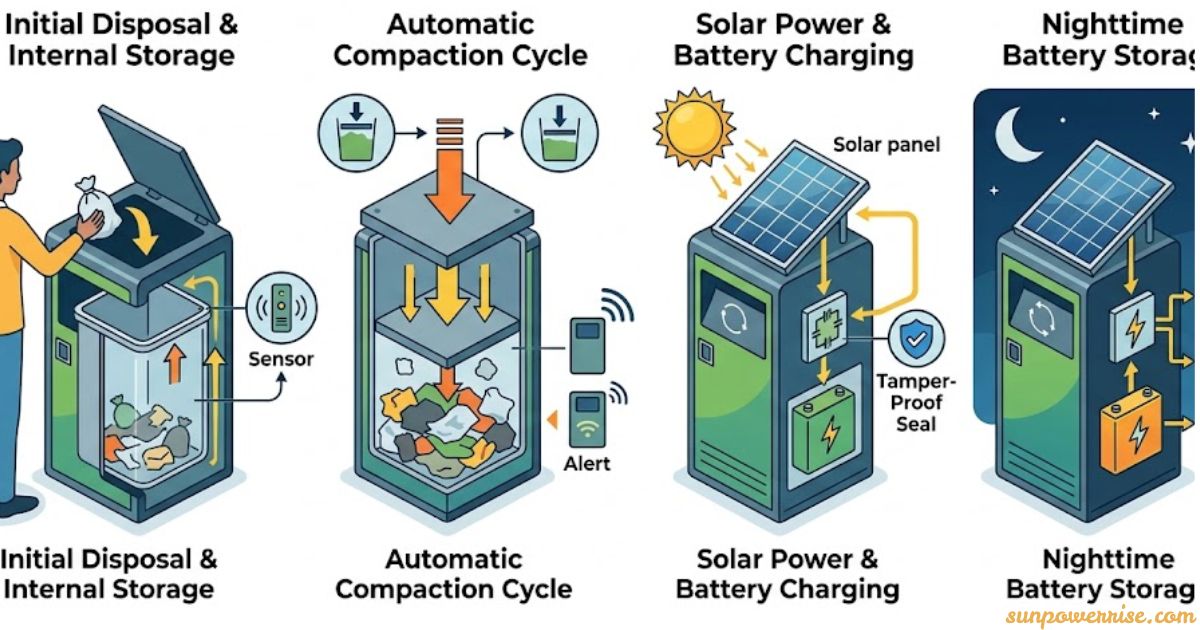
Initial Disposal and Internal Storage
Here’s what actually happens the moment rubbish goes in, since this is really the mechanical heart of the whole system.
Litter falls into an enclosed inner container and sits there until a compaction plate is triggered it doesn’t fire on every single deposit, only once the bin reaches a certain fill level or a set number of drops.
Automatic Compaction Cycle
When the system decides it’s time, the plate presses down with real force, squashing the material and freeing up space for more. This cycle repeats on its own until the bin is genuinely full, at which point it fires off an alert rather than letting anyone find out the hard way.
The numbers behind the squeeze
Manufacturer specs across the market put the compaction force at roughly 600kg, enough to shrink most waste down to somewhere between a fifth and a seventh of its original volume.
Units generally come in three standard sizes: 120L, 240L, and 360L, built from steel around 2mm thick with a powder coating for weather resistance. None of that detail changes what the bin feels like to use on the street, but it’s exactly what a procurement team wants before signing off on an order.
Solar Power and Nighttime Battery Storage
The solar panel sits on top of the unit, angled typically around 10 to 11 degrees both to catch the most sun over the course of a day and to stop people using the panel as a shelf for their rubbish.
Energy collected during daylight doesn’t just power the bin in that moment; it charges an internal battery so the whole system keeps running through the night.
Both the battery and the panel are sealed away in their own compartment, kept out of reach to prevent tampering or vandalism. Some manufacturers now build these as spill-proof battery units specifically to reduce the risk of leaks or fire if the casing is ever damaged.
Key Features of a Solar Bin
Waste Hatch & Foot Pedal
Every solid bin design comes down to a handful of parts working together, and those parts are the clearest way to see what a solar bin actually does day to day.
At the front sits the waste hatch a flap that opens either by handle or with a simple foot pedal at the base, so nobody has to touch anything to dispose of rubbish.
Internal Compactor & Secure Container
Inside is the enclosed inner basket that holds the waste, blocks wind, and keeps vermin out. The compaction plate presses straight down to compress whatever’s been thrown in, turning loose rubbish into something far more compact.
A lockable door keeps the whole thing secure, so only trained collection staff using a key or the release pedal can actually open it and empty the bin.
Smart Sensors & Remote Monitoring
Internal sensors track fill level constantly and feed that data to LED indicators on the outside, so anyone walking past can see at a glance whether the bin is nearly full.
Behind the scenes, that same data goes out over a wireless link to a central platform, which is how staff get alerts and monitor the whole fleet without a single physical check.
Most current systems now pair this with a mobile app, giving operators live updates and capacity alerts from their phone rather than a desktop dashboard a small shift, but one that changes how quickly a team can actually respond.
Why Are Authorities Switching to Solar-Compacting Bins?
Upfront Investment and Long-Term Value
So why make the switch, once the cost is weighed against what these bins actually do? I’ve put this question directly to waste managers, and the answer usually comes down to hard numbers rather than trends: a higher waste capacity, an internal compaction mechanism, and real savings on staff time that add up fast enough to offset the higher sticker price.
The Trade-Off Nobody Talks About
Here’s the part most vendor pages leave out entirely: the upfront cost is the real sticking point, and it doesn’t disappear just because the long-term maths works out.
Multiply the per-unit price across a borough that needs hundreds of bins, and the total rollout cost can be enough to stall a project before it starts, which is exactly why some councils and site operators choose to hire units rather than buy them outright.
Hiring sidesteps the big capital outlay, though it usually means waste collection and cleaning of the unit aren’t included and have to be arranged separately.
Buying outright makes more sense for a permanent, high-footfall site; hiring makes more sense for a trial, a seasonal location, or a council still building the budget case. Neither option is free of running costs; someone still has to service, clean, and eventually replace these units, and that ongoing line item is easy to leave out of the pitch.
Smarter Collection Routes
Field data backs this up: just-in-time collection means routes get planned around which bins actually need a visit, cutting pointless travel between sites.
That translates into less fuel burned, lower emissions, and fewer vehicle trips overall some vendors report collection-cost savings as high as 80% once routes are optimised this way, though the real figure depends heavily on how spread out a council’s bins are to begin with.
Staff get text and email alerts the moment a bin nears capacity, which means maintenance gets scheduled ahead of time instead of someone discovering an overflowing bin on their morning round.
Hygienic Public Experience and Immediate Results
None of this works without a smooth experience for the person actually using the bin. The foot pedal means no one has to touch a handle to dispose of rubbish, which is a small design choice that adds up to a genuinely more pleasant experience.
Councils that make the switch tend to see results almost immediately bins spend less time full, crews empty them less often, and the whole system runs leaner across the board.
Mechanical Emptying via Standard Wheeled Bins
A different kind of innovation came from the QCR Solar Bin, available for hire or purchase from Spring 2026. What sets it apart is simple: the inner container is a standard wheeled 240L bin, so crews with an existing fleet can empty it mechanically instead of lifting bags by hand a detail that matters a lot to councils juggling different waste needs across a patchwork of sites.
High-Footfall National Park Trials
Loch Lomond & The Trossachs National Park has spent years managing waste across sites under its direct control, testing new approaches to see how solar bins would hold up in a very different setting from a town centre.
Three units were installed at Balmaha, Luss, and the Duncan Mills Memorial Slipway at the start of September for a four-week trial. These sites were picked specifically because they see heavy visitor numbers and fall under the Park Authority rather than a local council or private landowner.
The Land Operations team tracked results closely throughout, and the day-by-day monitoring gave a genuinely clear picture of how the units performed under real conditions.
FAQs
What do solar bins do?
Solar bins collect litter and use solar-powered compaction to squash waste down, holding far more rubbish than a standard bin before it needs emptying.
How long does a solar bin run without sunlight?
A fully charged unit typically has enough stored battery to keep operating for three to four weeks, though this varies with how often the compactor cycles and how much the bin gets used. It’s built to comfortably ride out several days of overcast weather without missing a beat.
How does a solar bin know when it’s full?
Internal sensors monitor waste level continuously and send an alert to council or site staff once the bin reaches capacity, usually via a connected app or dashboard.
How much extra waste can a solar bin hold compared to a normal bin?
Most solar bins hold somewhere between five and ten times more waste than a standard bin of the same size, depending on the manufacturer and the type of waste going in.
Are solar bins expensive to install and run?
Yes, solar bins cost more upfront than traditional bins, and some models can cost thousands of pounds each to buy or lease.
Do solar bins help reduce collection costs for councils?
Yes, because crews only visit bins that are actually full, saving fuel, time, and reducing unnecessary collection trips.