

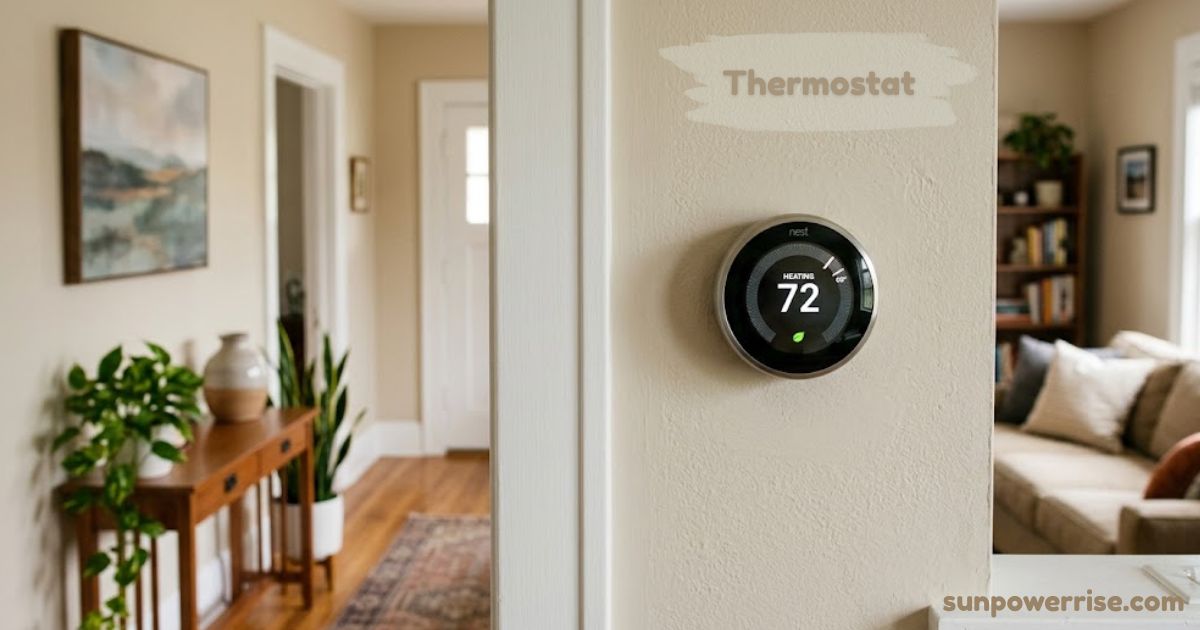
If you have ever stood in a cold hallway fiddling with a thermostat dial, wondering why the house still feels chilly, you already know how much a small box on the wall can shape your daily comfort. After years of testing different setups at home, I’ve learned that understanding what this device actually does saves both money and frustration.
What Is a Thermostat?
A thermostat is a small device that acts as the main control for any heating and cooling system, and it doesn’t just guess; it senses the ambient temperature in every room, then gives a command to turn on the boiler, air conditioning, or fridges whenever needed, and to turn them off once the job is done.
Unlike a thermometer, which only displays the air temperature without controlling anything, it works as the crucial component that helps you regulate your household’s comfort by comparing the current temperature against your set temperature, so when the temperature drops, the unit switches on the central heating right away.
Once the space feels warm enough, the same unit switches off the cooling system or heating system, which helps prevent overheating and keeps the sensor ready to read temperature changes accurately all day long.
How Does a Thermostat Work?
A room thermostat sends either an electrical signal or a wireless signal to your boiler whenever it detects a need for heat, and this simple message tells the heating system to spring into action and warm up the space until it can satisfy room comfort fully. Say you pick 21ºC as your desired temperature.
Once the home temperature falls short, the signal fires up the boiler and helps switch heating on, and the process continues without stopping until the room temperature finally matches your set temperature.
The moment the reading temperature hits that mark, the system will turn off heating automatically, which helps avoid wasting energy and stops the boiler from constantly running while still managing to deliver heat exactly where you need it.
Types of Thermostats
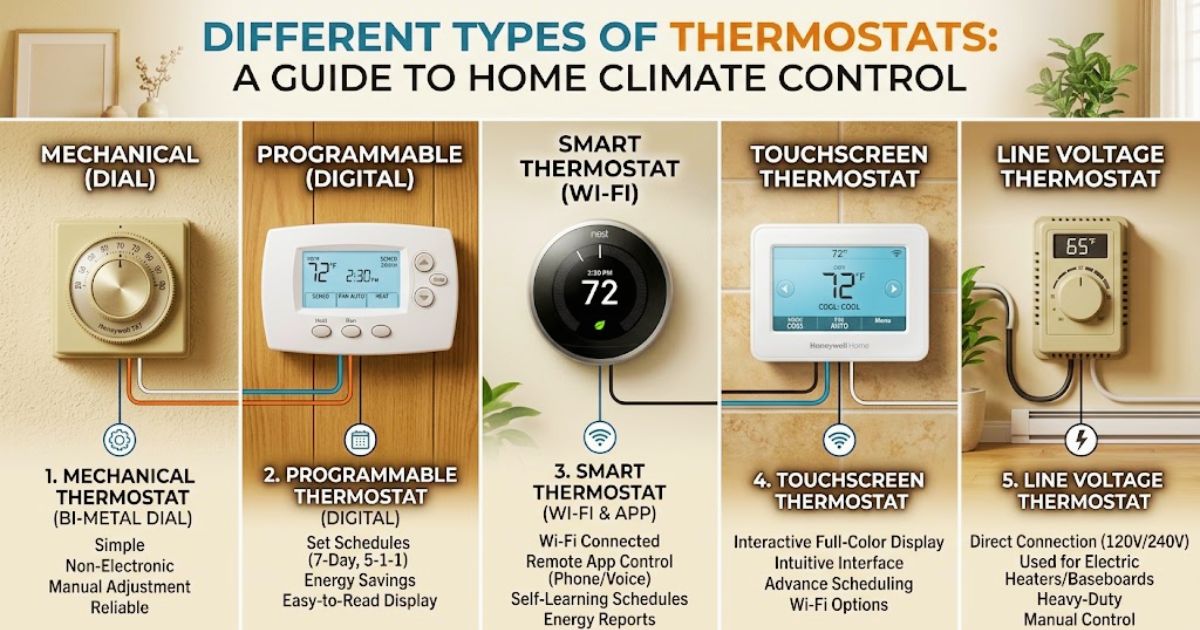
Mechanical
Mechanical thermostats rely on a bimetallic coil, which is basically two metals laminated together so they expand and contract at different speeds whenever temperature changes happen, and this wound coil connects straight to a mercury switch that lives inside a sealed glass tube holding liquid mercury.
As the coil rotates, the liquid mercury slides toward or away from tiny electrical contacts; when the coil unwinds because the temperature drops, the mercury slides back to the contacts, the circuit completes, and the heating switches on, while reaching your target set point later makes the coil wind back, the mercury disconnects, and the heating switches off again.
Digital & Electronic
Digital and electronic thermostats use internal components and electronic sensors for far more responsive reactions, keeping the room temperature and interior temperature within a single degree of your target temperature and helping the unit fine-tune heating to match your exact target setting.
Beyond basic programmable devices, smart thermostats feel almost like a small computer: programmable ones let you set schedule patterns for heating or cooling, with time settings and temperature settings working together to regulate temperature and save energy, as long as you account for the warm-up time and cool-down time while programming thermostat routines.
Smart & Connected Features
A true smart thermostat adds temperature control remotely through internet connectivity and app-based control, letting you build separate heating zones, track energy monitoring and reports, and even rely on GPS motion-sensor detection for automatic adjustment that uses your GPS location to pre-warm home spaces before you arrive.
Sensors & Hybrid Models
Beyond the classic bimetallic strip found in analogue temperature dials, a sensor-based electric circuit can also combine ease of use with performance, and modern digital thermostats with sensitive electronic sensors hold onto your chosen setting with real precision, while electromechanical thermostats blend both mechanical and digital parts together.
Connectivity & Automated Learning
Some models stay wireless and battery-operated, others stay connected with wires, and either way they can run at certain times of day on a fixed schedule; plus a smart thermostat controlled by smartphone can even use machine learning to adapt to daily routine habits, much like popular names such as Google Nest, Ecobee, and Hive.
Where to Position a Thermostat
When you install thermostat units, the position matters more than people expect, and a hallway with good fresh air flow usually works better than a room stuck in constant sunlight or a sunny area tucked behind curtain folds.
Mounting it on a wall near patio doors, where highest heat losses often happen, helps the unit sense temperature accurately and deliver an accurate reading of the true ambient temperature, so try to keep it about 5 feet above the floor to gauge temperature the way it should be measured.
If you’re setting up a smart thermostat, place it close to a reliable Wi-Fi connection with a strong connection, and make sure nothing blocks sensor readings.
Ideal Temperature Settings
Most experts suggest starting with the lowest comfortable temperature you can live with, which usually sits inside the 18-21ºC range, so a typical bedroom temperature might land near 18 degrees while your living room temperature feels better around 21 degrees.
Keep in mind that every 1ºC increase can add close to a 3% jump in your heating bill, so many households choose a setback temperature of about 16-18°C for the night, which keeps the whole 24-hour period comfortable and genuinely eco-friendly.
Don’t Treat Cold Days Differently
It’s tempting to turn up it dials on cold days, but resist that urge, because the system is built to sense colder weather on its own and keep the heating on just long enough to warm up house temperatures to your chosen set point.
On an especially chilly day, it makes more sense to switch on earlier instead, and a programmable thermostat can regulate ambient temperature and control temperature automatically once you set the temperature and time for different times of day.
How to Check If My Thermostat Is Working
A faulty reading often starts with a simple power supply issue, so first check whether the batteries have run out, since most digital thermostats use either AA batteries or AAA batteries that need a battery-replacement routine with a fresh set every so often.
If power comes from an electrical circuit instead, look at the power circuit, the fuse box, and the circuit breakers, because if one has tripped, you can usually switch it back on and try again, though a stubborn fault may still need an electrician.
Beyond power, dust and dirt can get built up inside the casing, so turn off power first, then open thermostat covers or unscrew faceplate panels, remove batteries if needed, and clean its parts with a dry paintbrush, a soft brush, or compressed air, working to clean gently every time.
Benefits
Having one at home lets you control heating at any time of day, and dialling in the right temperature creates a genuine wellbeing zone for the whole family. On top of comfort, it quietly saves money on energy bills while it keeps the home warm all season long.
Uponor’s Types of Thermostats
Uponor offers a full lineup of Smatrix controls, including the newer Smatrix Pulse series alongside classic wired thermostats like Smatrix Base and wireless like Smatrix Wave, and together these can manage up to 48 heating control zones through voice control options such as Alexa or Google smart home, all from one easy-to-use app.
Looking at the key features, the T-146, T-166 digital, and T-148, T-168 digital prog models measure room temperature and RH, plus display Celsius, display Fahrenheit, a handy backlight, and clear comfort/eco settings, while every unit shares the brand’s Uponor autobalance technology.
Simpler options like the T-145, T-165 dial stat rely on light indication, a timer function, and heating/cooling demand indication, whereas the T-143, T-163 public stat adds tamper detection with an adjustable setpoint temperature and an optional floor/outdoor sensor, and the T-141, T-161 sensor shares that same tamper detection and floor/outdoor sensor support alongside 6 pre-programmed schedules, comfort/eco indication, and other timer functions.
How Does a Radiator Thermostat Work?
A TRV, short for thermostatic radiator valve, sits at the base of each radiator as a cylindrical gauge marked with numbers 0 to 6, giving every individual radiator its own set point once it’s fitted properly. You can leave most radiators switched on while turning down the ones in rooms not often used, a small habit that ends up saving energy and cash over time.
How to Replace One
Choosing to upgrade analogue thermostat hardware to a digital or smart thermostat counts as a real DIY job, and honestly, it’s not for novice hands to attempt alone. Working around a live circuit demands strict electrical safety and a safe protocol around electricity, so unless you feel fully confident, it’s worth following a detailed guide before you replace thermostat units yourself.
FAQs
What is a thermostat used for?
It is used to regulate the temperature inside your home by telling your heating and cooling system when to turn on or turn off, keeping every room comfortable without wasting energy.
What is the definition of a thermostat?
A thermostat is a device that senses the ambient temperature and acts as the control for a heating or cooling system, switching it on or off to match your set temperature.
What is a HVAC thermostat?
An HVAC thermostat is the control unit that manages your heating, ventilation, and air conditioning system, sensing room temperature and signaling the system to warm up or cool down as needed.
How does a thermostat work?
It senses the current room temperature and compares it to your desired temperature; if it detects a temperature drop, it sends a signal to your boiler or AC unit to switch heating or cooling on until the target is reached.
Is a thermostat DC or AC?
Most household thermostats run on low-voltage DC power, though some older mechanical thermostats and certain HVAC systems use AC power depending on the wiring and circuit design.