

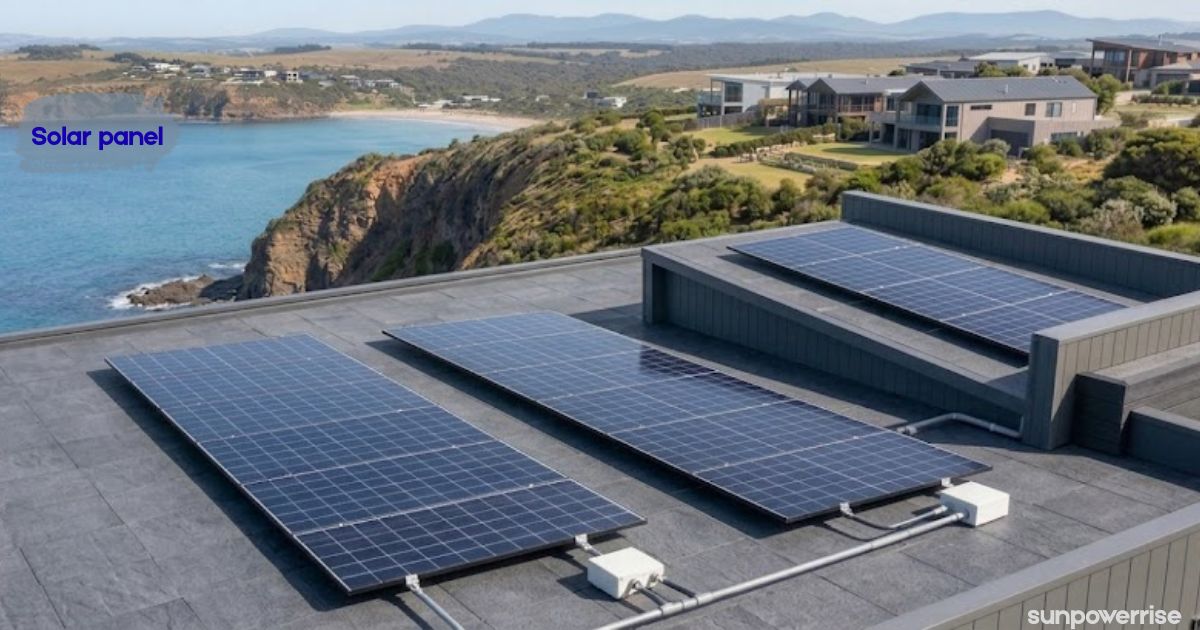
Walk through any neighborhood today, and you will spot solar panels sitting quietly on rooftop after rooftop, working without noise to turn the sun into usable electricity.
These solar panels are manufactured at a scale that stretches across entire regions and countries, feeding power to millions of people who never even think about where their electricity comes from.
The world is chasing clean power at a pace that once seemed impossible, and India is a great example, racing to add gigawatts of new solar installations to its grid every year.
What Are Solar Panels?
A solar panel is really a cluster of tiny solar cells working as a team, and I like to think of each cell as a small worker that never takes a break.
Photovoltaic panels produce a voltage output because sunlight hitting the cell releases electrons that travel from the negative terminal of one cell to the positive terminal of the next, and this is the basic wiring trick behind every solar module you will ever see.
On their own, individual panels only manage a modest amount of power, so manufacturers connect many of them, wired together, until they form a string.
Several strings joined side by side create a solar array, and when you place thousands of arrays across many acres of land, you end up with a solar park large enough to light up a major city.
What Are Solar Panels Made Of?
Anatomy of Silicon Panels
The heart of a solar cell is usually silicon, and depending on how that silicon is processed, you get either monocrystalline or polycrystalline material, both prized for being efficient semiconductors.
Manufacturers sandwich this silicon between sheets of glass and protective polymers, then wrap the whole thing in an aluminium frame that gives it rigidity and helps it survive years of weather.
To move the electricity generated inside, conductive metals such as silver and copper are woven through the cell, and this combination gives the panel its durability and weather resistance.
Thin-Film Flexibility and Abundant Elements
Not every panel relies on crystalline silicon, though. Thin-film cells use lighter materials like amorphous silicon, cadmium telluride, also known as CdTe, or a blend of indium, gallium, and selenide called CIGS.
These get pressed into thin layers on top of steel or even flexible sheets, making the final product lighter and far more adaptable to unusual surfaces.
I have seen these thin-film versions bent gently around curved rooftops, something a rigid panel could never do, and while their output is sometimes lower, the choice of raw material matters less than people think since silicon is the second most abundant element found in the Earth’s crust.
How Solar Cells Are Made
Every solar cell begins its life as ordinary silica sand, and honestly, that fact alone amazed me the first time I toured a factory.
Workers heat this sand in a furnace alongside a carbon source, reaching close to 2,000°C, before the mixture is cooled down into what is called metallurgical-grade silicon.
That silicon gets liquefied again to strip out impurities, then blended with tiny amounts of boron and phosphorus before being molded into ingots and carefully sliced into wafers roughly 0.2mm thick.
Coating, Contacting, and Quality Sorts
Each wafer then travels through a coating stage where silicon nitride is applied and the surface is textured to cut down on reflectivity, since any sunlight that bounces away is simply wasted energy.
A layer of silver paste goes onto the front surface and the rear surface, and just like that, you have a finished solar cell ready for panel assembly.
During inspection, workers look for cracks, and any damaged cells usually get a second life in smaller, off-grid gadgets like solar-powered toys rather than being thrown away.
Grid Assembly and Luminescent Testing
The cells then go through sun testing under artificial sunlight to prove they actually work, followed by a stage called lay-up, where a sticky layer of EVA, short for ethylene-vinyl acetate, acts as an adhesive on top of tempered glass.
Precise robotic arms place the cells in a neat tile pattern, and thin wiring, made of fingers and busbars, carries the electricity to the panel output while engineers balance electrical resistance against how much of the cell surface gets shaded.
After encapsulation with another EVA layer and a protective backsheet, the panel goes through electroluminescence testing, a clever trick that uses the fact that photovoltaic cells glow faintly whenever current passes through them, helping spot hidden microcracks since silicon wafers stay naturally brittle and sensitive to temperature swings.
Final Weatherproofing, Framing, and Smart Quality Control
Once everything checks out, lamination applies heat and vacuum pressure to bond the layers into one weatherproof unit, and framing adds an aluminum frame for sturdiness against snow and wind loads.
A junction box with built-in diodes is fitted to control which direction the current flows, and final testing includes a weatherproofing check and repeats the sunlight test one last time before shipping.
Many manufacturers now lean on AI-based inspection systems to catch flaws early, protecting quality and cutting down on waste long before the silicon is extracted and heated in the very first step of the process.
Types of Solar Panel
There are really only three main categories worth knowing when it comes to solar panels, and each one goes about converting sunlight quite differently.
Photovoltaic Solar Panel
The photovoltaic effect is the name given to the process where sunlight knocks loose electrons inside solar cells, and this reaction turns raw sunlight into electrical energy we can actually use.
Crystalline panels, especially monocrystalline panels, come from a single crystal of pure silicon, and I always tell people this is why they carry the highest efficiency, often between 15% and 20%, along with high power output, a long lifespan, and a compact size perfect for residential use.
Polycrystalline panels look a little different too, usually showing off a blue hue because they are formed from raw silicon fragments that get melted together rather than grown as one crystal.
They cost less to buy but come out less efficient, take up more space, and are more sensitive when exposed to high heat, which is why I would think twice before installing them in hot climates.
Then there are amorphous panels, part of the wider thin-film panels family, built to be flexible and lightweight using amorphous silicon, cadmium telluride, or gallium compounds.
Their efficiency drops somewhere between 7% and 10% lower than crystalline options, and they carry a shorter lifespan with a larger footprint, yet their lower cost makes them a smart pick for large installations across industrial sites and public facilities.
Thermal Solar Panel
Instead of chasing electricity, thermal panels, sometimes called solar collectors, focus entirely on capturing heat from sunlight.
A panel absorbs solar energy and passes it into a tank or collector filled with fluid that absorbs heat, which then flows through a heat exchanger to produce warm water for domestic heating and hot water systems back at home or a business heating setup.
Different collectors handle different jobs. Low-temperature collectors stay around 50°C, while medium-temperature collectors add a transparent cover to cut heat loss and climb up to 90°C, and high-temperature collectors use two covers to create a vacuum, reaching as high as 150°C for use in thermal power plants and general electricity generation.
A special version, the concentrating solar-thermal panels, turns that heat into steam strong enough to spin turbines and generate electricity on a much larger scale.
Hybrid Solar Panel
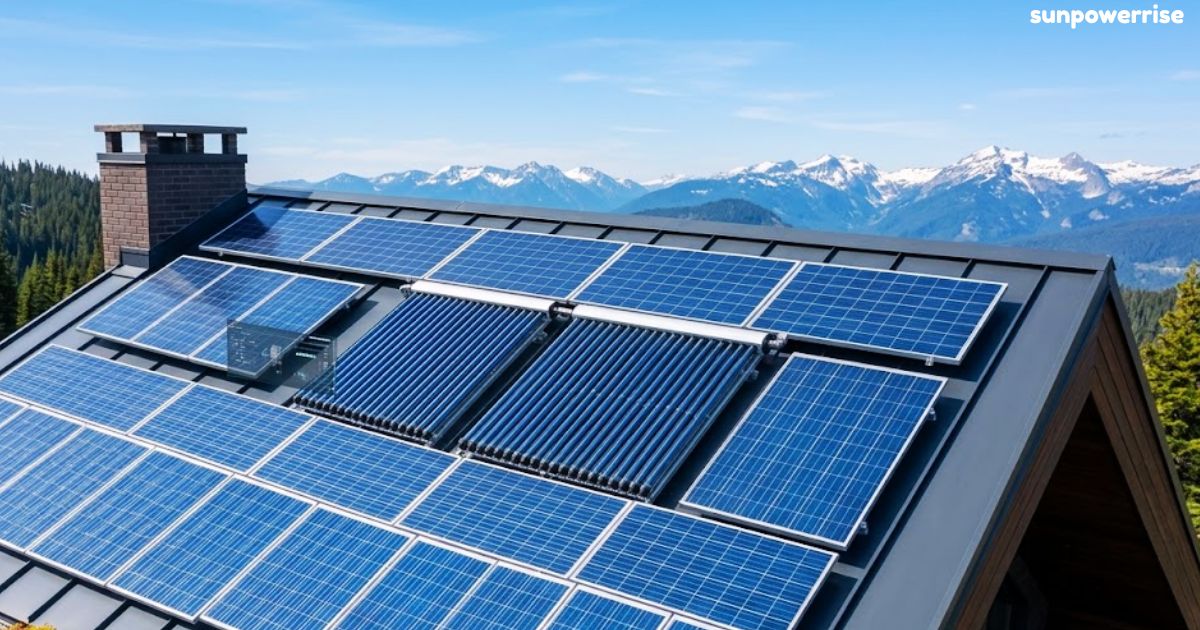
Hybrid panels represent a genuinely emerging technology, blending photovoltaic and thermal collection inside one single system so electricity and heat come from the same source at the same time.
This combination manages to boost performance in the photovoltaic cells by up to 15%, and these hybrid systems can even be paired with other renewables, like wind power, to squeeze out additional energy output from the same rooftop space.
How Solar Panels Work
Every one of these solar panels relies on the same photovoltaic effect: sunlight strikes the solar cells, and the photons inside that light knock electrons loose from the semiconductor material, almost always silicon.
This movement of electrons creates direct current, or DC, and that current becomes the raw building block of all the electricity we eventually put to use.
Since most homes, businesses, and everyday electrical devices run on alternating current, or AC, the DC power first passes through an inverter that converts it into something practical.
From there, the usable power can be self-consumed, or it can be stored inside batteries for later use, or it can be pushed straight into the electrical grid for someone else to use.
Utility-Scale Solar
Scaling up to large-scale projects means connecting individual panels into strings, and each string works on increasing voltage the same way a line of batteries would.
Multiple strings get linked in parallel to build larger arrays, and all that wiring eventually meets inside a combiner box, which gathers the DC electricity from every string and sends it toward an inverter for conversion into AC.
From there, step-up transformers work to increase voltage so the electricity can travel long distances along transmission lines without losing much energy, feeding into the wider grid that distributes power from generation sites to consumers while balancing supply and demand in real time.
Along the way, battery banks are often installed to soak up excess electricity made during sunny periods, storing that sunlight for later.
Solar parks built across thousands of acres can generate several gigawatts, enough power to meet the energy needs of a major city, proving that the same simple panel technology truly scales all the way from a single rooftop up to a piece of national-level infrastructure.
Real-World Applications
I have watched energy companies fold solar into both consumer strategies and corporate strategies, offering self-consumption solutions for homes and communities through what some call solar community models, letting people plug into a shared local solar installation even without a roof of their own.
On a bigger scale, large-scale manufacturing expansions of solar panel factories are helping entire nations chase ambitious national renewable energy targets.
FAQs
Does a 400W solar panel produce 400W?
Not exactly, a 400W solar panel only hits that number under perfect sunlight and lab conditions, so real-world power output usually sits a bit lower depending on weather and angle.
How much does a 3kW solar panel cost UK?
A 3kW solar panel system in the UK typically costs around £5,000 to £6,000 installed, though prices shift with panel quality and installer rates.
How to use a solar panel?
You simply let sunlight hit the solar cells, and the inverter turns that captured energy into electricity you can use straight away or store in batteries. It’s honestly satisfying watching your own rooftop quietly do the work for you.
What are 10 disadvantages of solar panels?
Common downsides include high upfront cost, weather-dependent power output, space requirements, lower efficiency on cloudy days, disposal challenges, panel degradation over time, grid dependency without storage, aesthetic concerns, and the need for regular maintenance and cleaning.
How efficient are solar panels?
Monocrystalline panels sit at the top as the most efficient, usually between 15% and 20%, while polycrystalline panels trail a little behind. Thin-film panels, including amorphous panels, run less efficient, sitting around 7% to 10% lower than crystalline options.