

Solar energy comes with plenty of promise, but it also comes wrapped in a fair share of solar myths and misunderstandings.
Some of these ideas get repeated so often that people start treating them as fact, even when the science says otherwise. Let’s break down the first and most common myth to see what’s really going on.
Solar Myth 1
Do Solar Panels Work on Cloudy Days?
When my friend asked me why solar panels stop working the moment the sky turns grey, I knew I had to clear up this misconception once and for all.
This myth about cloudy days is one of the most common ones out there, almost like a humble rumour that spreads around neighbourhoods without anyone bothering to check the facts.
The truth is, solar panels are built from photovoltaic cells, and these cells turn sunlight into usable energy even when thick clouds sit overhead.
On a clear, sunny day, sun rays travel directly to the panels with no obstruction in the way, but on foggy days or on an overcast day, the clouds scatter the light so it reaches the panels as diffused sunlight instead of a straight beam.
Think of it like a sunburn: you can still get one on a hazy afternoon because UV rays sneak through the haze, and solar panels catch that scattered light the same way.
Clear Sky vs. Overcast Test Results
I once watched a National Geographic-style clip that showed visually how a rooftop solar system keeps producing power even when the sun hides for hours.
We ran side-by-side experiments comparing a clear sunny day, a completely cloudy day, and a half-and-half mix of both, and the results settled the breakdown in people’s thinking for good. The solar output was considerably lower on cloudy days, but it never dropped to zero, usually landing somewhere between 30% and 50% of normal production.
Watching how light hits the panel surface and gets turned into a representation of usable power made it obvious how energy actually happens in real time. The case is now cracked wide open: going solar still makes sense, rain or shine.
Myth 2: Solar Is Too Expensive
Solar Savings by the Numbers
Plenty of people assume solar is expensive, but the real numbers tell a different story. I met a family that was paying $467 a month to their utility for electricity cost alone, and after switching to solar, their monthly bill dropped to $260, giving them $207 in savings every single month.
Another set of homeowners who felt overcharged at $408 a month moved to Sonuska and now pay just $225, saving $183 monthly, clear proof that solar isn’t more expensive, it’s actually cheaper than sticking with the grid.
Power Purchase Agreements vs. Buying Your System Outright
Under a power purchase agreement, a home gets the power needed without owning any equipment, delivering cleaner energy without sacrificing quality. I spoke with a client who needed a system cost of $25,515 upfront and was paying $165 a month before making the switch.
Over 20 years, as utility rates keep climbing the way they have for decades, that household stands to save $70,000 by paying upfront instead of renting power forever.
Solar either saves money or makes money depending on how it’s set up, and once you run the numbers, it’s clear solar makes sense in your mind and in your wallet both.
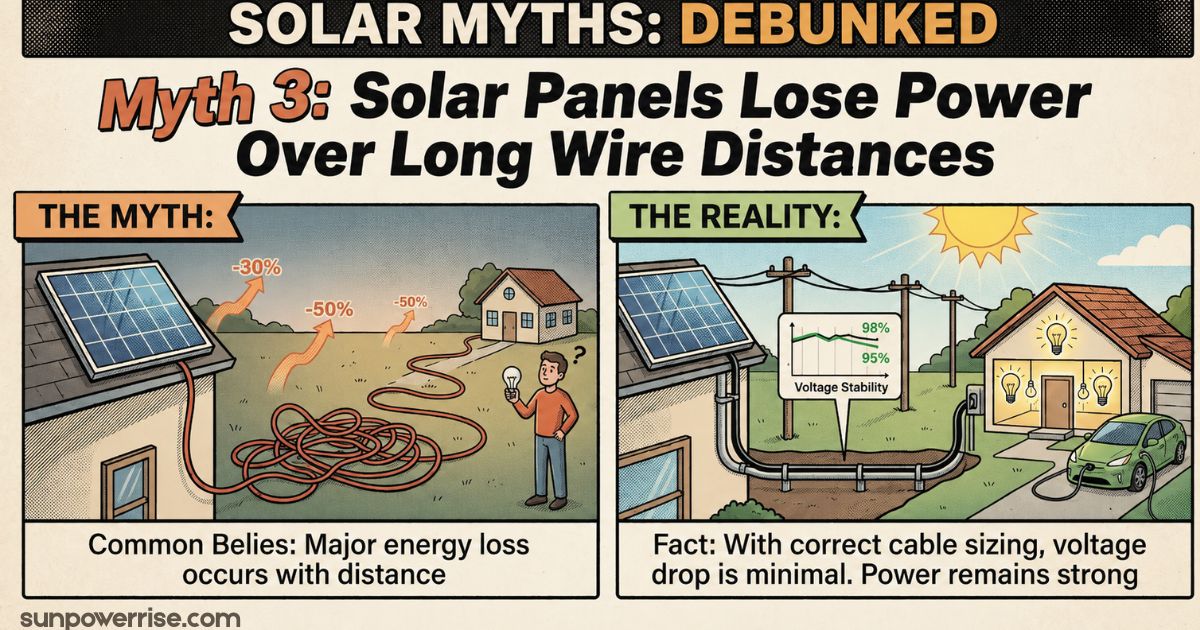
Myth 3: Solar Panels Lose Power Over Long Wire Distances
Testing Voltage Drop Over 400 ft of Solar Wire
At my off-grid cabin, I decided to test the solar myth that solar panels lose serious power over long distances. My panels sit 400 ft away from the power shed, connected through solar wires using 8-gauge wire, and every chart I found online warned of heavy power loss at that range.
To check the truth for myself, I looked at VOCC, also called open circuit voltage, next to VMP, the voltage at max power, since these two numbers explain how a battery and charge controller behave under real load.
I hooked up an MC4 connector and a branch connector, wiring the positive and negative leads carefully, then took a reading straight from the panels: 347 volts and 6.3 amps, which, by the watts formula, worked out to about 2130 W, matching the app’s 2.13 kW.
Wire Gauge vs. Distance
After driving down to the shed, I checked again and got 340 volts climbing to 345 volts, with 6.7 amps flowing through, giving roughly 2300 watts, almost matching the app’s 2.19 kW reading. There was barely any voltage drop at all.
It turns out the ampacity of the cable matters more than the length of the run. My 8-gauge wire is rated for 40 amps, far more than the 12 amps to 13 amps the panels actually put out, while thinner options like 12-gauge wire rated for 20 amps or 10-gauge wire rated for 30 amps would have cut things much closer.
A clamp meter, the right cable, and thicker wire choices, not distance, decide how much VOC and amps you keep by the time power reaches the shed.
In the end, my probes told the real story: the calculation wasn’t fancy math, just simple volts times amps equals watts, and my first reading landed almost exactly at the expected 2100 watts, proving that honest solar panels and honest numbers don’t lie.
FAQs
Do solar panels still work on cloudy or foggy days?
Yes, solar panels keep producing power on cloudy days, usually between 30% and 50% of normal output.
Is going solar actually more expensive than using the grid?
No, solar often costs less than a regular utility bill and can save homeowners hundreds of dollars every month.
How much money can someone save by switching to solar over time?
Some households save up to $70,000 over 20 years by paying upfront for a solar system instead of renting power from the grid.
What causes the drop in solar output on overcast days if the panels still work?
The sun’s rays get scattered by clouds instead of hitting the panels directly, similar to how UV rays can still cause a sunburn on a hazy day. This diffused light produces less energy than direct sunlight, so output drops but doesn’t stop.
What’s the difference between buying a solar system outright and a Power Purchase Agreement (PPA)?
With a PPA, a household gets solar power without owning the equipment, avoiding the upfront cost. Buying the system outright costs more initially (e.g., $25,515 upfront in one example) but can save significantly more over time, up to around $70,000 over 20 years as utility rates rise.