

Anyone reading about battery news lately has probably run into the phrase sodium ion battery, and for good reason: this sodium-ion battery technology is finally leaving the lab and showing up in real products.
People keep asking why this matters when lithium home batteries already work just fine, and the answer comes down to what’s inside the box. Instead of lithium, an expensive metal and honestly a bit of a rare metal too, this chemistry leans on sodium cheap, common, and everywhere.
That single swap changes how the cathode and anode move ions back and forth, and it’s the reason people talk about reliable supply chains and lower cost in the same breath as home batteries.
What Is A Sodium Ion Battery?
Strip away the marketing and a sodium battery is simply a rechargeable battery that swaps lithium for sodium, the same stuff sitting in table salt. Sodium makes up roughly 2.3% of the Earth’s crust, and it’s pulled from seawater, salt flats, and ordinary minerals, which explains why people keep talking about its abundance.
How They Work
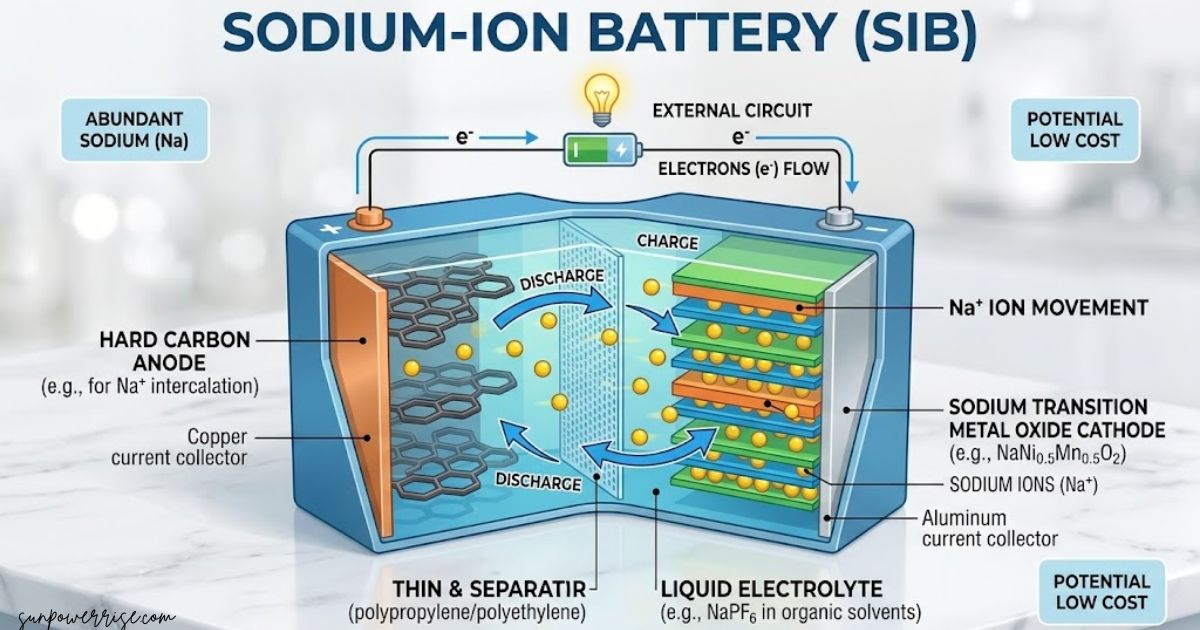
This sodium-ion battery moves sodium ions between a positive electrode and a negative electrode through an electrolyte, and that back-and-forth motion of ions is what lets the pack charge and discharge.
On the cathode side, engineers often reach for layered oxides, olivine compounds like LFP, or nickel-rich NMC mixes for lithium cells, while sodium teams experiment with newer Prussian blue materials instead.
Compare that with the anode, where both lithium-ion batteries and sodium packs lean on carbon-based materials: regular graphite for lithium, and hard carbon for sodium, because its disordered structure handles the bigger sodium ions better than graphite’s tighter layered structure. This difference in battery chemistry shapes everything downstream, from cycle life to how much energy density the finished cathode can deliver.
Right now this chemistry isn’t as commercially successful as older lithium setups, but it’s growing fast in stationary energy storage, backup power systems, and grid storage tied to renewable energy.
Comparison of Sodium-ion & Lithium-ion Batteries
Energy Density vs. Material Supply
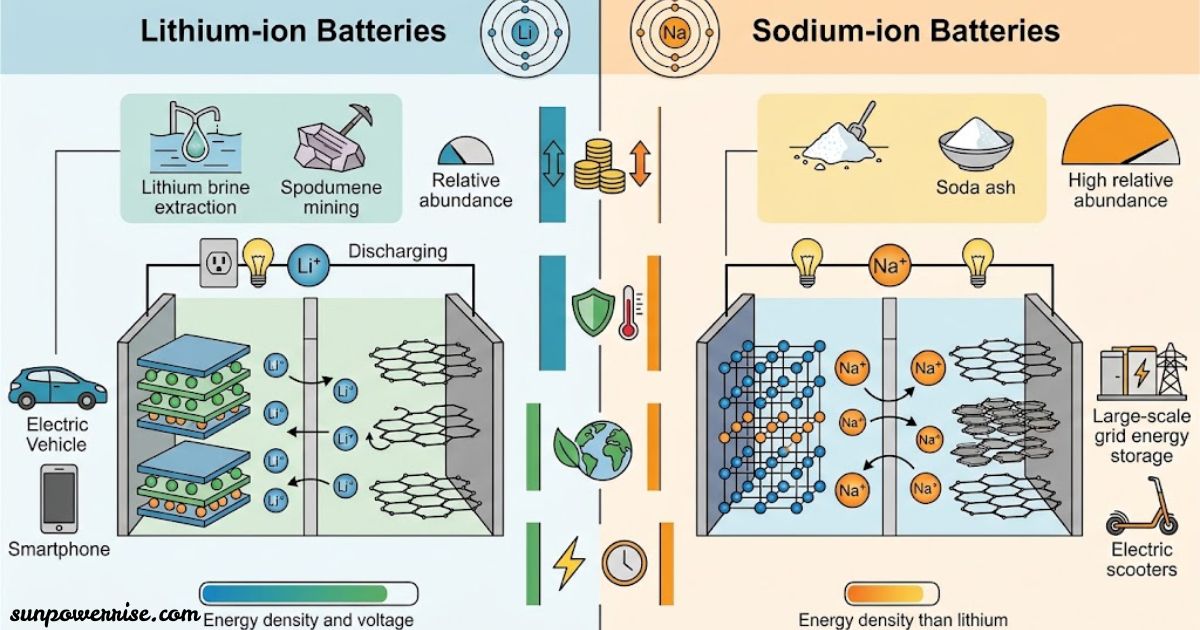
Put lithium batteries and sodium batteries side by side and the trade-offs show up fast, and once you’ve compared a few models, it’s clear sodium ion batteries aren’t just a cheaper substitute, they’re a genuinely different tool for a different job.
Lithium still wins on energy density, which is why it powers long-range electric cars and most EVs on the road, while sodium runs about 30-40% less energy per cell compared with the richest NMC cells.
But sodium answers back with its own list of sodium-ion advantages: it stays plentiful, it’s cheap, and it skips cobalt and nickel entirely, which frees it from the foreign supply chains that lithium depends on.
Thermal Safety and Cold Performance
Safety is where sodium quietly pulls ahead. These cells can be safely shipped and fully discharged without the overheating risk or thermal runaway that lithium packs carry, and recent test results back that up.
In cold temperatures and extreme cold, sodium ions dissociate faster, which keeps charging speed and fast charging strong even when the mercury drops something the CATL Naxtra battery has demonstrated in real conditions rather than just laboratory conditions.
Lifespan, Tech Maturity, and Market Outlook
On paper, both chemistries claim roughly 10,000 cycles, giving sodium a cycle life that rivals lithium’s, though real-world validation still trails the real-world application lithium has racked up over decades.
Sodium’s numbers land close to LFP cells too, and while its maturity still trails lithium’s head start, lithium’s mature technology and familiar technology show up in wider charging options and better product support, and its supply chain is simply more built out.
Sodium still needs roughly 3 to 5 years before large-scale commercialisation catches up, and it’s unlikely to fully replace lithium anywhere. Stationary storage, lower energy density, or energy per pound truly matter, but the lithium-ion advantages column is getting shorter every year, not longer.
Cold Weather Performance
This is where cold weather performance turns into the whole pitch, and it’s arguably the single strongest argument for sodium ion batteries right now. CATL’s Naxtra battery holds onto 90% usable energy even at minus 40 degrees Celsius, a number that would cripple traditional lithium ion batteries long before they got that cold.
Home units built on similar chemistry are rated from -40 to -60°C, or -40 to -140°F, which matters a lot if the box sits outside in Canada, Alaska, Russia, or Scandinavia.
For anyone living across the northern United States, that cold tolerance alone can become the deciding factor between two otherwise similar systems.
Sodium Battery Applications
Safety Advantages and Industrial Uses
Because a lower-energy battery sodium pack still carries real safety advantages, these sodium ion cells end up filling roles where compact size matters less than steady reliability.
Discharge one all the way to zero volts, fully discharged with no leftover risk, or a full 100% discharge, and there’s no transport hazard the way there is with lithium batteries, which is exactly why shipping these packs is so much simpler.
That single trait pushes them toward warehouse forklifts, robotics, telecom towers, data centres, and cold storage or refrigerated logistics, anywhere weight takes a back seat to cost and dependability.
Grid Resilience and Energy Storage
The biggest opportunity, though, sits at the grid resilience level. Power grids leaning on solar power and wind power need help with load levelling and smoothing out intermittent generation, and that’s exactly the job grid storage and large battery installations are built for.
General Motors is already backing sodium-ion cells for this kind of energy storage and broader infrastructure work across the United States, and unlike lithium, this storage doesn’t compete with laptops and smartphones for the same tight-margin materials.
Product Spotlight: UniGrid Na+ Casa
A California startup called UniGrid just shipped its first Na+ Casa units, and these boxes are now sitting in real homes across the United States and Europe, not just on a slide deck somewhere. The units still need to clear North American certification requirements before a wider rollout, but that step looks like a formality at this point.
25-Year Lifespan and Modular Integration
As a sodium ion battery built specifically for the home, UniGrid’s Na Casa is rated for 25 years, roughly matching a rooftop solar system’s own lifespan, and that beats the 15 years most homeowners quietly budget for with a Tesla Powerwall-style setup, hidden replacement cost and all.
Each cell stores 9.25 kWh, and because it works with common hybrid inverters, it suits new installations and retrofits alike, so a homeowner can stack extra battery modules onto an existing garage setup right next to the solar panels.
Fire Safety and Thermal Risk Elimination
UniGrid claims this design stops thermal propagation outright, meaning the chain reaction behind thermal runaway and fire simply can’t get started, which matters a lot to insurers and to anyone in a bushfire-prone area.
Standard lithium ion phosphate systems already carry solid protection layers, but removing the risk instead of just managing it is a different story for a box bolted to a wall.
Supply Chain Independence and Production Scaling
Because sodium stays cheap and sodium abundant supply skips lithium, cobalt, and nickel, the pack avoids critical minerals and the messy supply chains tied to them, and pricing sits close to lithium-ion phosphate systems even though production is still in a ramp-up phase.
Current output covers 200 megawatt-hours a year, with plans to reach 2 gigawatt-hours by 2027 through manufacturing partnerships across China, South Korea, and Japan a serious step toward real mass production in North America.
FAQs
Why don’t we use sodium ion battery?
Sodium-ion batteries are still in a ramp-up phase, with lower energy density and less large scale commercialisation than lithium batteries, so adoption is growing but not yet widespread.
Is a sodium battery better than lithium?
It depends on the job. Sodium batteries beat lithium on cost, cold weather performance, and safety, but lithium batteries still win on energy density for long-range electric cars.
Is Tesla using sodium-ion batteries?
Tesla hasn’t confirmed a shift to sodium ion batteries; it’s mainly CATL, UniGrid, and General Motors leading current sodium ion cells adoption for stationary storage.
What’s the problem with sodium ion battery?
Beyond lower energy density, the biggest hurdles are limited supply of manufacturing capacity and a cost that hasn’t dropped much below lithium ion phosphate systems yet.
Do sodium batteries have a future?
Yes, with grid resilience, EVs, and home energy storage all leaning into abundant, cheap sodium, the outlook for sodium ion battery tech looks genuinely promising.