

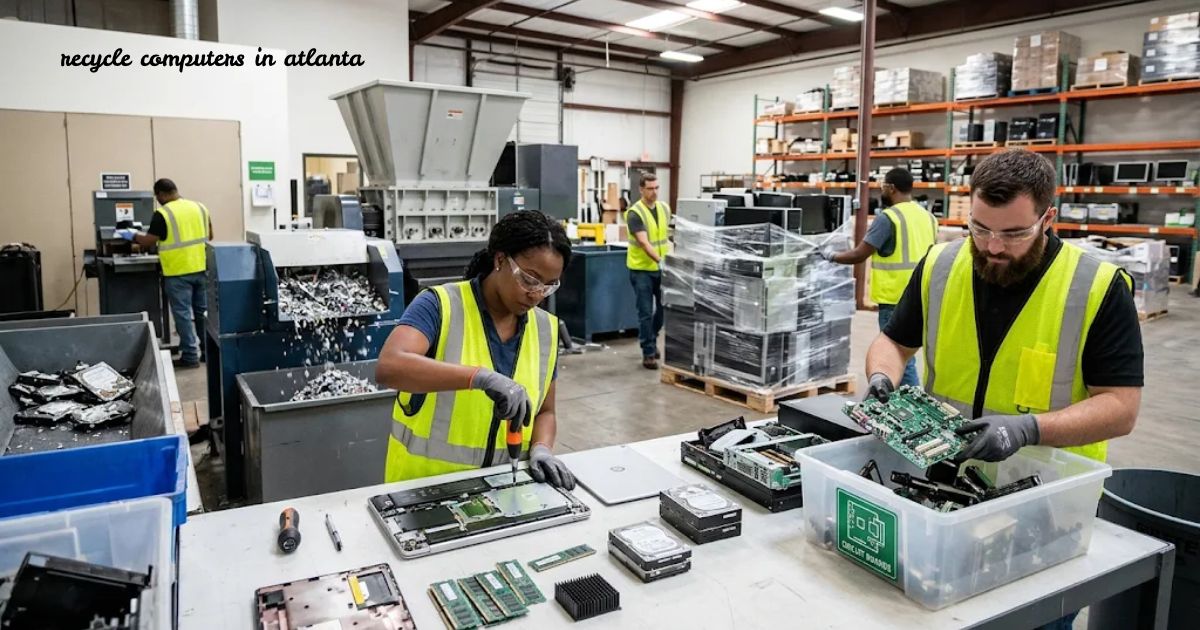
Electronics recycling Atlanta GA means that a certified e-waste recycler collects your retired equipment, destroys the data, and sorts the materials for reuse. If you want to recycle computers in Atlanta, you can choose a drop-off site or a pickup across metro Atlanta. This guide explains what to check before you hand anything over.
We read seven provider websites, and computer recycling Atlanta searches lead to very different companies. Some serve households with e-waste recycling, while others run electronic waste disposal programs for hospitals and corporations. Our comparison shows what to check first.
What does responsible e-waste disposal accomplish?
Responsible e-waste disposal keeps hazardous materials out of landfills and returns useful metals and plastics to manufacturers. Old electronics recycling delivers landfill diversion, resource conservation, and fewer greenhouse gas emissions in a single step. Recovered laptops, monitors, and servers also reduce demand for newly mined metal.
Older monitors and batteries can leak lead and mercury once a landfill crushes them. Raw material recovery supports a circular economy and trims your carbon footprint. Environmental stewardship starts with tracking where each material goes.
eWaste ePlanet plants a tree for every working device it processes and describes a carbon offset program. Beyond Surplus and STS both state a zero-landfill policy. Ask each provider what that phrase covers.
Which devices can you recycle in Atlanta?
Most Atlanta recyclers accept desktop computers, laptops, tablets, and monitors, and many also take printers and servers. Each provider publishes its own accepted-items list, so check it before you load the car. Cell phones and iPad recycling appear on several of those lists.
Provider lists also name flat-screen monitors, TVs, copiers, scanners, fax machines, and multifunction devices. Businesses add networking equipment, switches and routers, phone systems, storage media, computer peripherals, and medical equipment. STS mentions legacy electronics and ink and toner cartridges, while Urban Technologies says lithium-ion batteries need separate handling.
What happens to the parts inside a computer?
Recyclers break a computer into parts and sort them by material. The CPU, RAM, hard drive, motherboard, power supply, and heat sink each follow a different path toward reuse or refining. Ecycle Atlanta describes this component-level recycling on its own homepage.
A solid-state drive (SSD) and a spinning disk need different sanitizing steps. Working parts can return to service as refurbished devices, while the rest become feedstock for new products. Full Circle Electronics says its Georgia location sells refurbished devices.
How does data destruction work?
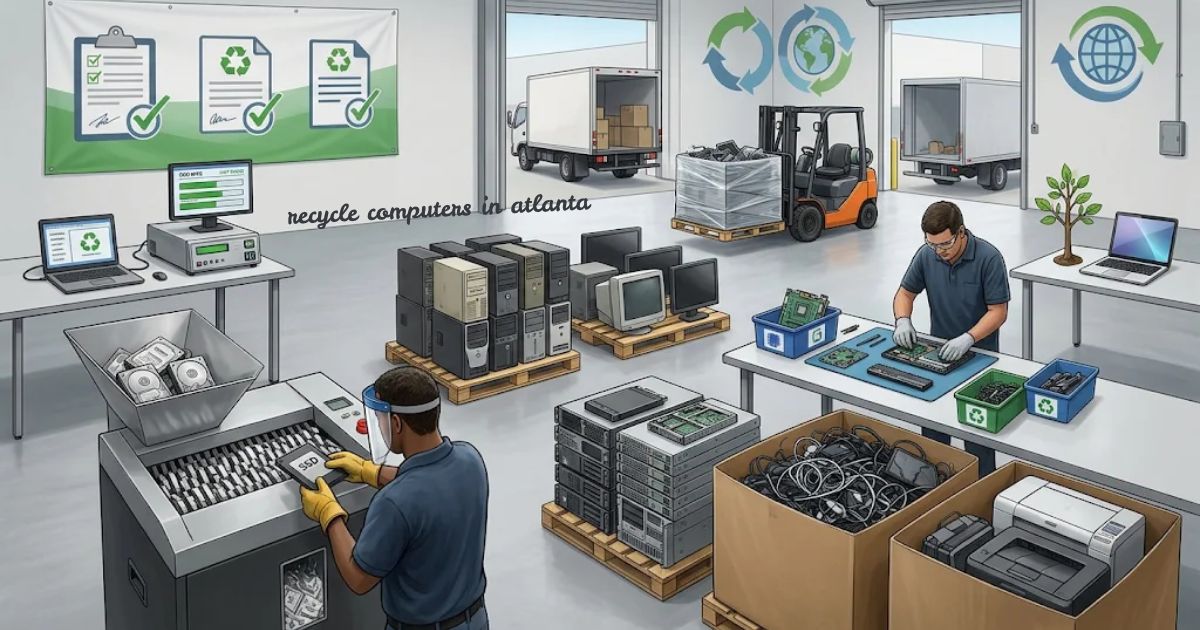
Data destruction either overwrites a drive or physically breaks it. Data wiping and data sanitization follow standards such as DoD 5220.22-M and NIST SP 800-88, while hard drive shredding leaves nothing to recover. Providers treat every drive as one of the data-bearing devices, including SSDs in laptops and servers.
Beyond Surplus describes three-pass erasure as its default, and STS cites purge-level overwrite. Urban Technologies lists degaussing, crushing, and shredding as physical destruction methods. Onsite hard drive shredding lets you watch, serialized hard drive shredding logs each drive, and witnessed destruction gives auditors direct proof.
What documents should a recycler give you?
Request both a Certificate of Destruction and a Certificate of Recycling for every load. Each document should name the date, the method, and ideally the drive serial numbers. These records create an audit trail and show the chain of custody from your door to final processing.
Beyond Surplus says liability transfer happens when it issues its certificate, and Urban Technologies calls its certificate legally binding. A missing record can turn a lost drive into a data breach, identity theft, or an exposure of personally identifiable information (PII) and protected health information (PHI). The FTC Disposal Rule, which comes from FACTA, puts regulatory compliance on any company that holds consumer records.
Which certifications and regulations matter?
Look for R2v3 certified or e-Stewards certified status, plus NAID AAA for data destruction. These independent programs audit how a recycler handles environmental, safety, and data security risks. Verify each certificate in the issuing body’s public directory before you sign anything.
ISO 9001, ISO 14001, and ISO 45001 cover quality, environment, and workplace safety, and both Full Circle Electronics and eWaste ePlanet list them. Urban Technologies lists B Corp certified status. Health, finance, and education clients also ask about HIPAA compliant handling, the Gramm-Leach-Bliley Act, the Sarbanes-Oxley Act, FERPA, and a Business Associate Agreement.
A strong provider also cites EPA guidelines and OSHA compliance, holds state registration, and practices downstream vendor tracking. Beyond Surplus states Georgia state registration, and Urban Technologies states no overseas export of electronic waste. Teams that file ESG reporting should request that documentation.
What services go beyond basic recycling?
Many Atlanta providers sell IT asset disposition (ITAD) alongside recycling. ITAD covers the full retirement of company equipment, including IT asset management (ITAM), IT asset recovery, and reverse logistics. Service lists vary by company, so match the list to your project.
Some firms run IT equipment buyback, computer liquidation, lease buyout, or asset remarketing. Others handle equipment decommissioning, data center decommissioning, de-installation, OEM product destruction, or recycling consultation. Reworx Recycling lists junk removal, Urban Technologies offers device-as-a-service, and Full Circle Electronics lists auditing and reporting.
Reworx Recycling also accepts equipment donation to narrow the digital divide. Urban Technologies gives enterprise clients an Impact Report. Beyond Surplus offers logistics coordination for large loads.
How do pickup, drop-off, and mail-in options compare?
Pickup suits companies with pallets of equipment, while drop-off suits individuals with a few devices. Free pickup, onsite pickup, and free drop-off appear on several provider sites, usually with conditions such as minimum volumes or business-only eligibility. Confirm those conditions before you book.
Ecycle Atlanta lists onsite pickup with no minimum, while Beyond Surplus asks for about one pallet for priority pickup and handles palletizing and loading itself. Reworx Recycling lists nationwide pickup, and Urban Technologies lists same-day pickup. Beyond Surplus and Reworx Recycling both list recycle by mail.
Reworx Recycling’s menu says its after-hours box is gone, yet its homepage still describes a tamper-proof drop-off box. Beyond Surplus mentions an after-hours lockbox on its homepage, but its FAQ says supervised business hours apply. Call before you drive over.
Who uses electronics recycling services?
Healthcare systems, government agencies, schools and universities, and financial institutions send the most regulated equipment. Data centers, law firms, nonprofit organizations, and Fortune 500 companies also hire recyclers. Municipalities and medical facilities appear on several provider lists as well, usually with their own paperwork needs.
Each group follows different rules, from patient privacy to student records. Ecycle Atlanta lists pickups for schools, data centers, nonprofit groups, and local governments, while STS names healthcare, education, and legal clients. Individuals have options too, covered in the FAQ below.
Where can you find an electronics recycling center near you?
An electronics recycling center near me search in Atlanta usually leads to Smyrna, Alpharetta, Norcross, or south Atlanta. Beyond Surplus and Reworx Recycling operate in Smyrna, Full Circle Electronics operates in Alpharetta, and eWaste ePlanet operates in Norcross. Ecycle Atlanta works from Cordell Drive.
STS describes service across Fulton County, Cobb County, Gwinnett County, and DeKalb County, while Beyond Surplus names Marietta and Sandy Springs. A customer review of Ecycle Atlanta mentions a Peachtree Corners drop-off. Ecycle Atlanta says its locations sit close to the I-285 and I-75 corridor.
How do you choose the right provider?
Match the provider to your equipment, your data risk, and your timeline. A household with one old laptop needs a nearby drop-off, while a company needs corporate computer recycling with documentation. Compare certificates, accepted items, and pickup terms before you decide.
A Georgia electronics recycler should give you the same answers by phone that it posts online. Secure computer recycling should include a named data destruction method, and business electronics recycling should include a written scope. Free electronics recycling exists, but several sites limit it by volume, item type, or customer type.
Across the seven sites, we found mixed claims about pickup minimums, after-hours drop-off, and fees. Now we phone each provider and request the accepted-items list and a sample certificate. Try the same routine yourself.
Which Atlanta providers should you compare?
Seven providers appear in this guide: Ecycle Atlanta, Beyond Surplus, STS Electronic Recycling, eWaste ePlanet, Full Circle Electronics, Urban Technologies, and Reworx Recycling. Each provider offers the services listed on its own website, so verify details there. We describe only what those websites confirm.
Which providers offer free pickup and drop-off?
Ecycle Atlanta and Reworx Recycling both state free drop-off on their websites. Ecycle Atlanta also lists free onsite pickup for organizations, and Reworx Recycling lists free pickups across the country. Both describe hard drive shredding as part of their services.
Ecycle Atlanta describes shredding with a certificate, and its accepted list includes servers and network hardware. Reworx Recycling lists equipment buyback, IT asset disposition, and recycling consultation, and it operates as a social enterprise. Both keep weekday hours.
Which providers focus on business IT asset disposition?
Beyond Surplus, STS Electronic Recycling, and eWaste ePlanet each describe IT asset disposition for organizations. Beyond Surplus lists IT buyback and product destruction, STS lists computer liquidation and lease buyout, and eWaste ePlanet lists IT asset buyback and reverse logistics. Each company offers the services shown on its own website.
STS collects equipment in Atlanta and processes it at its Texas facilities, so ask about transit time and records. Beyond Surplus works from Smyrna and lets clients watch shredding at its warehouse. eWaste ePlanet works from Norcross and says it often waives fees for qualifying metro Atlanta businesses with enough volume.
Which providers stress certifications and buyback?
Full Circle Electronics lists R2v3 and three ISO standards for its Georgia location, while Urban Technologies lists NAID AAA, e-Stewards, and B Corp status. Both describe data destruction and IT asset disposition. Confirm each service on the provider’s own website.
Full Circle Electronics lists auditing and reporting with a certificate of recycling, and its Alpharetta center accepts public drop-offs on weekdays. Urban Technologies lists IT equipment buyback, device-as-a-service, and an Impact Report, and its Atlanta page describes free pickup. Urban Technologies lists a Jacksonville, Florida office address, so ask where it processes equipment.
What questions do people ask about recycling computers in Atlanta?
People mostly ask about wiping data, cost, who can recycle, and what to bring before they visit. The four answers below draw only on details that the provider websites state. Check each provider’s own page before you rely on any answer.
Should you wipe a laptop before you recycle it?
Yes, back up your files, sign out of your accounts, and wipe the drive before you hand over a laptop. Providers such as Beyond Surplus and Urban Technologies destroy data afterward, but your own wipe adds a second layer. Businesses should still request a certificate for every device.
Does recycling computers cost anything?
Some providers charge nothing for computers, while others charge for certain items or small loads. eWaste ePlanet says individuals and specialty items may carry fees, and Beyond Surplus says some items cost money to process. Read the accepted-items page first.
Can individuals recycle computers, or only businesses?
Individuals can use several providers, mostly through drop-off rather than pickup. Reworx Recycling states free drop-off for all customers, eWaste ePlanet welcomes individual drop-offs, and Beyond Surplus accepts residential drop-offs during business hours. Full Circle Electronics lists public drop-off hours on weekdays.
What should you bring to a drop-off?
Bring a list of items, remove personal files, and ask for a certificate before you leave. Beyond Surplus asks business customers for details such as five computers, three printers, and two laptops. A clear list speeds up the visit for everyone.
Where can you find the right electronics recycling in Atlanta?
To recycle computers in Atlanta, start on our website, where we line up each provider’s confirmed services. Open each provider’s own website, because each company offers the services listed there, and call to confirm accepted items, fees, and hours. This route gets you to the right Electronics Recycling Atlanta GA provider with less guesswork than reading seven sites yourself.