

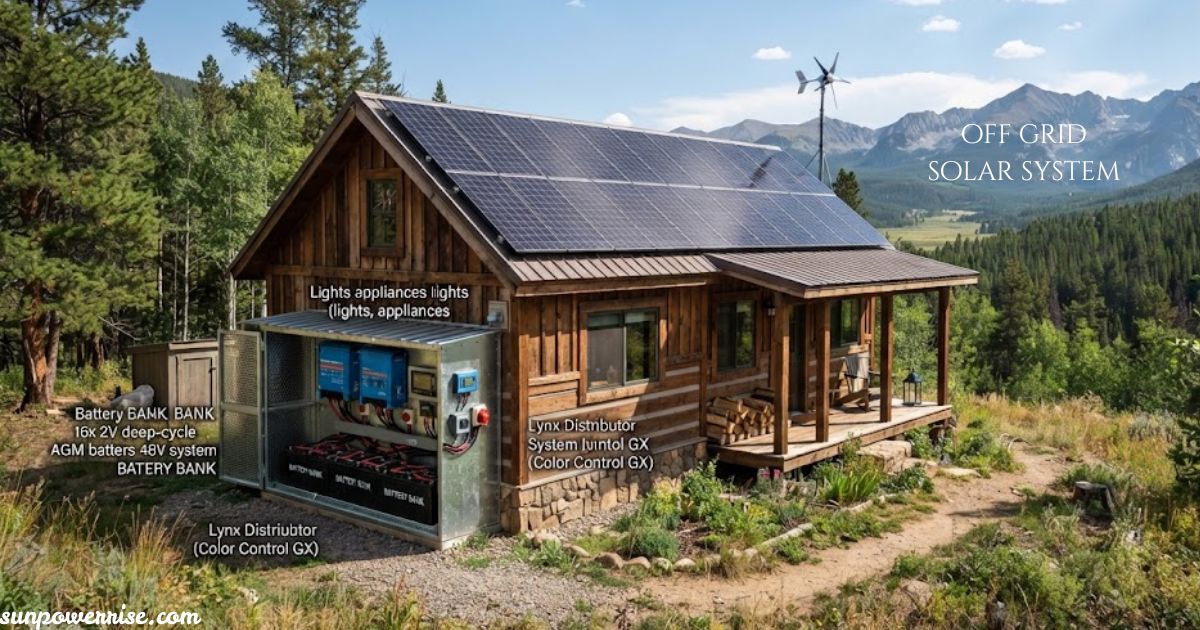
An off grid solar system is a solar power setup that runs completely independent of the public electricity grid. Instead of pulling backup power from a utility, it generates its own electricity with solar panels and stores extra energy in batteries, so the home or property has power around the clock , including at night and on cloudy days.
This kind of setup gives real energy autonomy because it doesn’t lean on a traditional electricity grid at all, and that independence builds true resilience when the lights go out everywhere else.
A recent report from the Global Off-Grid Lightning Association backs this trend up with hard numbers: off-grid solar system sales jumped 17% during the first half of 2024, a clear sign that global energy access is expanding fast.
People are choosing an off-grid solar power system over a grid-tied solution for many reasons, and one big driver is growing worry about grid reliability paired with rising electricity rates that never seem to slow down.
What is an off grid solar system?
People often ask me what is an off grid solar system is, and honestly, once you see one running, the answer clicks fast some even phrase it as what is a off grid solar system, and the meaning stays the same either way. Think of a solar power system as the heart of any off grid solar system; it works completely apart from the local utility grid and leans on batteries to hold onto electricity for later.
Living off the grid means running your home autonomously, with no cord tying you to a utility, so every appliance has to pull from power made right there on site to cover your household needs and stay powered onsite.
This kind of off-grid living fits small homes in rural locations best, especially where grid access just isn’t realistic, and even going solar in general grants a taste of energy independence even though it doesn’t automatically mean you’re fully cut off.
Since solar panels can’t make electricity without sunshine, most residential solar power systems across the United States stay grid-connected so families can still draw power at night or on cloudy days.
Off Grid Solar Power System Components
If you’ve ever wondered what is needed for off grid solar system builds, the short answer is a handful of core parts that every one of the off grid solar power systems out there rely on.
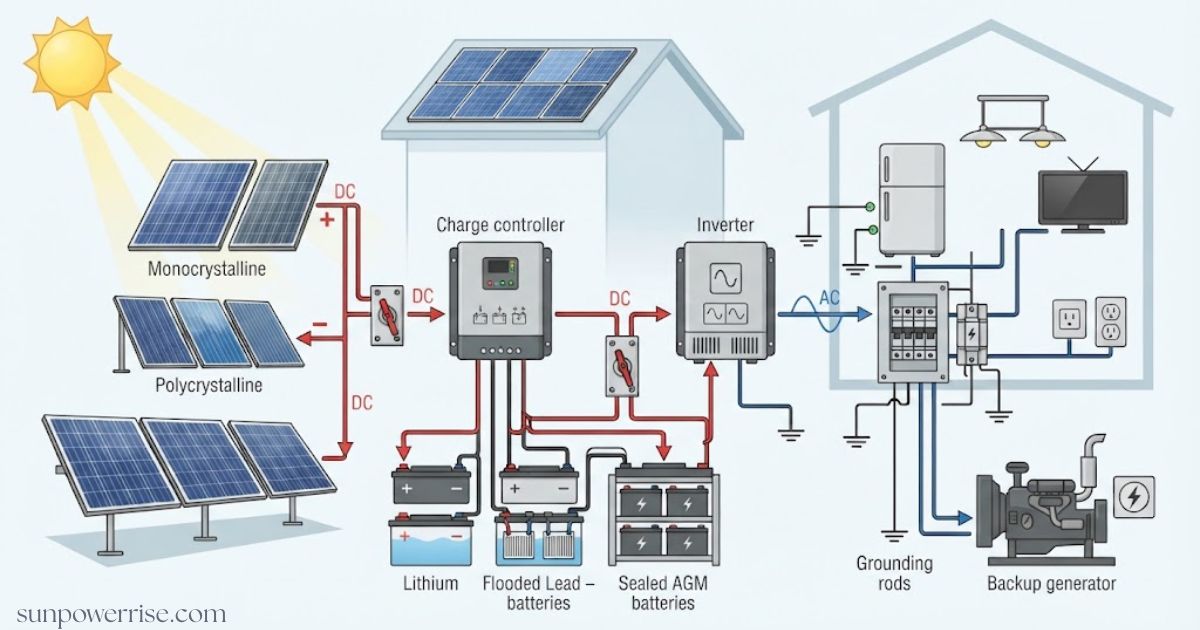
Every solid setup needs a few essential components working together to capture, store, and distribute power, starting with solar panels that catch sunlight and turn it into direct current, or DC electricity.
PV Panels
I’ve installed photovoltaic panels, also called PV panels, in three flavors: monocrystalline cut from one silicon crystal for top output, polycrystalline as a budget-friendly pick with slightly lower efficiency, and thin-film panels suited to large-scale installations. You can ground-mount or roof-mount them depending on space and sunlight exposure, and both choices work fine on most properties.
Charge Controller
Next comes the charge controller, which manages electric current so batteries never suffer overcharging, protecting battery life and keeping safety front and center while making sure no excess energy gets wasted during limited sunlight days, all so you keep a continuous power supply running.
Batteries
For storage, lithium batteries need no ventilation and stay safe with low maintenance and a long lifespan, while flooded lead acid batteries demand real maintenance, including water level checking, and AGM lead acid batteries sit in between with a shorter lifespan yet still cost less than lithium, though nothing here comes cheap batteries in general stay expensive.
Once power sits stored as DC power, the job of turning it into alternating current, or AC power, falls to the inverter, which feeds your household appliances the right frequency and voltage so it plugs straight into standard household outlets.
Inverters
Bigger systems often pair several solar inverters with careful wiring, cables, and solid mounting equipment, alongside a PWM charge controller or MPPT charge controller for smarter charging.
Round out the build with energy storage in a solar battery, a backup generator for cloudy stretches, and full safety equipment think safety disconnects, grounding equipment, and surge protection to keep the whole flow of electricity safe from panel to plug, powered by clean solar energy the whole way.
Off-Grid Vs. Grid-Tied Vs. Hybrid Solar Systems
Comparing an off-grid and on-grid solar system side by side, along with grid-tied solar systems, off grid solar systems, and hybrid solar systems, makes the choice much clearer.
A grid-tied setup stays wired to the utility power grid, so any extra solar energy you make turns into excess electricity that flows back out through net metering, often earning a bill credit under a billing structure known as full-retail net metering though this only works with the right equipment and won’t help during a power outage.
Standalone systems, on the other hand, suit rural areas and remote cabins perfectly, since they lean on solid battery storage and sometimes a gas-powered generator to stay fully self-reliant; living this way just asks you to stay energy-conscious about daily consumption and watch your solar production closely.
Solar-plus-storage systems blend both worlds and shine brightest where grid failures happen often, delivering clean energy even though the upfront cost makes some homeowners question whether it’s truly financially viable.
Most residential solar panel systems stick with the grid because pairing energy storage systems with a grid connection turns out more cost-effective and reliable on demand, while going fully off-grid limits your equipment options and adds a genuinely complicated installation, plus it rules out any net metering participation entirely.
Off-grid solar system pros and cons
Going off-grid puts you fully in charge of your own power source, and I love how these independent solutions hand you real control over your energy instead of leaving you at the mercy of fluctuating energy prices or surprise monthly bills.
For remote areas dealing with unreliable electricity, this setup solves a real problem, and with smart system sizing plus solid battery storage, you can count on reliable power even through stretches of low sunlight.
Nothing here comes free, though: higher initial costs hit hard because of how many batteries the system needs, and any wasted energy you don’t use simply disappears. Still, for anyone without grid access, staying self-reliant through an expensive setup and accepting a few lifestyle changes feels worth the trade in the long run.
How to decide the appropriate size for an off grid solar system
Sizing a system right starts with knowing your energy needs, your location, and your budget, since all three shape the final number. Work out your daily kilowatt-hour, or kWh, energy requirements by adding up the wattage of every one of your appliances and how long each runs, then check that against your usage duration and local peak sun hours to land on the right kW output from your solar panels.
A simple rule I share often: pick a 12V system if your needs sit under 1,000 watts, and size up if you’re running anywhere between that and 3,000 watts. From there, weigh the upfront costs against what you can afford, and tools like the PVcase Yield calculator make settling on the right system size far less stressful.
How much do off-grid solar systems cost?
Anyone pricing out off grid solar systems should expect a fairly wide range, since budgeting for an off-grid build means covering initial equipment, installation costs, and ongoing expenses like battery maintenance and solar panel maintenance, and I always tell clients to check whether the whole plan stays financially viable over time.
The upside is real: lower electricity bills turn into steady savings that slowly pay back your initial investment, and government incentives plus rebates often sweeten solar energy adoption even further, especially as societal pressures, economic pressures, and environmental pressures push more companies to care about their company image and reputation by embracing renewable energy.
Here’s roughly what you’re looking at: at least $5,000 for a 10 kW array of panels, around $4,000 for an inverter with a built-in charge controller, and about $20,000 for a 20 kWh battery system.
Add $3,200 to $4,600 for installation and labor costs, which usually lands near 7% of the total, plus engineering and logistics and other overhead expenses that can climb to 40% of project costs. All told, most homeowners see a total price landing somewhere between $45,000 and $65,000 for a complete off-grid build.
How to pick the best solar system for you
For most households, a plain grid-tied system remains the smartest financial choice, since it offers the best return on investment thanks to a low upfront cost and a simple system design.
A hybrid system starts making more sense if you deal with frequent power outages or you’re chasing real energy independence while getting the most out of renewable energy, and a solar plus storage system could be exactly what fits that goal.
Off-grid systems work best for remote areas and might be the right call for a mountain cabin, but honestly, they rarely make sense for everyday city living.
The safest next move is calling local solar companies, since local solar installers know your area best and can help you get the most from your solar panels.
Why go off-grid?
Living in a remote area without grid access is the clearest reason to go off-grid, and smaller solar systems paired with smart storage systems can handle heating and cooling needs just fine when the electrical systems in the home stay simple and the family adjusts its lifestyle around certain electricity periods.
Some people just want autonomy from their utility company and the regulators behind it, whether that’s about supporting free market principles, stepping away from a fossil-fueled grid, or dodging annoying connection fees.
Others care most about resiliency when their utility can’t guarantee steady power, and installing a couple of solar batteries with islanding capabilities gives them the power to form their own grid keeps the house running through a severe weather event or sudden grid outage.
For most solar shoppers, this path offers a genuinely cost-effective way to boost home resiliency without committing to a full off-grid lifestyle.
FAQs
Why is off-grid living illegal?
Off-grid living itself isn’t illegal, but some areas still enforce building codes and zoning laws that require a grid connection or permits before you can legally disconnect.
What is the estimate of big solar system I need for off-grid living?
It depends on your daily energy needs and appliance usage, but most homes need enough solar panels and battery storage to cover 1,000 to 3,000 watts comfortably.
What is the best choice of solar system off-grid or on-grid?
An on-grid solar system is cheaper and more reliable for most homes, while an off grid solar system wins for true autonomy in remote areas. It really comes down to your own priorities and peace of mind.
Can I run AC on an off-grid system?
Yes, but running an air conditioner takes serious battery capacity and a properly sized inverter, so it demands careful system sizing first.
What are the drawbacks of having off-grid solar system?
The biggest drawbacks are higher initial costs, heavy reliance on battery storage, and the lifestyle changes needed to stay mindful of daily energy consumption.