

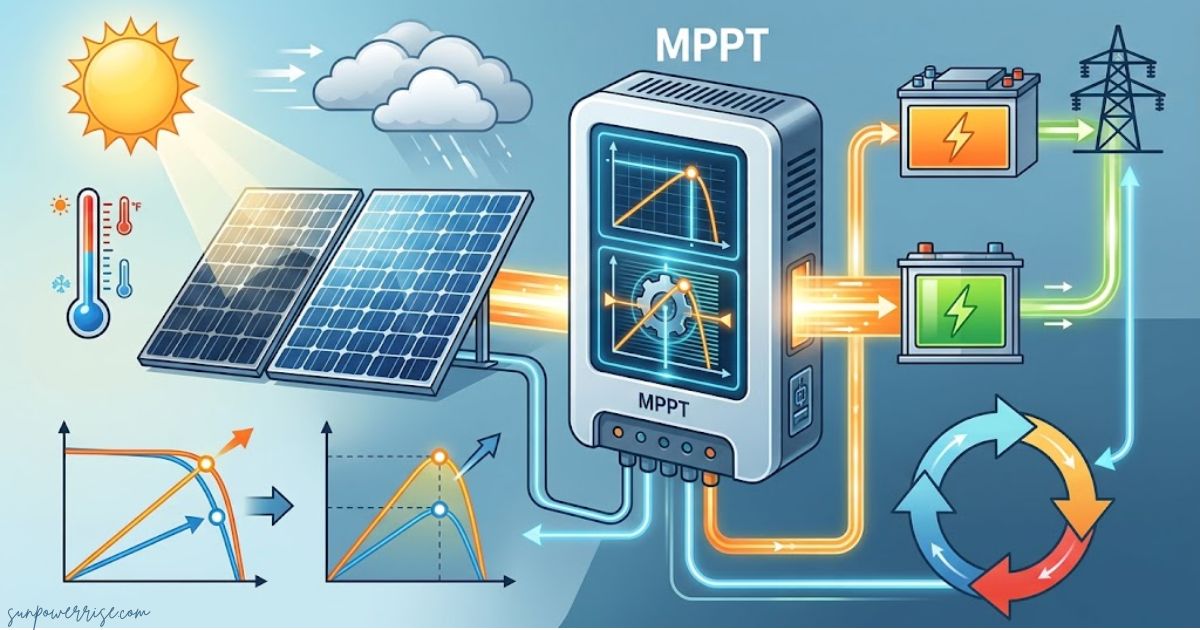
MPPT plays a crucial role in every solar setup I have worked on, and it stands for Maximum Power Point Tracking, a technology built into every inverter, the bigger inverters used in large arrays, and charge controllers to pull the most energy output from solar panels.
The basic idea comes from a simple equation used across the solar PV system world: Power equals voltage multiplied by current, written as P = V x I, where Watts measure Power, Amps measure current, and Volts measure voltage.
Every solar panel has one exact spot on its Amps-Volts curve, often called the I-V curve, where Vmp and Imp meet to create the maximum power point, also shortened to MPP.
This optimal operating point never stays fixed because environmental conditions keep shifting throughout the day. Sunlight intensity, irradiance, radiation, temperature, shading, and even the angle of the sun all push the curve up or down, so the load on a solar panel has to move with it.
What is MPPT
This technology works quietly behind the scenes to keep output steady even when sunlight disappears behind a cloud. Solar panels create direct current, or DC power, but the amount of voltage and current they push out changes with orientation, temperature, and shading. By constantly resetting the operating point, the system keeps hunting for the maximum power point, protecting overall efficiency and energy delivery.
How It Works
An MPPT controller behaves like a smart DC-to-DC converter sitting quietly between the array and the battery, and its first job is monitoring panel output through constant measurement of DC voltage and current.
Every calculation the controller runs uses real-time conditions such as sunlight intensity, temperature, and the angle of incidence on the glass, and once a drop in sunlight happens, it recalculates and finds the new maximum power point almost instantly.
This adjustment to the operating point, known as adjusting operating point, keeps the system close to its optimal operating point and maximises power even under less-than-ideal conditions like passing clouds.
The whole process, sometimes called optimization, protects potential energy from turning into energy losses, supports maximum power transfer, and results in strong battery charging efficiency.
By searching for the ideal voltage-current combination and increasing energy harvest, the controller keeps power transfer efficient no matter how conditions shift. It also monitors every change in panel voltage, not just the wider maximum power point of the whole array.
Key Benefits
Higher Energy Yield is the headline benefit of MPPT, since tracking maximum power point behaviour lets each solar panel or array segment run near its highest efficiency. Improved Performance shows up clearly during Suboptimal Conditions, and good MPPTs keep delivering results even through long cloudy days or partially shaded conditions.
Greater Flexibility in System Design comes from installations that use multiple MPPTs, since panels can then sit at different orientations and steep angles, covering multiple panel angles across one roof. Builders can plan complex layouts without sacrificing efficiency, which is exactly why so many modern rooftops trust this approach.
MPPT Charge Controllers
Voltage Matching & Conversion
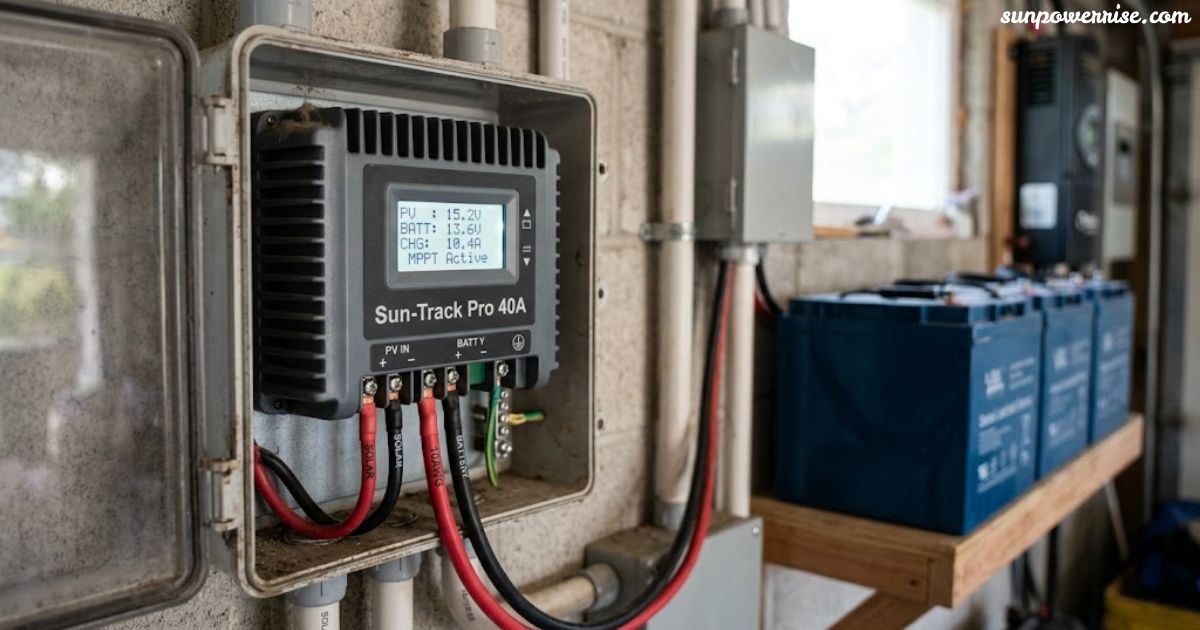
A good MPPT solar charge controller works as a DC-to-DC power converter placed between the solar array and the battery bank, and its whole purpose is fixing the mismatch between panel voltage and battery voltage.
Connecting a panel making 30–40 volts straight to a battery system built for 12V, 24V, or 48V would cause inefficiencies and even potential damage over time.
Instead, solar charge controllers built around maximum power point tracking turn that higher voltage into additional current, so no surplus voltage or excess voltage gets wasted as heat.
Optimising Power Flow & Efficiency
Because electrical power follows the rule P = V × I, a properly tuned MPPT charge controller can step down voltage while it works to regulate current and voltage together, keeping electrical characteristics compatible between both sides.
This conversion protects compatibility, holds strong efficiency, and pushes usable power toward the battery, so total power stays close to what the panels first produced instead of getting lost through poor power flow. Brands like Victron MPPT and Victron Energy MPPT are well known in this space, often chosen for their reliable tracking performance across changing conditions.
Battery Protection & Energy Yields
Without this kind of optimised input, batteries in off-grid systems risk becoming overcharged or undercharged, and either mistake shortens battery life and hurts battery storage over the years.
A standard non-MPPT charge controller often ends up wasting part of the harvested energy, causing inefficient charging results and weak system performance across the whole home setup.
The right controller instead delivers correct charging output, protects against improper charging, and helps protect batteries from charging current swings tied to variable solar input.
In this way, homeowners get full rated power from their solar panels, keep batteries charged efficiently, and enjoy 10-30% more power compared with older gear, all while the system continues to optimise and track maximum power point performance from a solar PV system every single day.
MPPT in Inverters
String Inverters
String inverters usually run Maximum Power Point Tracking across a whole string of panels, often near 14 units strung together, which is why engineers call string-based something of a compromise compared to true panel-level MPPT.
When a whole string shares one single MPPT, every panel inside must face similar environmental conditions, similar radiation, similar temperature, and similar orientation, or the averaged I-V curve drags down the power produced.
Shaded panels sitting next to sunny ones inside the same strings create an averaging effect that quietly steals higher output, so smart design choices group panels facing different directions into separate individual strings wherever possible.
Some advanced string inverters solve this with dual or even multiple MPPTs, letting groups of panels placed under similar conditions run through their own individual panel-level tracking instead of one shared load. Even a single inverter must account for passing shading before it can trust its readings.
Micro-inverters
On the other hand, micro-inverters, sometimes written as microinverters, along with power optimisers, give every panel its own MPPT, an independent MPPT that behaves completely independently from its neighbours and finds its own optimal point.
This setup fits installations with multiple roof orientations perfectly, because each unit still chases its optimal operating points through fresh input and manages to boost power output across multiple strings and central inverters alike.
Why is It Important?
It stands out as a key factor in solar systems because it keeps optimising energy output no matter what the sky is doing outside.
By continuously adapting to changing environmental conditions, it maximises energy harvest and protects system performance for both homeowners and businesses alike. The real payoff shows up as savings on the electricity bill, especially in homes dealing with partial shading or multiple roof orientations.
I-V Curve
The IV Curve tells the whole story of how current and voltage move together across a panel’s lifetime. Every MPPT system reads this curve constantly. It is the map that guides every decision the controller makes.
Faqs
What does an MPPT do?
It continuously tracks the maximum power point of your solar panels and adjusts voltage and current to pull the most energy output possible, even when sunlight and temperature keep changing.
What size MPPT for 200W solar?
For a 200W solar panel setup, a 20A MPPT charge controller is usually enough, but always check your battery voltage and panel Vmp to be safe.
Which is better, PWM or MPPT?
MPPT wins almost every time because it delivers 10-30% more power than a standard non-MPPT charge controller, especially when panel voltage is much higher than battery voltage.
What does MPPT mean for solar?
It stands for Maximum Power Point Tracking, the technology that helps solar panels capture the most energy possible under any environmental conditions.
What are the downsides of using an MPPT charge controller?
It costs more upfront than simpler options and can be a bit more complex to install, though the efficiency gains often make it worth the investment over time.