

If you’ve started looking into solar power, you’ve probably been hit with an alphabet soup of terms: kWh, kW, and kWp. Don’t let the acronyms intimidate you; once you understand how they track power and production, the rest of the puzzle falls into place.
Whether you are fitting a solar panel on a home or running a business, these units decide how well your solar installations meet your energy needs, and once you grasp how much clean energy a panel can realistically produce, the rest of the numbers fall into place.
Kilowatt peak and kilowatt hour work together to describe the peak power rating and the real PV yield of solar panel systems, while everyday electricity use ties back to the standard conditions every photovoltaic system is tested under.
kWp Meaning
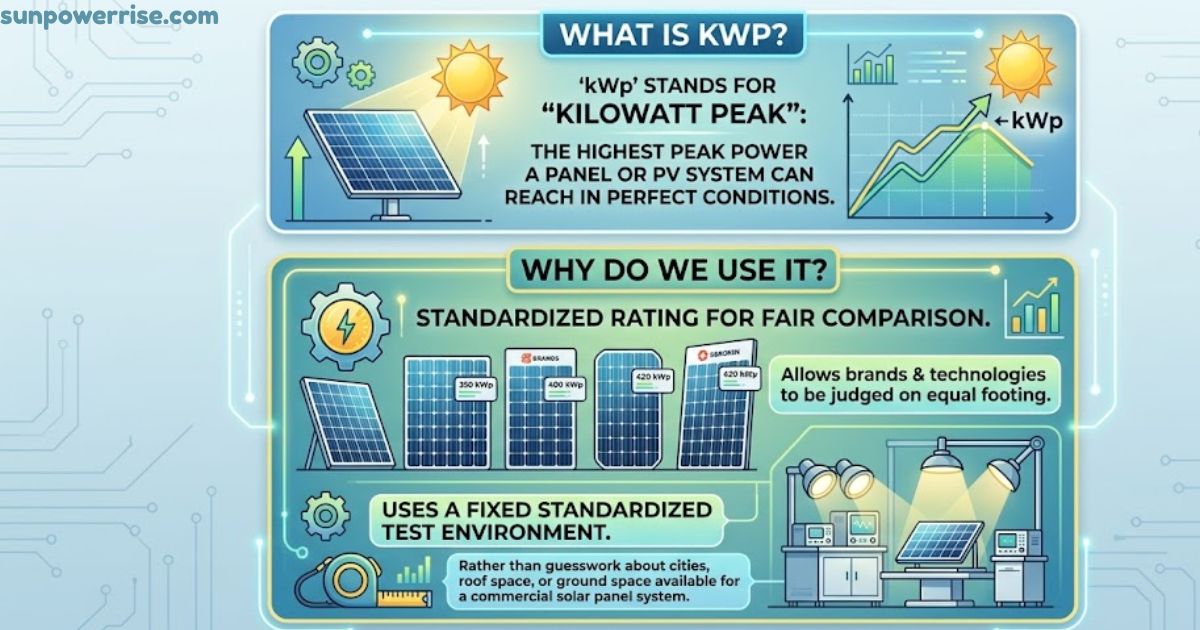
I remember the first time I read a solar quote and saw kWp printed next to a set of panels it looked technical, but it simply means kilowatt peak, the highest peak power a panel or PV system can reach in perfect conditions.
Manufacturers rate every solar panel this way so that brands and technologies can be judged on equal footing, using a fixed standardised test environment rather than guesswork about cities, roof space, or ground space available for a commercial solar panel system.
This figure comes from an industry-wide standardised test conditions setup, run under Standard Test Conditions where solar irradiance sits at exactly 1,000 W/m2 (also written as 1,000 watts per square meter), the air mass follows an AM 1.5 spectrum (sometimes just called AM 1.5), and the module temperature stays fixed at 25 degrees Centigrade, or 25 °C.
That combination of numbers is not random; it copies a sunny day in the afternoon under clear sunny weather, giving every panel the same solar spectrum and the same term peak to aim for, no matter where the individual modules are made.
The STC label you see on a data sheet reflects this exact theoretical value, and it exists purely so buyers can make a fair comparison between competing values without worrying about factors like outside temperature or shifting light irradiation.
In plain terms, kW measures ordinary electrical appliances, kWh tracks actual energy consumption, but it is the accurate unit and maximum power output figure that lets you compare the true maximum output of different solar modules.
Standard Test Conditions (STC)
Behind every kWp number sits a lab test, and that test has a name: Standard Test Conditions, shortened to STC on almost every module data sheet.
The rules are strict and always the same: irradiation of 1,000 watts per square metre, air mass AM 1.5 (written as 1.5 on some sheets), and a cell temperature of 25 degrees Celsius, giving the module performance a fixed, uniform operating conditions baseline.
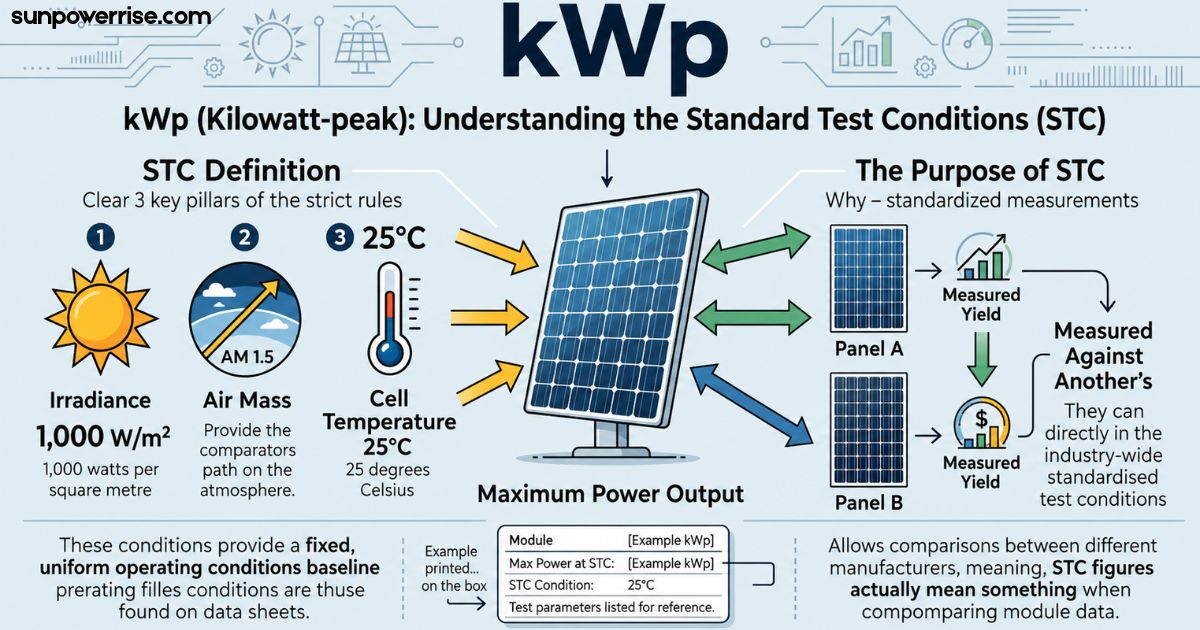
This standard test condition is what allows one panel’s module temperature, solar irradiance, and PV yield to be measured against another’s using the same industry-wide standardised test conditions, so the maximum power output printed under 25°C on the box actually means something when manufacturers compare STC figures.
Which Is Better: STC or NOCT?
Here’s something I’ve noticed working around real installations: the tidy STC number rarely survives contact with reality. Critics point out that lab test conditions sit far from real operating conditions, so once a PV system goes up on site, the actual PV yield can drift noticeably from the theoretical data on the box.
To close that gap, engineers built the NOCT, short for Normal Operating Cell Temperature, which measures performance the way modules actually behave once real sunlight hits them.
Unlike STC, NOCT accepts that PV modules heat more than a lab ever admits, so it assumes a module temperature of 45 degrees Celsius at a lower irradiance of 800 watts per square metre. Both numbers appear on most data sheets, and both shift the final values a buyer should expect, so a smart shopper reads manufacturers’ claims against both scales rather than trusting one test alone.
Measuring kWp Matters
Knowing your kWp rating matters for reasons far beyond bragging rights on a spec sheet. It gives buyers a standardised way to run a fair comparison between competing models, brands, and full solar system options, which leads to more informed decisions when picking a solar installation that fits both the budget and the roof.
It also shapes System Sizing: a household with heavy energy consumption needs a higher kWp rating, while a smaller household can comfortably choose a lower setup, and getting the appropriate kWp right avoids wasted cost on unused capacity.
Understanding kWp also protects buyers from energy production miscalculations without it, people tend to guess wrong about potential energy production, throwing off both cost savings and expected return on investment.
There are Cost Implications too: higher kWp systems carry a higher upfront cost but usually deliver stronger energy savings and better long-term potential savings, which matters a lot for larger homes and growing businesses chasing lower bills.
Because standardised optimal conditions never match the real world, a 1 kWp solar PV system rarely hits a full 1 kW of output once shade, dust, or other limitations creep in. This is why Performance Expectations should be set using a constant reference figure from the start.
So the energy demands of any household or market-facing business line up with realistic efficiency, believable power output, honest energy, and a panel choice that actually suits the types of systems and solar panels on offer, whatever the target electricity bill or solar installation size turns out to be.
kWp to kWh
Picture a panel running flat out for an hour: a 270kWp array working at maximum capacity for that single hour produces 270kWh of usable electrical energy, converting the sun’s radiance directly into power you can use.
The real kilowatt-hour total any home or business sees depends heavily on shade, size of the array, and how sunny the site genuinely is, which is exactly why working with solar panel specialists pays off when planning a solar panel system meant to hit its potential output.
Everyday electrical appliances put this in context: a television sips 50 to 60 watts, while a washing machine pulls 800 to 1,000 watts, or about 1.0 kilowatt, and comparing that against your kWh use each kilowatt-hour cycle shows exactly how much demand your household places on the grid.
Think of a single kilowatt-hour as roughly 50 hours of lighting a room with an energy-saving lamp, or seven hours of television, or one load of laundry, or baking one cake a handy mental shortcut for energy efficiency around the house.
The simplest way to separate the two terms: the kilowatt-hour figure shows the energy generated, while other one shows the theoretical ceiling, as one neat rule puts it; peak power defines the maximum, and kWh defines the harvest.
As a working shortcut, Germany typically sees around 1,000 kilowatts of output per kWp every year, so a 6.9 kWp system should deliver close to 6,900 kWh annually, though this average value always depends on local hours of sunshine.
Factors That Affect the Electricity a Solar Panel Produces
No panel performs in isolation. Location shapes everything first, since a house in East Sussex enjoys more usable daylight than one in Glasgow or Greater Manchester, and even a south-facing roof in the same region beats a north-facing one because of the latitude, angle, orientation, and how much direct light and intense light actually reach the cells.
Weather and Clouds decide the rest of the daily swing: a sunny summer day with clear skies pushes wattage close to its rated maximum capacity, but thick clouds can drag output down to just 10 to 25%, and heavy rain or snow stalls a solar panel’s performance almost completely for the day.
Temperature plays a quieter but real role too; rising ambient temperature actually cuts efficiency, trimming power output by up to 25% on the hottest days, which is why proper spacing between panels protects airflow and prevents overheating.
The Orientation and Angle of panels matter just as much: keeping panels near 30 to 45 degrees from the horizon, facing the summer sun, maximises solar-to-electric energy conversion through the photoelectric cells.
Type and Efficiency of Solar Panels varies widely by solar panel technologies Amorphous Thin Film Silicon Cells manage roughly 6% to 7% efficiency rate, Polycrystalline Silicon Cells reach about 13% to 16%, Monocrystalline Silicon Cells climb to 15% to 23%, and High Concentration Photovoltaic Cells can hit 30% to 40%, which is a huge spread across the types used across the UK.
Finally, Maintenance and Lifespan rounds out the picture: dust, debris, fallen leaves, animal droppings, and bird nests all chip away at daily kWh, while cleaning restores lost performance decline, since even a well-kept kWp rating on a condition-worn array can drop by 0.5% per year across its years in service, so tracking these factors, this efficiency.
Average PV System Specs for Single-Family Home
A typical private PV system fitted on a single-family house carries an output of four to ten kWp, built from around ten to 36 modules depending on roof space.
Translated into everyday terms, that means the typical PV yield for an average home lands somewhere between 4,000 and 10,000 kWh across a full year, a range worth keeping in mind before signing any quote.
Summary
Pulling it all together: the power rating of your PV system is measured in kilowatts, the kilowatt-hours figure describes how much your storage can hold, and the kilowatt peak describes the nominal power stamped on your modules.
Grid rules matter here too: most setups may only feed 70 percent of that nominal output into the grid, dropping to 50 percent where battery storage funding comes from KfW, and any PV system rated under ten kWp stays exempt from certain EEG levies.
Matching electricity storage and capacity to your household needs remains the real goal, so the whole system modules, grid connection, and stored PV yield works as one balanced unit rather than a mismatched pile of parts.
FAQs
What does kWp actually stand for?
It stands for kilowatt peak, the maximum power a solar panel or system can produce under Standard Test Conditions (STC), not what it produces every day in real life.
Is kWp the same as kWh?
No. kWp is the theoretical peak power rating of your system, while kWh (kilowatt hour) measures the actual energy your system generates over time. Think of kWp as the “top speed” and kWh as the “distance traveled.”
How much electricity can I expect from my kWp rating?
As a rough rule of thumb, 1 kWp produces around 1,000 kWh per year in places like Germany. So, a 6.9 kWp system would generate roughly 6,900 kWh annually, though this varies by location and sunshine hours.
What size kWp system does a typical home need?
Most single-family houses install systems between 4 to 10 kWp, using around 10 to 36 solar panels, producing an estimated 4,000–10,000 kWh of energy per year.
Is STC or NOCT a better way to judge solar panel performance?
STC gives a standardised lab comparison between panels, while NOCT reflects more realistic operating conditions (higher temperatures, lower irradiance). Checking both figures gives a fuller, more accurate picture before buying.