

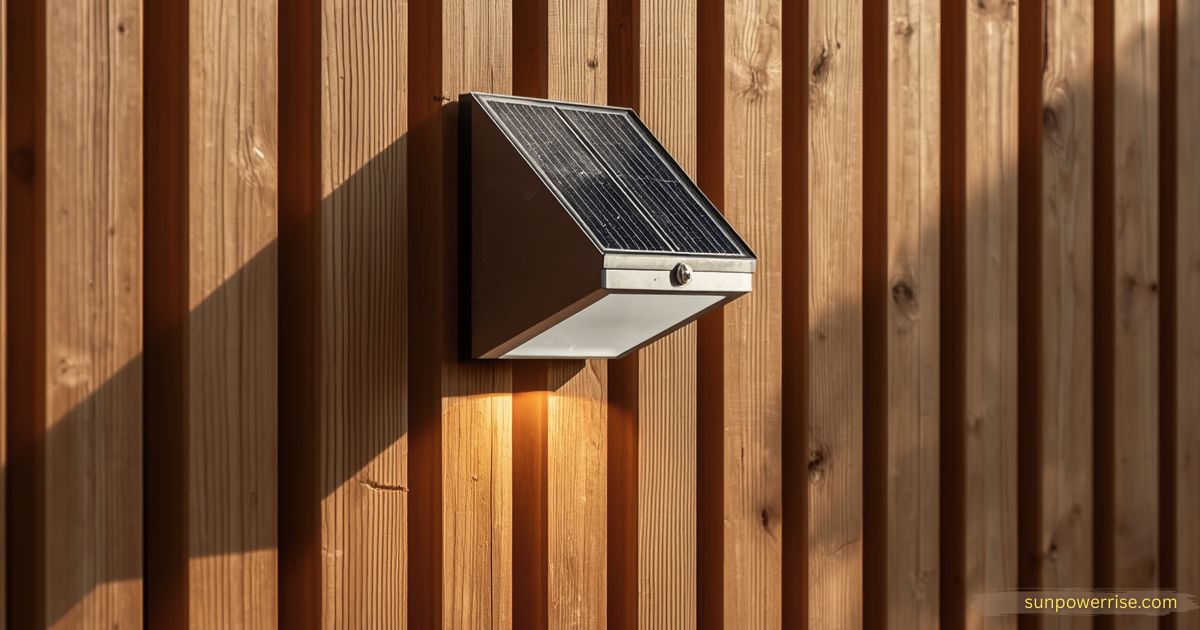
A solar lamp wall light is a self-contained outdoor fixture that mounts directly onto an exterior wall, fence post, or boundary surface and runs entirely on sunlight no wiring, no electrician, no mains connection.
A small solar panel on the housing charges an internal lithium battery through the day, and once dusk falls the unit switches on automatically, either staying lit continuously or activating when a motion sensor detects movement nearby.
In practice, “solar lamp wall” covers two overlapping products: plain dusk-to-dawn lights that give steady low-level illumination, and motion-sensor lights built more for security than ambience. Most of what’s sold under this name sits somewhere in between.
How Solar Lamp Wall Actually Works
Four parts do the work: solar panel, battery, LED array, and on most modern units a PIR motion sensor. The panel feeds a lithium battery commonly rated between 1200mAh on small fixtures and 5200mAh on larger security-style units.
Battery capacity, not lumen count alone, decides whether a light survives a cloudy week or dies after two nights. A unit with a big panel but small battery charges fast and drains faster; one with a large battery and modest panel holds its charge longer but needs more consistent sun to top up.
LED output typically runs 50 lumens for accent lighting up to 300+ lumens for functional security use. PIR sensors detect body heat rather than simple movement “human body induction” triggering on a person’s heat signature within 5 to 8 metres on standard units, up to 10 metres on higher-spec ones. Most stay lit around 30 seconds after triggering, though some premium models let you adjust that window.
What Actually Matters When You’re Choosing One
Spec sheets throw a lot at you, but three things decide real-world performance:
Sun exposure, not brand. A north-facing wall, a spot under a deep eave, or shade from a tree for half the day will underperform no matter how good the panel is. Most units need two to six hours of direct, unobstructed sun daily for a full charge shaded spots extend that considerably. If your mounting location doesn’t get clear midday sun, budget for shorter nightly runtime than the box promises.
Weatherproofing. IP65 or higher for anything fully exposed to rain and wind; IP44 is fine under a covered porch but won’t hold up on an open fence line. Rubber-sealed USB-C ports matter here too a lot of early failures on cheap units trace back to water getting into an unsealed port, not panel or LED failure.
Mounting height. Most manufacturers recommend 6.5–8 feet (roughly 2–2.5 metres) for motion-sensor units high enough to catch a person’s heat signature without triggering on every passing cat, and clear of ground-level shade.
Wall Lights vs. Fence Lights
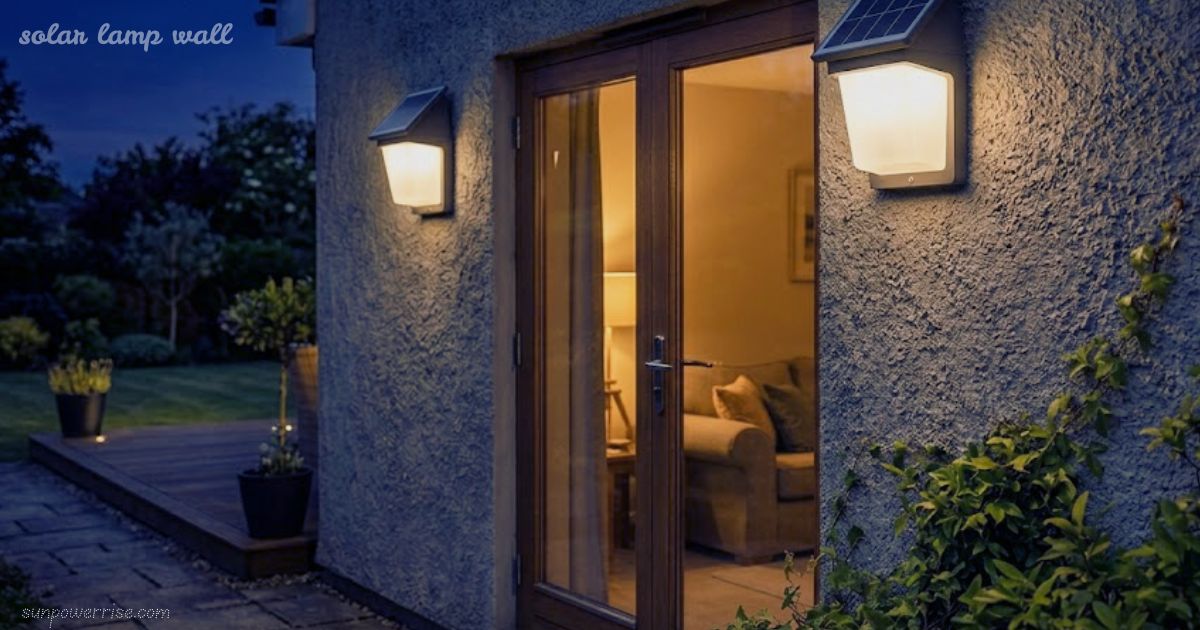
Same panel-battery-LED-sensor setup, different job. Wall lights usually fix to a house wall or garage and favour a wider flood beam for entrances and pathways. Fence lights are lower-profile, meant for posts and boundaries, and typically sold in four- or six-packs so you can line a whole perimeter instead of lighting one door. If you’re lighting a boundary rather than an entrance, a multi-pack (often £20–£35 / $25–$40) usually works out cheaper per fixture than several standalone wall units.
Solar Lamp Wall Price Ranges and Where to Buy
Budget ($10–$25 / £10–£20): 50–100 lumens, basic dusk-to-dawn or motion function, 1200–1800mAh battery. Fine for porch accent lighting, less reliable as standalone security.
Mid-range ($25–$60 / £20–£50): 200–300 lumens, 2400–5200mAh batteries, adjustable panels, tighter IP65 sealing. This is where most genuinely dependable units sit.
Premium ($60+ / £50+): built-in cameras, app connectivity, person detection, Alexa/Google integration effectively lighting plus a security camera.
In the UK, Screwfix and B&M both stock budget-to-mid-range multi-packs with standard three-screw mounts, useful if you want something same-day rather than ordered in. US buyers find the equivalent tier on Amazon and at home-improvement chains at comparable specs and prices.
FAQs
Can a solar wall light be used on a shaded or north-facing wall?
Not well as a primary light source. North-facing walls and shaded spots get little to no direct sun, so the battery struggles to reach full charge. If that’s your only option, pick a unit with the largest battery capacity you can find (3000mAh+) and expect noticeably shorter runtime than the packaging claims — or mount the panel separately on a sunnier spot using an extension cable, which some mid-range and premium models support.
Will a solar wall light still work after the battery degrades?
Yes, but dimmer and for less time each night. Lithium batteries in these fixtures typically hold a useful charge for 2–3 years of daily cycling before capacity noticeably drops. On models with a replaceable 18650 battery, swapping it is a £5–£10 fix; on sealed units, battery degradation usually means replacing the whole fixture.
Do solar wall lights work in winter, or should I expect them to fail?
They’ll work, just at reduced output. Shorter days and weaker sun angle mean less charging time, so a light rated for 8+ hours of runtime might only manage 3–4 in December. This isn’t a fault, it’s normal seasonal variation, and a bigger battery buys more buffer through consecutive cloudy days.
Can I leave a solar wall light on constantly instead of motion-activated?
Most mid-range and premium units offer a mode switch for this, usually a button behind the panel or a companion app. Running in always-on mode drains the battery much faster than motion mode, so it’s only realistic with a large-capacity battery and strong, consistent daily sun.
Do solar wall lights attract insects like regular outdoor lighting does?
Less than traditional bulbs, generally. Most use cool-white or daylight LEDs in the 5000–6500K range, which attract fewer insects than warm incandescent or yellow light. Units offering a warm white (3000K) option will draw slightly more bugs but are often chosen anyway for a softer look near entrances.
Is it legal or allowed to install solar wall lights without permission, e.g., on a shared fence or rented property?
Usually fine since there’s no wiring or structural alteration, but a few exceptions matter: shared fences technically need the neighbour’s consent if you’re drilling into their side, rented properties may have tenancy restrictions on wall fixtures, and HOA-governed properties in the US sometimes restrict visible exterior fixtures regardless of power source. Worth a 30-second check before drilling into anything you don’t solely own.