

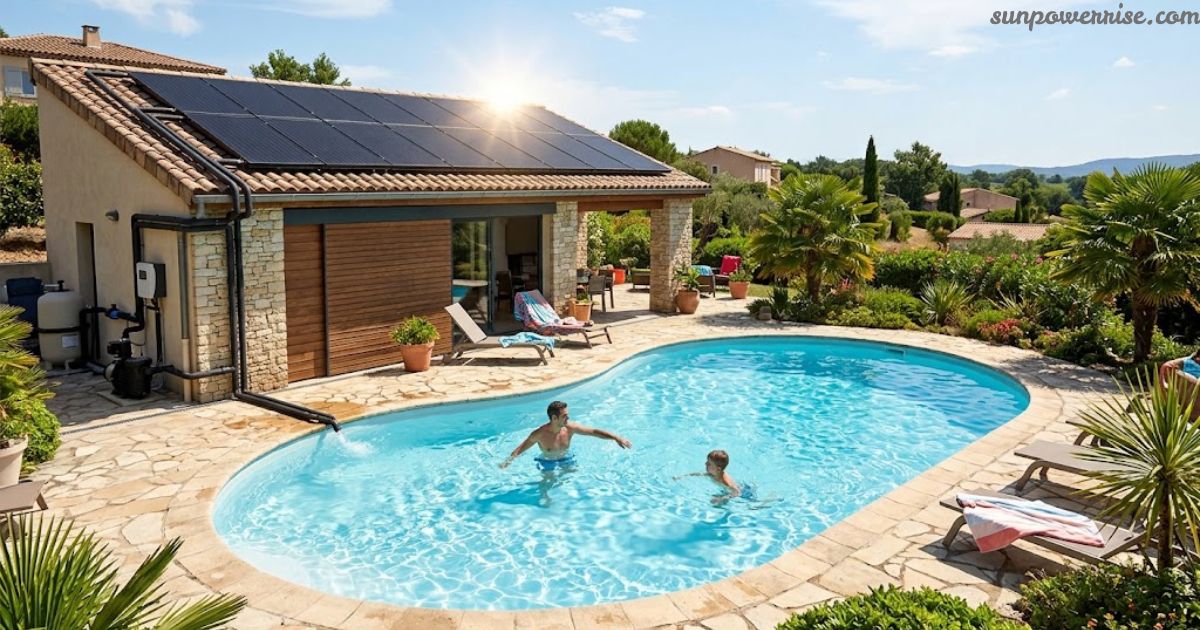
A solar pool heater makes heating a swimming pool with solar energy possible, warming your water for free without burning gas or drawing extra electricity.
I remember the first summer I stopped paying for gas to heat my pool. It felt strange at first, almost too simple, yet the water stayed warm, and my bill stayed small. That’s really the whole story behind solar pool heating, and I want to walk you through it the way I wish someone had walked me through it back then.
How Heating a Swimming Pool With Solar Actually Warms
Compared with old-style boilers running on oil or LPG, solar thermal heating is both more efficient and cheaper to run for any swimming pool, since the fuels used by traditional systems keep climbing in cost.
A well-sized solar thermal heating system can cover 60–80% of a pool’s energy requirements and heating requirements, particularly for outdoor pools used mostly across summer.
System Setup & Plant Room Placement
The setup itself isn’t complicated: a solar collector gathers warmth and passes it through a heat exchanger into the water, and owners can choose a mixed system that pairs solar with a standard swimming pool heater, whether they’re running an indoor pool or an outdoor pool.
For the best results, everything should sit within 25–30 metres of the plant room, with the panels fixed to the roof, near the poolside, or on the side of the building, and wired straight into the pool circulation and filtration system rather than the home’s space-heating system.
Sizing, Materials & Roof Orientation
The size of the pool you own decides the energy performance you actually need, and a sealed circuit made from plastic piping or corrosion-resistant piping, such as PVC or stainless steel, keeps everything chlorine-resistant over time.
Ideally, panels face a south-facing roof, with shading and roof aesthetics both worth considering, and many closed systems run a glycol solution as antifreeze inside these closed-loop systems, though a lot of pool-specific setups simply circulate pool water directly instead.
Heat Absorption & Temperature Management
Inside each panel, an absorber captures light and turns it into heat, and the whole process is electronically monitored, so pumps and a filter only kick in when needed.
This is how you get low maintenance, a quieter system, and an installation that usually wraps up in just a few days. Comfortable swimming sits around 26–28°C, though you’ll need to keep an eye on the chlorine level at that range to stop bacteria and algae growth from building up.
Alternative Setups & Flexible Options
Beyond fixed panels, solar radiation alone can lift the water by as much as 5°, changing the water temperature noticeably once it passes through the filter circuit and solar collectors with help from a water pump.
Other setups use solar domes or solar heating mats connected through a basic pipe system, a route that suits an above-ground pool particularly well, and any solar water heater arrangement depends a lot on your garden layout feeding back into the water circuit.
Why So Many Pool Owners Are Turning to the Sun
Many swimming pool owners in the UK deal with unpredictable weather and rising energy bills every year, especially through the cold off-season when the pool just sits there, unused and quietly costing money.
Switching to solar power taps straight into free sun’s energy, turning an ordinary swimming session into something almost free to enjoy, and moving away from conventional pool heating toward heating a swimming pool with solar is exactly why so many people go looking for a proper guide before they spend a penny.
Climate change has already pushed temperatures higher than most of us expected, and heatwaves now feel like a normal part of summer rather than a rare surprise; parts of Europe have recorded 40C readings more than once in recent years, and Las Vegas once hit 115F (46C) for four consecutive days, breaking an old record first set in July 2005.
On a hot day like that, a pool without proper heating balance loses a lot of its appeal, and that’s exactly the gap a solar energy-powered heater fills.
Every Type of Solar Heating Worth Knowing About
Solar Thermal Pods & Flat Plate Collectors
Solar thermal pods, sometimes called domes, offer a compact way to cut heating costs, and you can bolt them onto an existing heating system or run them completely on their own, whether you have in-ground pools or above-ground pools.
A flat plate collector works through a flat plate absorber sitting under a transparent cover that lets solar energy in while limiting heat loss; the unglazed type grabs a high amount of energy even at lower temperatures, because swimming pool water flows straight through it.
Evacuated Tubes & Solar Thermal Matting
Evacuated tube collectors rely on vacuum tubes to warm their solar absorbers, doing well in colder conditions and reaching higher temperatures, though they suit domestic hot water better than direct pool heating.
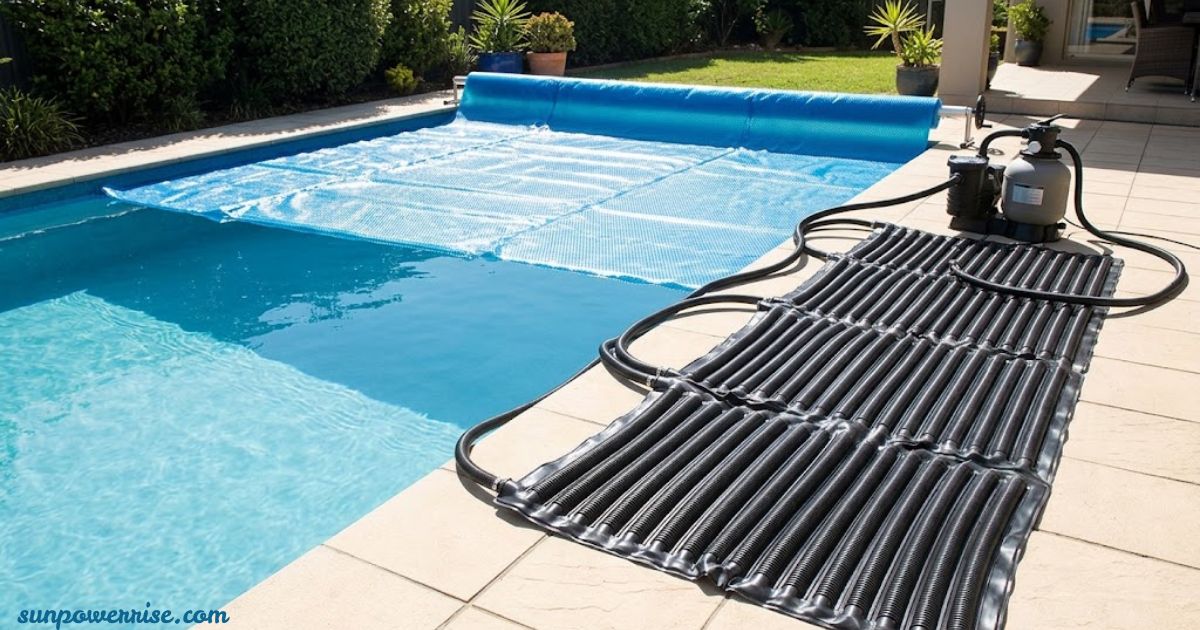
Solar thermal matting remains a low-cost option for the summer months, raising water to a comfortable optimum level and stretching the seasonal time you get to swim, all while cutting utility bills and maintenance costs thanks to P.V.C. manifolds plumbed straight into the swimming pool filtration plant.
Core System Components & Collector Types
Broadly speaking, solar pool heating systems and photovoltaic systems both rely on solar collectors, a filter, a pump, and steady water circulation managed by flow control valves.
Collectors are usually built from heavy-duty rubber or plastic and come unglazed or glazed the unglazed kind suits indoor pools or milder weather, while glazed collectors like solar pods use tempered glass for real year-round swimming.
Solar Tarps, Pool Covers & Flexible Solar Mats
For a cheaper fix, heat-conserving tarps, also known as a bubble tarp, keep out impurities, slow down algae, and trap warmth overnight.
A plain plastic tarp does the job, though calling it a solar tarp or solar pool cover isn’t quite accurate at around 10 euros per m2, since it mostly helps on windy days and through the night rather than actually heating anything.
A solar mat, also called a solar carpet or heating carpet, is built from flexible black hoses hooked into the filtration system, easy enough to roll up for storage, and available from any pool dealer for roughly €100 and €200 per square meter just make sure it covers 30 to 60% of your pool’s surface area to actually work.
How Many Panels You Actually Need
When planning on heating a swimming pool with solar panels, several deciding factors shape the right number of solar panels for your setup, including the size of pool, the average temperature you’re chasing, and how much warmth you genuinely want.
It stands to reason that larger pools and deeper pools call for more panels, and the Swimming Pool and Allied Trades Association (SPATA) recommends aiming for panel coverage of at least 50% of your pool’s surface area for a typical 11mx4m pool, that comes to a minimum of 22m2 worth of panels.
Since equipment choices and your local climate both shift the final count, it’s always worth asking a professional for tailored recommendations.
What It Will Actually Cost You
Here’s a straightforward look at average costs for a minimum 50% coverage level across a few standard pool sizes: a 6m x 3m pool needing 9 m² runs about £881 for matting or £1,335 for pods; a 10m x 5m pool needing 25 m² costs roughly £2,205 or £2,669; and an 11m x 4m pool needing 22 m² lands somewhere around £2,170 or £3,002.
Put simply, solar pool heating panels typically range from £881 to £3,002 for a normal residential pool, while PV panels cost noticeably more, usually landing between £7,026 and £9,837 for a three- or four-bedroom home. It’s worth checking a dedicated guide on solar panel costs if you want the fuller picture.
Even though those upfront costs feel steep at first glance, the savings build up quickly enough that most systems pay for themselves, with the current break-even point sitting around 15.46 years, leaving you with roughly 10 years’ profit after that point.
Faqs
How long does it take to heat a pool with a solar cover?
A solar cover typically raises pool temperature by 10–15°F in about 3–5 sunny days, trapping solar heat and slowing evaporation.
What’s the cheapest way to heat a swimming pool?
Using a solar cover or solar blanket is the most budget-friendly option since it relies on free sunlight instead of costly gas or electric heaters.
How many solar panels do you need to heat a swimming pool?
Generally, solar panels covering 50–100% of your pool’s surface area are recommended for efficient heat absorption, depending on climate and desired water temperature.
Will a pool warm up faster with a solar cover on or off?
A pool warms up faster with the cover on, since it traps heat, blocks evaporation, and shields against cool night air.
Should I turn my solar pool heater off at night?
Yes, turning it off at night prevents heat loss and protects the system, keeping your energy use efficient and your pool cozy for the next sunny day.