

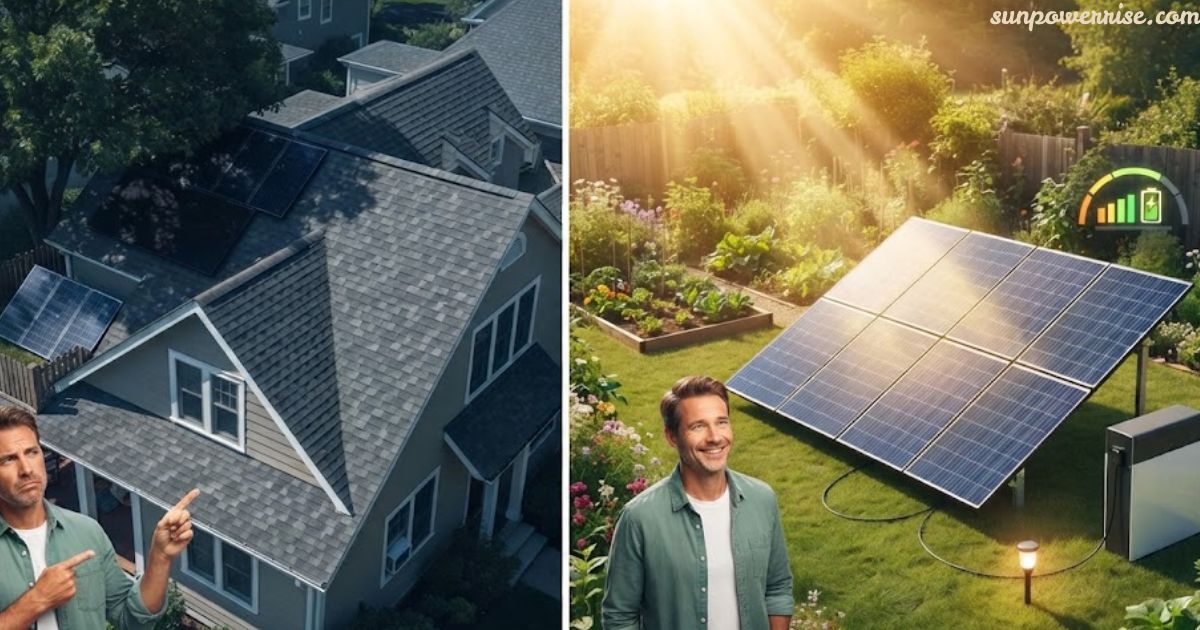
Garden solar panels turn your outdoor space into a source of renewable energy. Many homeowners who shop for solar panels for garden projects start with rooftop solar panels, but a shaded roof, an unsuitable roof, or a roof too small for the job can stop a roof installation before it starts.
Ground-mounted solar panels solve this because they sit on open land or in large gardens and give you full flexibility on where to put them. Your energy generation goal and your spare roof space decide how much panel area you need. Planning matters too, and planning permission rules for stand-alone domestic solar in England changed on 27th August 2026, while the UK has different rules by nation.
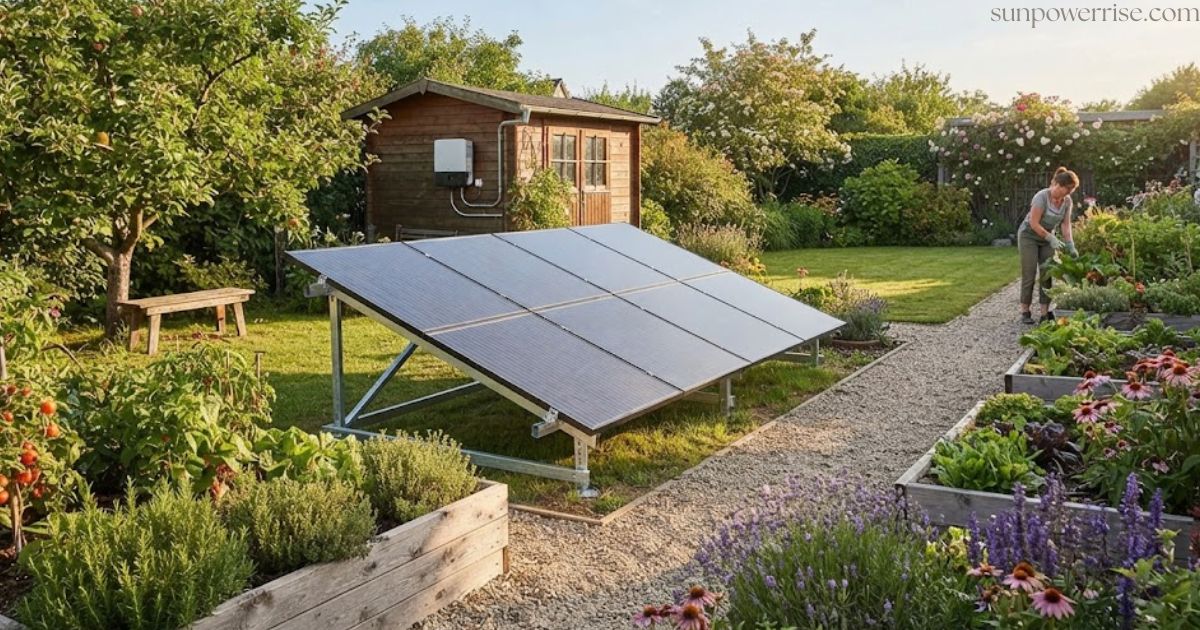
For a house, Class B permitted development caps the panel area at 9m². The maximum height is 1m, 2m, or 4m, depending on the boundary, the principal elevation, and protected land.
Garden Solar Panels Rules
The Planning Portal now separates the rules for a house from those for blocks of flats, and it adds a location-based height test. A householder who wants garden solar must keep a stand-alone array under the 9m² array-area limit. The portal also calls this a panel-area limit and a size limit, and it sits under the 2026 changes in England.
The height limit depends on where the array sits. Within 5m of the boundary and forward of the principal elevation, you get 1m, and elsewhere near the boundary you get 2m. In a conservation area, a spot nearer a highway than the nearest part of the house also gets 2m, while other spots get 4m, and prior-approval requirements may apply.
Some places carry tighter rules and additional restrictions. You cannot use this route for listed buildings or scheduled monuments, and World Heritage Sites, heritage locations, and article 2(3) land face extra checks. Modern domestic arrays often need more room than this, and current-format modules vary in dimensions, so 9m² may hold only a handful.
Permission Planning
Planning is devolved, so Wales, Scotland, and Northern Ireland use their own planning frameworks, and local restrictions can apply anywhere. Your garden does not escape planning control just because the panels are not on the roof. The electrical connection must also follow DNO rules, so check them before you buy equipment or start groundwork. A small swap, like a replacement solar panel for garden lights, usually sits far outside these rules.
Cost & Savings
One garden room with eight solar panels and a battery costs £6,354 and cuts the annual electricity bill by £918. That trims your electricity bills and gives a return on investment in just under six years. Solar is sustainable, so it works as a long-term solution for energy efficiency and lower energy costs.
The savings show up in every season. In Jan–March, the bill drops from £490 before solar to £273 after solar, an estimated saving of £217. April–June falls from £290 to £46 and saves £245, July–September falls from £361 to £103 and saves £257, and Oct–December falls from £491 to £292 and saves £199.
Ground kits carry different prices. Pitch Perfect costs £2,995 + VAT, Pitch Perfect Max costs £3,995 + VAT, and delivery and installation adds approx. £1,000. Compare a garden / ground mount with a roof mount: the cost of a roof mount often includes scaffolding and roof access, while a garden / ground mount needs a mounting frame. Both use solar panels, but the extras differ. If you only need to fix dim path lights, a replacement solar panel for garden lights costs a small fraction of a full system.
Benefits / Why Choose Garden Solar
I give 6 reasons to choose garden solar, and the first is money. You generate electricity from free sunlight, which means lower electricity bills and reduced reliance on the grid over the long term. With ever increasing utility costs, solar looks more affordable each year, and it brings low operating costs and low maintenance. A garden room owner gets the same gains on a smaller scale.
Next, financial incentives from energy suppliers and local authorities can cut your installation costs. You also gain energy independence because you lean less on external sources, which helps during energy crises and disruptions. Potential buyers like lower bills and environmental sustainability, so you may see increased property value.
Ground systems suit certain homes best. If you have a shaded roof, a roof that is too small, a roof facing the wrong direction, a roof that is architecturally unsuitable, or one due for replacement, ground-mounted solar panels step in.
A large garden or plot of land in a rural or semi-rural area with a straightforward cable route suits solar panels for garden use very well. You can place panels in the sunniest areas on open land and leave your home’s roof alone. Flexible installation also lets you add panels later, since the system gets scaled up easily.
Size Requirements
The Energy Saving Trust puts the average home solar system at 4.5kWp, and it uses about 20–30m² of roof surface. A whole-home array therefore needs far more room than the 9m² permitted-development limit in England for a stand-alone setup. So I would never ask how many panels I can squeeze into the garden.
Start with your energy requirement and ask how much generation the property needs, what area that takes, and which planning route fits that design. That is the design reality: the permitted-development limit is not a sizing target. A modest system can work in 9m², but annual electricity use, an EV, a heat pump, or a battery strategy may call for more, so let electrical design and planning follow your needs.
A standard installation of Pitch Perfect needs about 8 metres of length, 3 metres of width, and 2 metres of height. That compact footprint suits many garden sizes, and a ground-mounted system of this kind fits most plots.
Site Assessment & Garden Preparation
A clear patch of grass does not make a good site by itself. I begin with annual generation, shading, and electrical constraints. Check your solar resource as well, because orientation, tilt, and seasonal shade all count, and trees that look harmless in summer throw winter shadows while future tree growth makes it worse. Even a replacement solar panel for garden lights needs a sunny, unshaded spot to work well.
Face the panels south, with no more than 15 to 20 degrees of drift. Keep fences and buildings clear of the array, and pick fairly level ground. Leave installation space of about 8m by 3m, and plan your layout before you buy anything.
The cable route may run tens of metres from the consumer unit or inverter location, so check cable sizing, protection, and voltage drop. Keep a 240v AC power supply close by. Security matters too, because a garden array is easy to reach, and mowers, strimmers, children, animals, rodents, vehicles, and theft risk all threaten physical damage.
FAQs
Do I need planning permission for garden solar panels in England?
Not always, but you must follow the permitted development rules. For a house, a stand-alone array can cover no more than 9m², and the maximum height is 1m, 2m or 4m, depending on where it sits. A larger array, or a spot in a conservation area, near a listed building or on protected land, may need a planning application.
How much do garden solar panels cost?
The price depends on the system size and your site. A Pitch Perfect ground-mounted kit costs £2,995 + VAT, and Pitch Perfect Max costs £3,995 + VAT. Delivery and installation adds about £1,000. Ground conditions, trenching, cable runs and distance from the house can push the total higher.
What is the best angle and direction for garden solar panels?
In the UK, the ideal tilt is about 30 to 35 degrees. Face the panels south, with no more than 15 to 20 degrees of drift. Adjustable angles let you change the tilt with the seasons, which can raise energy production, and you should keep trees, fences and buildings from casting shade.
Do I need DNO approval or an MCS installer for a garden system?
Yes, a grid-connected system must follow DNO rules, whether it sits on a roof or in a garden. G98 covers systems up to 16A per phase, and G99 covers anything above that. To earn Smart Export Guarantee payments, you normally need an MCS certificate or a recognised equivalent, so a DIY job usually falls short.
Can I just replace a solar panel on my garden lights instead of buying a full system?
Yes, if your only problem is dim path or fence lights. A replacement solar panel for garden lights costs far less than a full system, and it sits well outside the planning and DNO rules. It still needs a sunny, unshaded spot, so check for shade before you buy.