

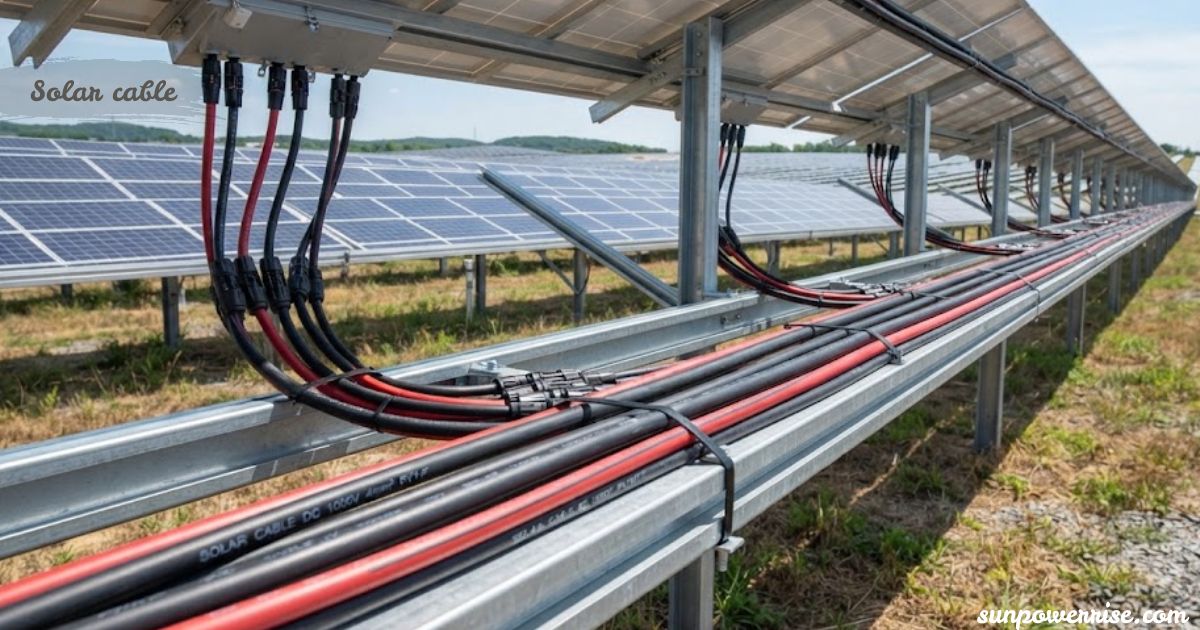
Solar cable work sits at the heart of every reliable solar panel system, and I have spent years around solar power projects across the UK learning just how much that single detail matters.
Renewable energy has grown fast in Britain, with roughly 1.5 million rooftops and fields now hosting solar power installations that push out close to 16GW of clean electricity from captured sunlight.
Most solar power kits and packages arrive without the right cable solar panel setup included, because every solar panel system is different and manufacturers keep the package price low by leaving that choice to you.
That is exactly why I built this guide, complete with a solar cable calculator that helps you settle on the correct cable size before you even open a toolbox.
What Are Solar Cables?
A solar cable is nothing like a normal cable you would grab off a hardware shelf, and I learned that lesson the hard way after trying a cheap substitute on an early project.
Real conductor material for photovoltaic installations almost always means pure copper, sometimes finished with tin or a tin coating to fight oxidation and corrosion before either problem starts. Silver conducts even better, yet it rarely shows up in solar arrays because the cost makes no sense for everyday specifications.
How Do Insulation Standards And Temperature Ratings Affect Solar Wire Selection?
The insulation wrapped around that conductor material decides how well a cable survives the outside world, and this is exactly where standards matter.
PV wire and USE-2 wire both rely on cross-linked polyethene, known as XLPE insulation, which stands up to ultraviolet light, UV radiation, ozone, moisture, and general extreme weather without breaking down early.
THHN wire, sometimes called building wire, shares the same voltage rating of 600V and 90°C ceiling as USE-2 wire, but that number drops to just 75°C once wet environments come into play. I only use it for indoor solar wiring, tucked into a shed, garage, or attic, never as a swap for PV wire or USE-2 wire when the job specifically calls for those.
What outer jacket and core types are best for durability?
Beyond the core, the outer jacket on a working solar cable is usually plastic or rubber, chosen for its heat resistance and toughness against direct sunlight.
Aluminium occasionally turns up in budget wiring, but it fights harder against conductivity than copper conductors do, so I steer clients away from it whenever the electrical load truly matters.
Solid core cable feels stiff and cracks with movement, while stranded wire offers more surface area, better flexibility, and a genuinely flexible feel that survives years strapped alongside charge controllers out in the elements.
How to Connect Solar Cables
Connecting panels always comes down to good connectors, and the industry mostly settled on the Stäubli MC4 connector for a reason: it locks tight and shrugs off years outdoors.
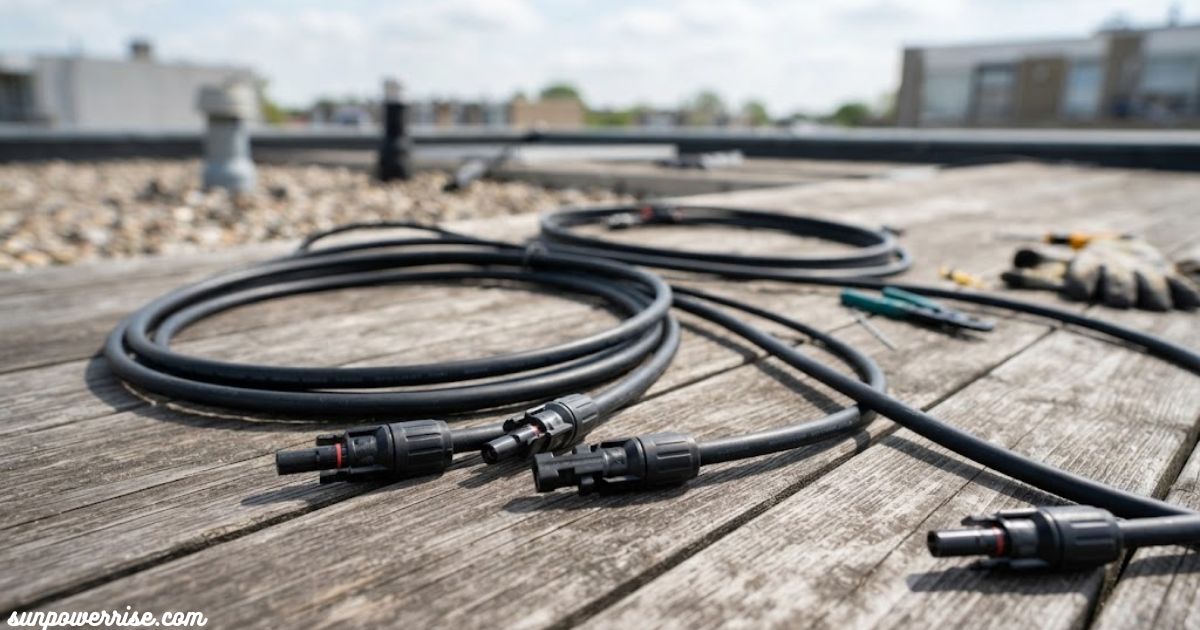
Older designs like the MC3, plus rivals such as Helios H4, SolarLok, and Radox, still show up occasionally, but none snap together or resist getting unplugged as confidently as modern MC4 connectors do.
Wiring modules in series raises voltage while current stays constant, and wiring them in parallel does the opposite, which is why multi-branch connectors exist for parallel strings.
Step-by-Step Guide to Assembling Solar Cables
Building your own solar panel cables starts with basic tools: wire strippers, crimpers, tightening tools, pins, and a matching male connector and female connector for every photovoltaic module.
This is also where a 6mm solar cable often comes into play, since I always strip insulation back about ¼ inch, roughly 6mm, on the positive wire before fitting the pin into the largest slot of the crimper and giving it a firm squeeze until it holds.
From there you crimp the wire down, sometimes needing a second pass depending on wire gauge, then slide on the end cap and the compression sleeve before pushing in the male connector until it gives a satisfying click. A tightening by hand comes next, finished off properly with a special tool so the lock truly holds and the joint stays watertight.
How Long Can Solar Panel Cables Be?
Cable lengths vary hugely across the solar world, and some manufacturers happily sell solar cables stretching past 100 metres for large commercial roofs.
There is no true maximum cable length for a single photovoltaic panel, but every extra metre of cable length raises the voltage drop-off, and that forces you toward a bigger diameter and a larger cable size to compensate.
Experienced installers know this instinctively, which is exactly why a proper length check belongs at the very start of any wiring plan for a solar panel with cable already fitted, not as an afterthought once the panels are already mounted.
How Far Can You Run Solar Panel Cables?
An efficient solar photovoltaic array always uses the shortest reasonable cable run, not the longest one, because distance is the enemy of clean power delivery.
I generally tell clients to keep panels within 50 feet of the main equipment, since pushing further invites a bigger voltage drop than most systems can comfortably absorb.
Smart location choices for inverters and batteries matter just as much as the cable itself, because grouping this equipment close together shortens every solar panel cable run and protects overall efficiency.
Joining Solar Panel Cables
A short solar panel cable does not have to stay short forever, because extending it is a normal part of most installs.
When you need to connect solar cables, whether that’s a full cable solar panel run or a short 6mm solar cable extension, end to end, a proper waterproof connector keeps moisture out far better than tape ever could. A solder sleeve works just as well for a permanent join, and either method beats leaving a fragile splice exposed to the weather.
Solar Cable Specifications
Picking the right cable size always comes down to two numbers: the length of the run and the power each solar module produces. I built a table below showing the minimum cross-section area for a two-core cable on 24V panels, keeping voltage loss under 5% across different metres of cable and different watts of output.
Beyond the chart, understanding gauge matters just as much, since thinner thickness over a longer cable length raises resistance, and higher resistance wastes power through energy loss or, in the worst case, risks an electrical fire. Plenty of online calculators and charts exist to save you the maths, and I lean on them constantly instead of guessing at current and mm² by eye.
FAQs
Do I need 4mm or 6mm solar cable?
It depends on your current load and cable run length, 4mm solar cable suits shorter, lower-amperage setups, while 6mm handles higher power and longer distances with less voltage drop.
What cable do you use for solar?
Always use a dedicated solar cable, typically PV wire with double-insulated, UV-resistant, and weatherproof coating designed for outdoor, high-voltage DC applications.
Is solar cable different to normal cable?
Yes, solar cable is built with thicker insulation, UV protection, and heat resistance to survive outdoor exposure, unlike standard household wiring.
What size cable should I use for my solar system?
The right cable size depends on your system’s amperage, panel distance, and voltage drop limits. Larger systems and longer runs need thicker cables for safe, efficient energy flow.
What are common solar panel wiring mistakes?
Frequent errors include undersized cables, poor connections, ignoring UV-rated wiring, and skipping proper grounding, all of which risk energy loss or safety hazards.