

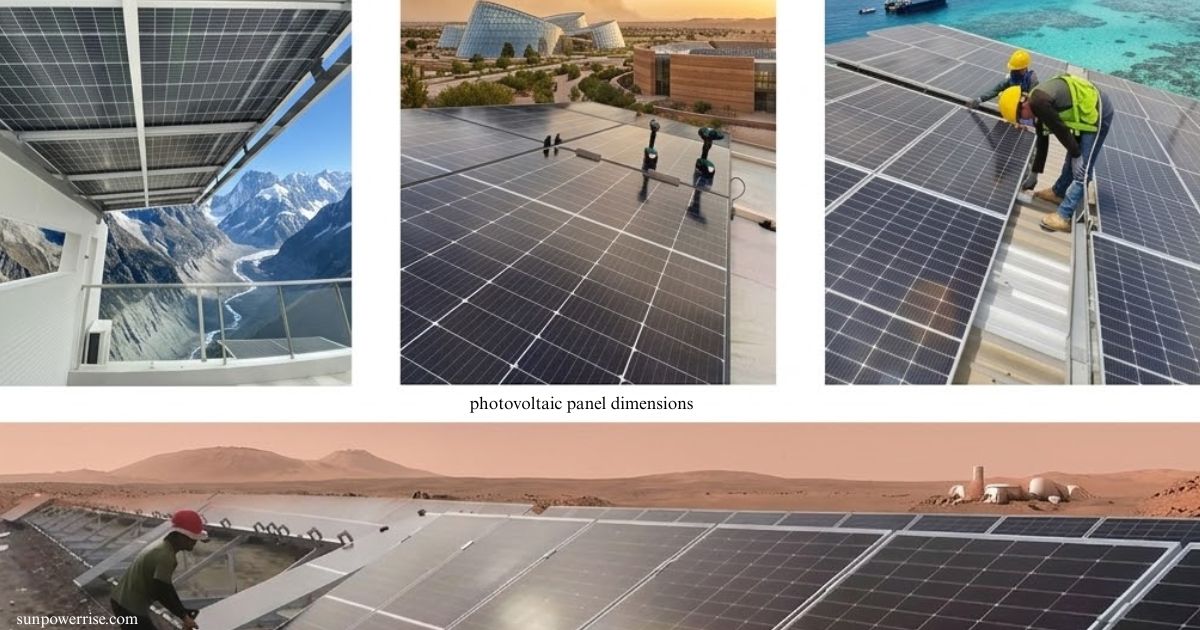
A standard photovoltaic panel dimensions in the UK is roughly 1.7m to 2m long, around 1m to 1.1m wide, and 3-4cm thick, with residential panels sitting toward the smaller end of that range and commercial panels toward the larger.
But the number on a spec sheet only tells you part of the story. What actually matters is how that size behaves on your roof, in your wattage bracket, and over the 25-year lifespan of the system, which is where most guides, and most quotes, fall short.
The UK market has made huge progress in making renewable energy accessible, and both residential and commercial properties can now benefit from solar panel sizes suited to their exact needs.
Getting your sizing right from the start means lower energy bills, better carbon emissions control, and a stronger Energy Performance Certificate score that keeps you ahead in UK property compliance.
Standard Solar Photovoltaic Panel Dimensions In The UK
Residential Panels
Residential UK installations mostly split into two formats: 60-cell and 72-cell panels, each suited to different roof sizes and energy needs.
- 60-cell panels: around 1.65m x 1m (1.6m²), 270W–340W output, 18kg–20kg
- 72-cell panels: around 2m x 1m (2m²), 350W–400W output, 22kg–28kg
Commercial Panels
Commercial installations lean heavily on 72-cell panels as the default, while the largest sites sometimes step up to 96-cell panels up to 2.1m x 1.1m, 450W–550W, and as heavy as 35kg.
Flat roofs and ground mounts give commercial sites more layout flexibility than angled residential roofs, which usually brings installation time and cost-per-watt down.
Typical commercial dimensions sit around 195cm x 99cm x 3.81cm (L x W x H), against roughly 189cm x 100cm x 3.99cm for standard residential panels.
Average Dimensions Of Leading Solar Panels
Manufacturer data varies more than people expect: SunPower panels measure around 1812 x 1046 x 40mm, Tesla panels around 1890 x 1000 x 40mm, and Panasonic panels around 1722 x 1133 x 35mm each shaped slightly differently to suit different roof layouts.
Across independently reviewed panels currently on the UK market, the average size works out to roughly 1,945.5mm x 1,130.1mm x 31.25mm, with an average weight of about 23.4kg. The lightest of these is the AIKO Neostar 3P54 470W at 21.1kg; the heaviest is a JA Solar model at 28.8kg a reminder that weight and dimensions don’t always move together.
Bigger Isn’t Always Better: Watts Per Square Metre
Here’s the mistake I see property owners make constantly: comparing two panels purely on wattage and assuming the higher number wins. A 500W panel sounds better than a 450W one until you realise it might be 15% physically larger to get there, which means it’s actually less space-efficient on your roof.
The number that actually matters is watts per square metre (W/m²), essentially the panel’s efficiency once you strip out sheer size. Most of the wattage growth the industry has seen over the last decade has come from manufacturers making panels physically bigger, not from meaningfully better conversion efficiency.
A panel from the early 2010s averaged around 290W; today’s average sits well over 400W, and premium panels break 500W, but a lot of that gain is footprint, not innovation.
Why Panel Dimension Matters
Photovoltaic panel dimensions affect far more than how your roof looks after installation. Output depends directly on how well wattage is matched to available roof area, and poor sizing decisions cause downstream problems with mounting, labour costs, and long-term returns.
Building regulations set clear boundaries on how a system must fit within a property, and those rules tie directly back to your choice of panel dimensions and total system wattage. I’ve seen projects delayed simply because the initial sizing ignored the compliance checklist before ordering panels.
A correctly sized system reduces running costs, protects your investment, and keeps your property aligned with current compliance standards without last-minute surprises once the installer is on the roof.
Solar Panel Sizes and Wattage
Most domestic UK installations use panels between 250W and 450W; commercial installations typically run from 400W to 600W depending on scale.
Every panel carries a wattage rating measured under Standard Test Conditions (STC) 1,000W of irradiance per m² at a cell temperature of 25°C, which is the industry benchmark for maximum output, not a guarantee of real-world performance.
Multiply panel count by individual wattage, and you get total kilowatt-peak (kWp) the standard measure of a system’s full rated capacity. UK weather realistically delivers around 85% of STC rating, so a 4.5kWp system produces roughly 3,825kWh of annual output.
For reference, MCS’s own installation data puts the average UK residential solar system at 4.6kWp as of early 2025 useful context if you’re trying to work out whether your own roof is being under- or over-specified.
How Panel Dimensions Are Actually Decided
Panel size isn’t arbitrary it’s driven by the number and size of the solar cells packed inside the frame. Most modern panels use half-cut cells: standard cells physically cut in half, which reduces internal resistance and slightly improves shade tolerance without changing the panel’s overall footprint much.
More recently, manufacturers have shifted to larger silicon wafer formats commonly referred to as G12 (210mm) and M10 (182mm) which let a panel pack more power into a similar or only slightly larger frame. This is why a 2026 panel producing 450–500W can be barely bigger than a panel from 2018 producing 300W: the gain is in cell technology, not sheer size.
Bifacial panels are the other development worth knowing about if you’re weighing up a flat commercial roof or ground mount they generate power from both sides, using reflected light on the underside, but need slightly more clearance beneath the frame and are rarely used on standard pitched residential roofs.
Factors Affecting Panel Size
The main factors that decide which panel size suits your property are cell count, panel type, manufacturer standard, and your own roof size. Monocrystalline, polycrystalline, and thin-film panels sit at different points on the wattage-to-space scale.
The right order of operations: match total system size to your annual energy consumption first, then work backwards to the panel wattage and dimension combination that actually fits your available roof space not the other way round.
How Heavy Are Solar Panels?
Standard residential panel weight in the UK falls between 18kg and 21kg; commercial panels typically run 22kg–30kg once frames and mounting are factored in.
But panel weight is only part of the load story. A complete system panels plus mounting rails, clamps, and fixings weighs meaningfully more than the panels alone. On a typical 12-panel residential system, mounting hardware alone can add 45–50kg on top of the panels themselves, which matters when a structural surveyor is assessing total roof load, not just panel specs.
Most modern UK rooftops carry a rafter load capacity of around 140kg per square metre, and a solar array adds roughly 20kg per square metre to that dead load about a 15% increase, which most roofs handle comfortably but which still warrants a proper structural check rather than an assumption.
I always recommend a professional structural assessment before committing to a system, because load tolerance varies significantly between older and newer UK builds a Victorian terrace and a 2015 new-build handle the same array very differently.
Roof Space, Spacing & Layout: What Dimensions Mean In Practice
This is the part most sizing guides skip, and it’s the part that actually determines your final panel count.
Panels are never installed edge-to-edge. UK installs follow MCS spacing standards, and typical clearances look roughly like this:
|
Clearance point |
Typical gap |
Why it exists |
|
Roof ridge |
150–300mm |
Structural integrity, water ingress prevention |
|
Roof eaves |
200–400mm |
Prevents overhang, load compliance |
|
Side/verge |
150–300mm |
Wind uplift resistance at edges |
|
Between panel rows |
10–20mm |
Thermal expansion, rail clearance |
|
Around chimneys/stacks |
600mm minimum |
Shading avoidance, structural access |
|
Around skylights |
300–500mm |
Maintenance access |
These aren’t optional extras they’re required for your system to qualify for the Smart Export Guarantee and to keep your installer’s warranty valid. A satellite-based online quote rarely accounts for all of these, which is the single biggest reason an initial online panel estimate and a post-survey panel count can differ.
Roof shape changes your usable count too. A hip roof (with triangular end sections) loses row capacity that a simple gable roof wouldn’t. Pitches steeper than roughly 45° reduce effective panel area because panels can’t sit at their optimal angle relative to the roof surface. Dormers usually sit on flat sub-roofs, which are frequently unsuitable for standard panel mounting regardless of the space they appear to offer.
Solar Panel Dimensions & UK Building Regulations
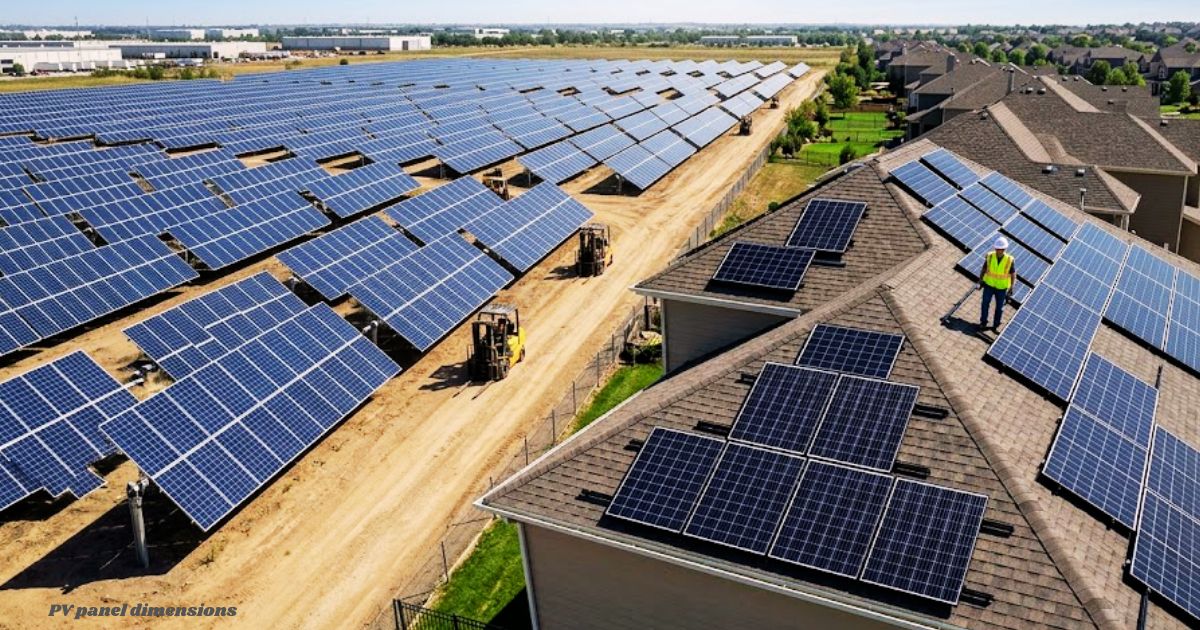
Photovoltaic panel dimensions play a direct role in UK building regulations compliance. The core rule: panels must not extend more than 200mm beyond the roof edge or wall, measured perpendicular to the surface; anything beyond that triggers formal planning approval.
Your array must also stay within 9m² total size, remain below 4m in height, and sit at least 5m from the garden boundary to qualify without full planning permission.
Commercial Settings
Larger commercial arrays bring fire safety planning into the mix alongside structural requirements. Permitted development rights cover most standard homes, but listed buildings and conservation areas always require direct engagement with the local planning authority before work starts.
FAQs
What are the most common sizes of solar panels?
The most common size is around 1.7m to 2m long and 1m wide, producing 250W to 450W, small enough to fit comfortably on most roofs.
What are the dimensions of a Tesla solar panel?
A Tesla solar panel measures 1890 x 1000 x 40mm, a residential-friendly footprint designed for standard rooftop installs.
What are the typical sizes of solar panels in the UK?
UK panels typically measure around 189cm x 100cm for residential use, with commercial panels running slightly larger at about 195cm x 99cm.
Is it better to have one large solar panel or several small?
Several smaller panels are usually the safer choice. They cope better with partial shading, give more layout flexibility, and mean one fault won’t cost you your whole system.