

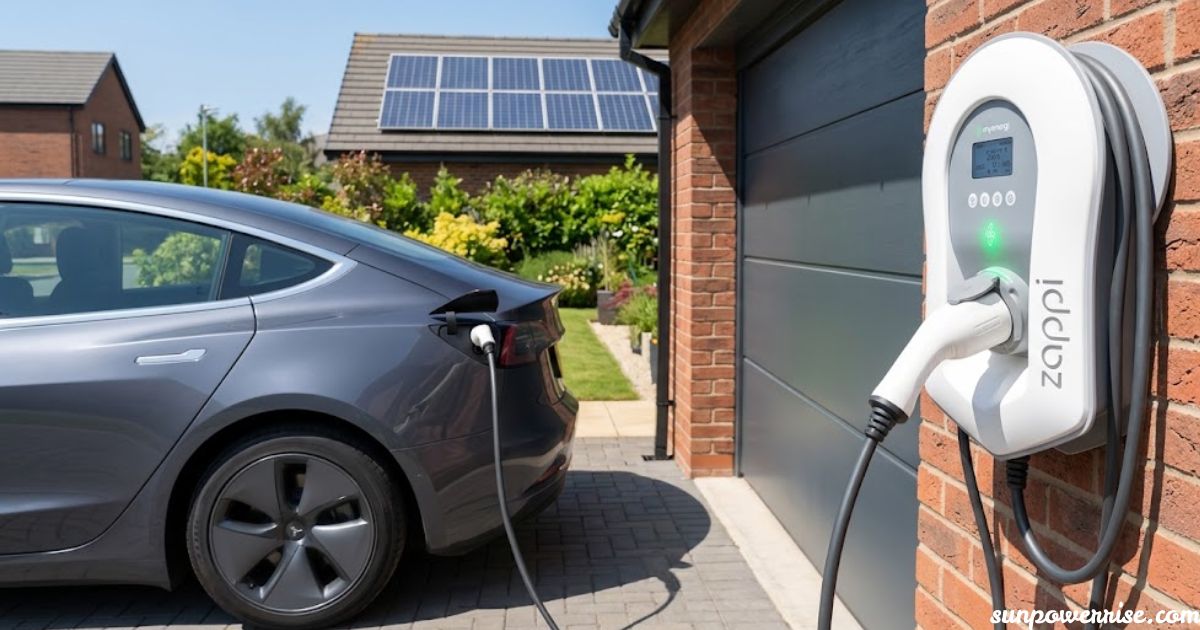
Anyone searching for an honest Zappi EV charger review will find plenty of marketing fluff, but I’ve spent time around EV chargers professionally, and I still remember the first time I plugged a car into a Zappi charger at a friend’s house in the UK.
It wasn’t just another standard car charger sitting on the wall it felt like a genuine solution built for the renewables industry, not an afterthought bolted onto an electric car.
Zappi EV Charger
The Zappi is an EV chargepoint made by myenergi, sometimes still spelt My Energy in older marketing, and the brand has shipped over 500,000 devices globally, which tells you plenty about trust earned over 10 years in this EV market.
What struck me as an EV driver myself is how the unit reads the weather, notices when an appliance switches on in the house, and quietly adjusts power without any fuss. This is the kind of intelligent behaviour that turns a frustrating charging routine into something calm.
It carries three charging modes, including a fast charge mode and two eco charge modes, and it’s genuinely easy to install as well as easy to use, meeting European standards while working as a proper EVSE.
Charging Modes (FAST / ECO / ECO+)
Once I understood the modes, everything about the Zappi clicked into place for me. In FAST mode, the unit behaves like an ordinary EV charging station, pushing full power regardless of solar generation on single-phase that’s up to 7.4kW, and on three-phase it climbs to 22kW, though the actual charge rate always depends on the EV’s onboard charger and the grid supply voltage.
ECO mode keeps a minimum rate of 1.4kW flowing at all times, since the EV charging standard won’t allow anything lower, and if the appliance load or cloudy weather cuts into your surplus solar power, the shortfall is quietly pulled from the grid to keep things steady.
Drop that setting to 10%, and it tolerates up to 1,260W imported before pausing, resuming again the moment 140W is exported; push it to 100%, and the car runs on pure surplus alone, right alongside the boost mode and eco mode options sitting next to the standard fast charge mode on the dial.
Design, Versions
Looking at the physical unit, myenergi clearly thought about real households and not just showroom photos.
The current model, the Zappi 2.1, handles both single-phase (7kW) and three-phase (22kW) setups from one single unit, and it’s sold with either a tethered unit carrying a 6.5m cable also written as a 6.5 meter cable for quicker charging, or an untethered unit with its untethered socket so you can bring your own cable and save wall space; the Type 2 connector fits nearly every electric car on UK roads.
Colours
You can pick black and white, choose the black finish or plain white, and every version comes with a function button panel and an LCD screen you can actually read in daylight, plus a lock feature that limits restricted access so a stranger can’t help themselves to your electricity.
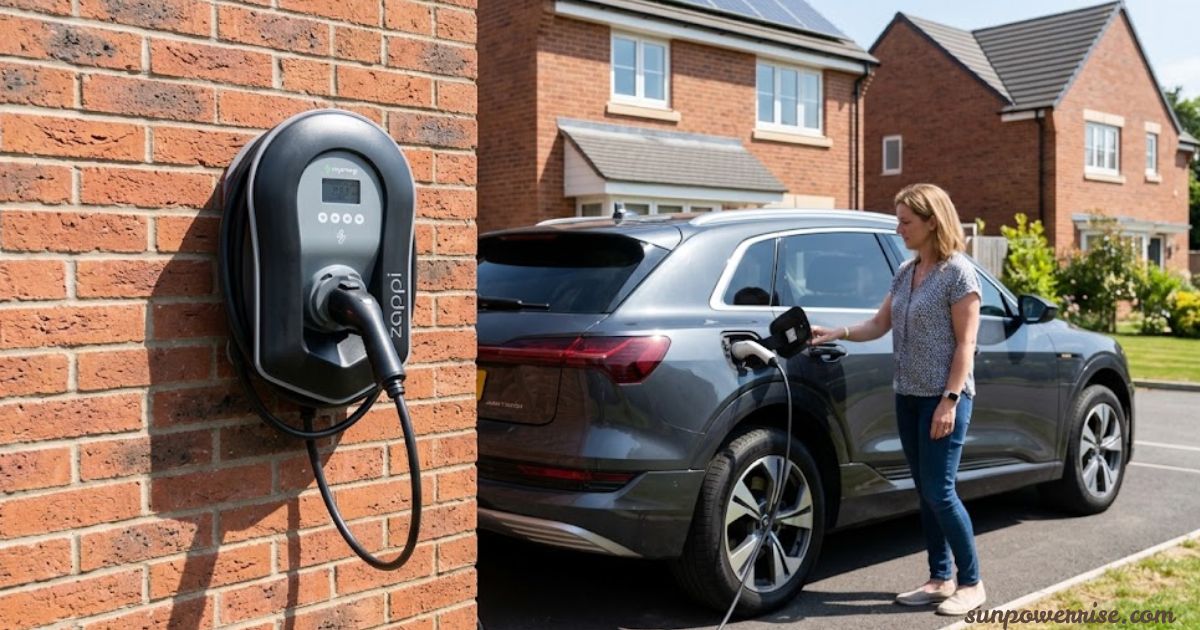
Built-in WiFi and Ethernet mean you skip a separate hub, the PEN fault detection removes the need for a separate earth rod in most domestic installations (worth roughly £100–£150 off your installation costs), and the typical Installed cost runs between £1,400–£1,600 depending on cabling requirements.
Keep the included Zappi EV charger manual handy during setup. It provides a step-by-step walkthrough of every button and setting.
Monitoring & App
None of this matters if you can’t see what’s happening, and this is where the app experience earns its keep.
Through the myenergi app, using either the built-in WiFi or an Ethernet connection, you get everything remotely; the unit stays remotely controlled and monitored from your phone no matter where you are.
I like checking how much surplus energy is going toward car charging versus hot water heating on the linked Eddi, and switching between charging modes, setting schedules, and tracking renewable devices all happens from the same screen without opening a second app for the Zappi.
Boost Functions / Scheduling
The boost functions are where the Zappi really shows off its thinking. Manual boost pushes the maximum rate until your EV battery hits a set charge level, which saves the day after a flat battery ruins your morning and you need just enough for a short trip.
Smart boost works differently, aiming for a minimum kWh figure by a set time say 15kWh ready for 7am on a sunny Sunday- letting solar cover most of it and Smart Boost topping up overnight if the solar surplus falls short of your work plans.
The Boost timer runs the charge rate at maximum during pre-set times regardless of weather, which suits overnight off-peak tariff charging, while Economy tariff boosting only switches on when your supplier’s economy rate electricity or Economy 7 night rate kicks in.
And the whole thing pairs neatly with the unit’s own charging scheduling capabilities, scheduling, and programmes sitting behind the ECO+ modes and plain ECO setting.
Eddi, Battery Priority & Installation
A couple of extra details rarely get mentioned, but they matter if you’re planning. The Eddi, much like an iBoost or Immersun, takes excess solar generation and redirects it into your hot water tank, and running it alongside a Zappi charger through the myenergi app lets you prioritise either the car or the hot water however you like.
If you’re running a DC-coupled battery system such as a Tesla Powerwall 3 or Sigenergy SigenStor, that battery takes priority first because the hybrid inverter handles solar dispatch directly, and only the surplus left over reaches the charger through a CT clamp setup during installation can be flipped if your team advises it.
On the practical side, flexible finance options are often available for the Zappi EV charger installation, and I’ve seen this pattern especially well handled by installers across Northern Ireland.
FAQs
Are zappi EV chargers any good?
Yes, the Zappi is a trusted EV charger from myenergi, with over 500,000 devices shipped globally, and honestly, once you see it adjust to weather and solar on its own, it’s hard not to feel a little proud of your electric car setup.
Can the zappi EV charger be integrated with solar panels?
Absolutely, that’s really its whole heart. The Zappi charger works beautifully with solar panels, using ECO mode and ECO+ mode to turn surplus power into free energy for your car.
How much does it cost to install a zappi charger?
Installation costs typically run between £1,400–£1,600, though this depends on cabling requirements and whether you need single-phase or three-phase supply.
Who installs zappi EV chargers?
Qualified electricians familiar with domestic installations and commercial properties handle zappi ev charger installation, and many regions, including Northern Ireland, have dedicated teams who know the unit inside out.
Which is the best EV charger in the UK?
Many drivers in the UK consider the Zappi among the very best, thanks to its eco charge modes, PEN fault detection, and genuine focus on renewable energy.