

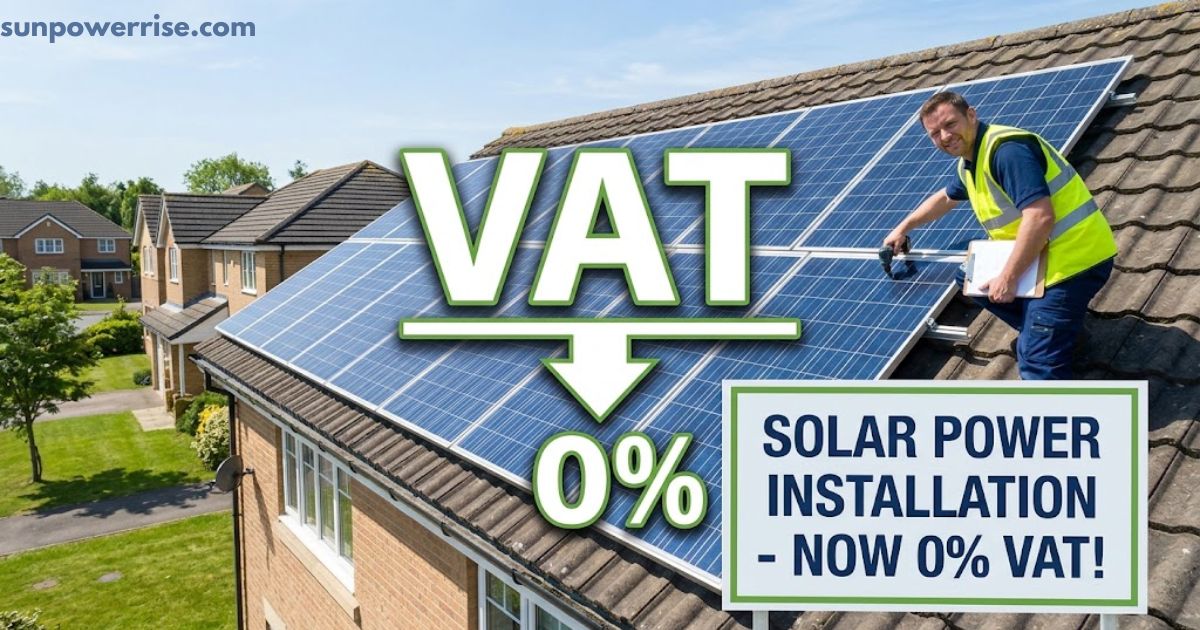
I still remember checking my own energy bill and thinking hard about vat on solar panels the week the energy price crisis hit, right after Russia started its war with Ukraine and rattled the global energy market, and that shock is really what pushed the UK government to act.
VAT on Solar Panels: Installation Charges
From what I’ve seen, installing panels at a residential properties level is refreshingly simple: a professional installer handles the whole job, and thanks to the 0% VAT charge, your solar system costs less from day one though that only applies once a professional actually does the work rather than a DIY attempt.
Business premises, on the other hand, sit under the standard VAT rate of 20%, and that standard rate genuinely affects the financial viability of projects for many businesses, since purchase price, equipment, panels, inverters, and PV solar batteries all carry that extra charge, along with labour and other installation costs.
Most companies simply purchase their solar panels and solar energy panels through the same professional installer, but the government has introduced a VAT exemption for energy-saving equipment aimed at people who want to incentivise their own solar installation and unfortunately this VAT reduction.
Introducing Zero VAT on Energy-Saving Measures
Chancellor Rishi Sunak used the Spring Statement 2022 as his guide, cutting VAT from five per cent to zero on solar panels, heat pumps, and insulation, and he framed the whole scheme as part of wider Energy Efficient Measures built to protect homes and households from rising costs.
These energy-efficient systems all sit under one straightforward VAT rule that keeps evolving as we approach 2027.
He promised genuine tax savings, saying families could see about £1,000 back plus roughly £300 off their energy bills per year, which is exactly the kind of number that got businesses and homeowners thinking hard about the financial consequences of an investment in domestic solar panels.
Legislative Expansion Across Regions
This VAT alleviation, or 0% rate, first became law across Great Britain in April 2022, and the legislation behind it soon grew: Northern Ireland received the same extension through the VAT Installation of ESMs Order 2023 by May 2023, and then, on 1 February 2024, VAT Notice 708/6 widened the ESMs definition to include storage batteries, water-source heat pumps, heating equipment, and charitable buildings.
On 11th December 2023, the Government confirmed the relief would also stretch to charitable organisations and other charitable endeavours, and this zero VAT approach now runs right through to 31 March 2027, when a 5% reduced rate takes over from 1 April 2027.
Lowering Solar Installation Costs
For UK households, the whole point of scrapping the old rate is to cut the installation cost of going solar, since financing a new system, covering the upfront costs, and even claiming solar panel grants all get simpler once energy-saving materials carry no extra charge; meanwhile, businesses running commercial solar panels for generating electricity, earning export income, or backing a Smart Export Guarantee also feel less expensive to set up.
VAT Rate Summary Tables
Think of every Stage of going solar as its own simple Type of cost: Purchase and Installation is the first and most Typical step, and here the VAT Rate sits at 20% for most buyers.
If you look at Financing, options like Hire purchase, Solar leasing, PPA, and Grants each carry a different VAT charged outcome the answer is Yes for the first three, at Upfront or Overtime stages of payment, and No for Grants, which stay at 0%.
Then there’s Grid Export Income, where the answer again depends on status: a VAT-registered business owes 20%, while a Non VAT-registered household pays nothing at all.
VAT on Commercial Solar Income
Once a household starts to sell electricity it doesn’t use, the Smart Export Guarantee, sometimes shortened to SEG, lets a business electricity supplier buy that excess electricity back through the local electricity distribution network.
The VAT treatment on those payments depends entirely on VAT status: a VAT registered company adds tax to its export receipts, while a non-VAT-registered one does not, so the whole VAT-registered companies picture around commercial solar panel systems and their sales stays split down the middle.
For ordinary homeowners, solar export income itself carries no VAT, though income tax can still apply depending on how much your residential property or domestic property produces against your normal usage; HMRC treats this as fine as long as you own and occupy the home and don’t produce more than 120%, or roughly 20% more, than your annual electricity consumption.
As an example, a house with a typical consumption of 4,000kWh would need to cross 4,800kWh before hitting that threshold, and even then any leftover export earnings usually fall under trading and miscellaneous income, which still lets you keep up to £1,000 tax-free a detail worth knowing.
Many businesses and households now track this electricity flow closely, especially once earnings cross into the 20% rate band that can trigger extra VAT.
VAT on Commercial Solar Panel Financing
Investing in a commercial solar panel installation is genuinely expensive, which is why so many businesses choose to finance the project instead of purchasing everything outright, and each agreement brings its own VAT implications.
Under hire purchase financing, a business pays VAT and a small deposit upfront, then covers the remainder of the purchase price in instalments over an agreed number of years; solar leasing, by contrast, skips those upfront installation costs entirely and instead charges a monthly commercial solar leasing charge that already includes tax at 20%.
Under a PPA arrangement, sometimes called Corporate Purchase Power Agreements, a third-party investor pays to install solar panels on your property and then sells you the electricity it helps generate at an agreed price, and those business electricity bills still carry the standard rate.
In certain areas, government grants and business energy grants can reduce those upfront costs further, and helpfully, they don’t attract VAT at all, so before installing anything, it’s worth asking your company exactly how it plans to sell or install the system and this installation stage for commercial solar panels always deserves a second look before signing anything.
FAQs
Has VAT been removed from solar panels?
Yes. 0% VAT currently applies to residential solar panel installations across the UK, lasting until 31 March 2027.
Why don’t all new houses have solar panels?
Mainly upfront cost, roof orientation limits, and builder incentives, not every developer priorities green energy even when it clearly benefits families long-term.
Is there VAT on solar panels in the UK?
No, there’s a 0% VAT rate on solar panels and storage batteries for most UK homes right now.
Do businesses pay VAT on solar panel installation?
Yes, commercial properties pay the standard rate of 20% VAT on solar installations.
Can I get 0% VAT if I install solar panels myself?
No, the 0% VAT rate only applies when a professional installer does the work, not DIY installations.