

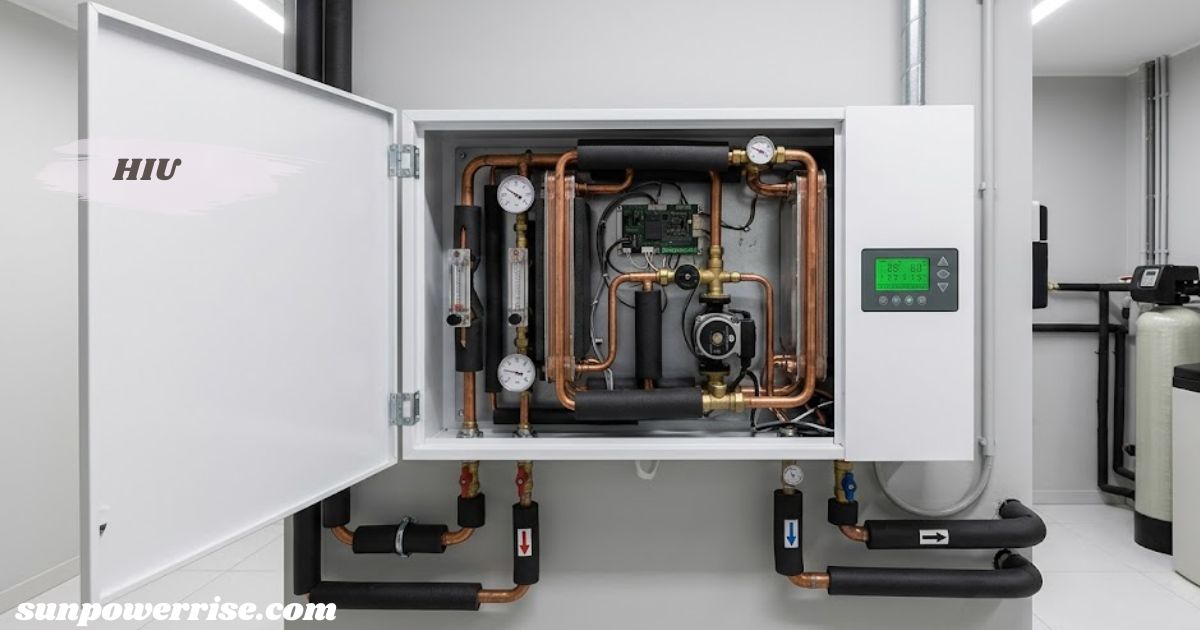
When I first came across a HIU in an apartment complex, I honestly mistook it for a standard boiler sitting on the wall, but it works in a completely different way.
What is a HIU?
A HIU, short for Heat Interface Unit, acts as a bridge between the central boiler and every hot water outlet inside an individual apartment, including taps, showers, and radiators, without ever needing to generate heat itself.
These units sit inside individual properties, dwellings, and even apartment blocks, residential developments, educational facilities, and commercial buildings, drawing hot water through insulated pipework from a central energy plant and a wider central heating network so that every dwelling stays warm, connected, and comfortable while building owners enjoy real cost savings and energy savings for their users.
How Does a HIU Work?
From my own experience walking through plant rooms, I’ve noticed that a HIU gets installed inside each property’s unit in a complex just as a regular boiler would be, then gets connected to one shared central boiler through a system of pipes.
Intelligent Heat Transfer & Control
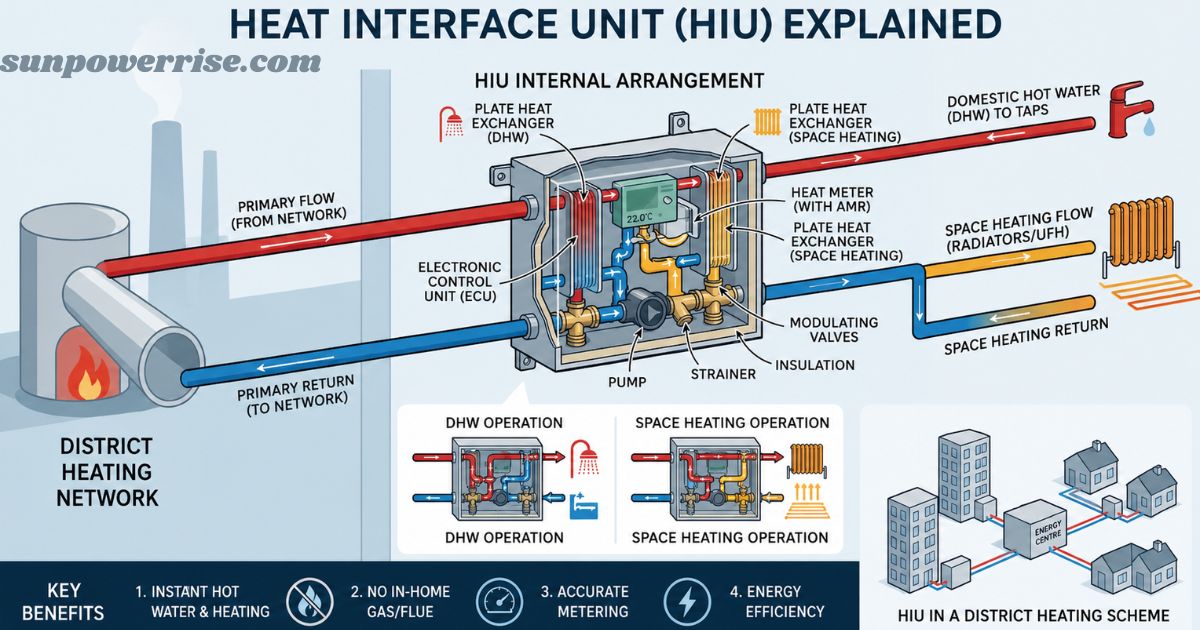
Inside the casing, one or two-plate heat exchanger technology handles the heat transfer, turning it into instantaneous heating and hot water that residents can use at their individual discretion, and brands like Altecnic build in an internal electronic control unit for maximum efficiency, faster reaction time, and smoother control.
Thermal Efficiency & Quick Response
Modulating valves manage the supply for both space heating and domestic hot water, while thermally insulated casings cut down on heat loss, and this whole setup of plate heat exchangers, an electronic control unit, and steady system performance keeps response times quick, comfort high, and energy efficiency strong for every HIU’s owner.
Benefits of HIUs
Energy Efficiency & Cost Savings
The UK government has been pushing district heating systems hard, and once you compare them to traditional heating systems, the advantages become obvious better energy efficiency, real cost savings, and long-term energy savings for landlords and tenants alike.
Environmental Targets & Gas-Free Safety
These systems help buildings hit low-carbon targets and meet renewable energy targets and requirements, since even with a central gas boiler in place, there’s room to bring in CHP, biomass, solar, and heat pumps, delivering instant hot water on demand without wasting energy through heat build up or dissipation.
The units stay responsive, offering instant supply, which keeps energy bills down thanks to communal heating, CO2 reduction, and lower running costs, all while removing the gas supply and any risk of carbon monoxide emissions, and giving occupants clear visibility into their energy consumption.
Streamlined Installation & Maintenance
On the practical side, installation and maintenance requirements shrink because everything centres on one plantroom, cutting down servicing time and proving far more cost-effective than covering labour requirements.
And time-consumption property by property this minimised installation approach brings long-term cost savings, simpler work on components for the engineer, and full compliance with renewable energy requirements, so long as the system is designed, installed, commissioned, and sized correctly.
Space Optimization & Consumer Advantages
Combining space-saving technology with fast response times, improved energy monitoring, lower maintenance costs and reduced operating expenses, the system offers an efficient heating solution for modern buildings. Its compatibility with solar thermal sources enables low-carbon heating while eliminating energy losses from stored hot water.
What is a Heat Network?
A heat network, often called district heating, relies on a centralised heat source tucked away in a plant, mechanical, or boiler room, built to distribute hot water across a wider network through insulated pipes.
I’ve seen this setup work well in residential buildings, apartment complexes, educational buildings, and commercial buildings, where HIUs handle the job of moving and transferring heat from that shared centralised source into each dwelling. It’s a simple idea in practice, yet it changes how an entire building manages warmth from one point down to every single home inside it.
Where Are HIU’s Installed?
In my time looking at these systems, HIUs consistently show up wherever central heating and hot water need to reach individual rooms and dwellings across larger buildings, especially apartment complexes with many households under one roof.
Residents and occupants gain far more control over their own heating, which naturally leads to accurate billing since usage gets tracked at the individual level rather than guessed at. This makes daily life simpler for everyone living there, from the person managing the building to the family switching on their radiator on a cold evening.
FAQs
What does HIU stand for?
HIU stands for Heat Interface Unit. It’s a device installed in apartments and dwellings to deliver instant hot water and heating without a full boiler on-site.
What is a HIU heating system?
A HIU heating system uses one central boiler or centralised heat source to supply hot water to many individual properties through a district heating network. Each home gets its own HIU, which handles instantaneous heating and hot water using a plate heat exchanger, giving residents control, comfort, and lower energy bills.
How much does a HIU service cost?
The price of HIU servicing depends on the unit and its location, but homeowners and building operators can often benefit from lower maintenance costs compared with individual boilers.
What does “hiu” mean in English?
Outside the heating industry, “hiu” doesn’t have a standard English meaning. It’s actually the Indonesian and Malay word for “shark.” In the context we’ve been covering, though, HIU specifically refers to a Heat Interface Unit, used in district heating systems.
Are there any common misconceptions about HIU?
Yes, quite a few. Many people assume a HIU works like a standard boiler and generates its own heat, when really it just transfers hot water from a central boiler through the building. Others think HIUs are complicated to maintain, but with proper installation and commissioning, they’re actually simpler to service than individual boilers .