


In the wake of the Consumer Energy Solutions administration, when a company’s trading ceased overnight, timing became everything. I’ve watched deals like this before, and value preservation almost always depends on early engagement with the administrators long before assets dissipate into thin air.
Even without a formal sales process announced, operational assets, useful data, and contractual positions tied to government schemes can still hide selective opportunities for those willing to look closely.
Navigating the Consumer Energy Solutions administration highlights how working in policy-driven sectors always carries a certain structural risk, since businesses that lean on government-backed schemes can collapse the moment funding frameworks shift beneath them.
That collapse often creates distress-driven opportunities, though anyone chasing them should expect real execution risk along the way. Schemes can unwind quickly, and the data left behind is sometimes the only asset worth chasing.
Consumer Energy Solutions Administration Overview
CES, known formally as Consumer Energy Solutions Limited, built its name as a well-known Welsh employer, running operations out of Swansea and Treorchy in Rhondda Cynon Taf.
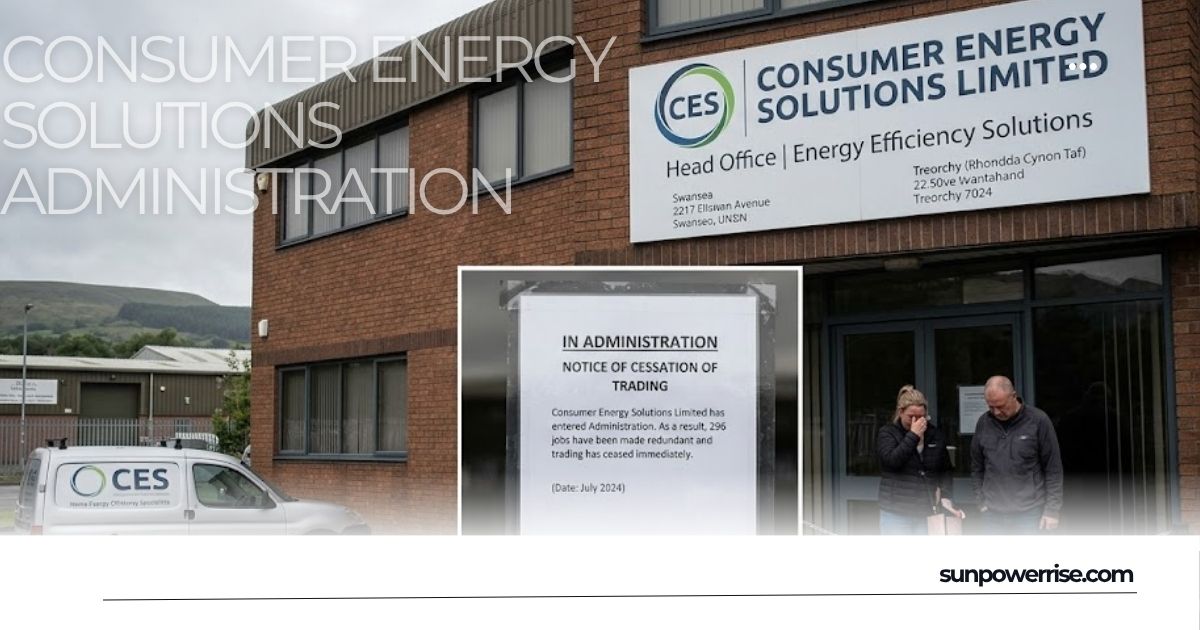
When the firm entered administration, nearly 300 jobs vanished almost overnight, and the immediate cessation of trading left no room for a soft landing. The company had carved a solid place in the energy efficiency sector, focused heavily on home energy improvement work for ordinary households.
Steering the Ship Through Insolvency
KR8 Advisory Limited stepped in as administrator on 9 January 2026, with James Saunders and Michael Lennon named as joint administrators overseeing the fallout.
CES had spent years fitting insulation, solar panel systems, and heat pump installations for residential homeowners, much of it funded through UK Government-backed schemes, especially ECO4. For distressed buyers and investors, this kind of collapse is a familiar story.
The Double-Edged Sword of Policy Dependence
Any business leaning too hard on single-policy revenue streams carries an obvious insolvency risk, yet that same weakness can open real acquisition opportunities once schemes end.
The Joint Administrators confirmed the company had ceased trading with immediate effect, leaving it unable to complete work already promised to customers. It’s worth noting this collapse doesn’t drag down every arm of City Energy Group, the wider parent business.
Next Steps for Creditors and Legal Safeguards
Right now, the priority is contacting creditors and employees directly about next steps and how claims processed will actually work.
If you’re a creditor who believes you hold a retention of title claim over goods supplied to the company, you can flag it directly.
Behind the scenes, the business affairs and day-to-day management are being handled by administrators who are authorised and regulated under the Insolvency Practitioners’ Association, acting only as agents and carrying no personal liability of their own.
The factors leading to CES’s administration
Regarding the Consumer Energy Solutions administration, CES never made its full debt position public, but the scale of redundancies tells its own story, with 295 employees losing their jobs as the firm chose to cease trading immediately rather than limp along.
That kind of decision usually signals acute liquidity pressure rather than a prolonged managed wind-down planned well in advance. The primary driver of the whole mess traces back to the ECO4 government scheme drying up, which had quietly propped up a huge share of the company’s work pipeline.
Systemic Risk of Shifting Subsidy Frameworks
Once that scheme-backed demand disappeared, it triggered a broader restructuring across City Energy Group, leaving CES with no way to sustain operations on its own.
This isn’t unique to the energy efficiency sector either; compliance-led sectors in general can see revenue visibility evaporate the instant subsidy frameworks shift.
Even professional services and project-based services built around public funding or regulatory incentives face the same kind of distress when the rules change beneath them.
Buyer and Investor Considerations
Cases like CES tend to attract three types of buyers. Trade buyers already working in energy services often want the regional coverage or extra operational capacity it offers, while platform investors see a chance to pull together fragmented installation and retrofit businesses under one roof.
Then there are asset-led acquirers, who care less about the brand and more about the equipment, systems, and data left behind rather than any real trading continuity.
Anyone circling this kind of deal should stay cautious, because recoverable value is usually limited to hard assets, a handful of residual contracts, or specific operational capabilities.
Any client relationships tied to government schemes are often non-transferable, and revenue visibility stays shaky without solid replacement funding mechanisms in place.
What actually matters here isn’t the brand or goodwill; it’s the infrastructure, the workforce capability, and the route-to-market advantages that can be redeployed under a fresh commercial model.
What happens next?
The joint administrators now have a full plate ahead of them, starting with employee claims and the redundancy processes that follow any collapse like this. Alongside that, they’re contacting creditors and validating claims while weighing up possible asset realisations for the benefit of creditors.
Because the company ceased trading with immediate effect, a full going concern sale looks unlikely unless a buyer turns up fast and willing to restart operations.
More realistically, expect piecemeal asset sales or a slower orderly wind-down instead. In the meantime, don’t expect any remedial works or repairs, and any existing complaints are effectively frozen. If you had an installation done and something’s gone wrong, reach out to TrustMark.
Who are TrustMark?
TrustMark works as the only Government endorsed quality scheme for home improvements across the country. It sits at the centre of the Energy Company Obligation 4, or ECO4, and the Great British Insulation Scheme, known as GBIS, offering quality assurance to consumers.
When something goes wrong, TrustMark also steps in to help find a resolution for problems tied to installations and other issues.
Why do I need to contact TrustMark?
Following the onset of the Consumer Energy Solutions administration, the Department of Energy Security and Net Zero, or DESNZ, has officially nominated TrustMark to support customers of Consumer Energy Solutions as they deal with relevant bodies connected to work done in their homes.
If your installation falls under ECO4 or GBIS, TrustMark will liaise closely with MCS, Certification Bodies, Guarantee Providers, and the administrators, all working toward the most appropriate response possible.
FAQs
How long does the administration process usually last?
Most administrations run somewhere between 6–12 months, though if any asset sales happen at all, they usually land in the early process, not near the end.
What happened to consumer energy solutions?
The UK-based Consumer Energy Solutions Ltd, a Swansea-headquartered energy-efficiency installer, collapsed into administration on 9 January 2026 and ceased trading, leaving nearly 300 employees redundant. Jimmy Saunders and Michael Lennon of KR8 Advisory were appointed as joint administrators, and the company employed 295 people across three sites in Swansea, Bangor and Treorchy
How much are consumer energy solutions worth?
No official valuation or net worth figure is publicly disclosed for either the collapsed UK CES or the US-based broker of the same name and the UK entity was deemed “no longer financially viable” at the time of administration.
Who is the CEO of Consumers Energy?
Garrick J. Rochow is President and CEO of CMS Energy and its principal subsidiary, Consumers Energy, the major Michigan electric and gas utility.
Are customer contracts transferable?
Most customer contracts linked to government schemes are usually non-transferable, and they tend to terminate automatically the moment trading ceases.