


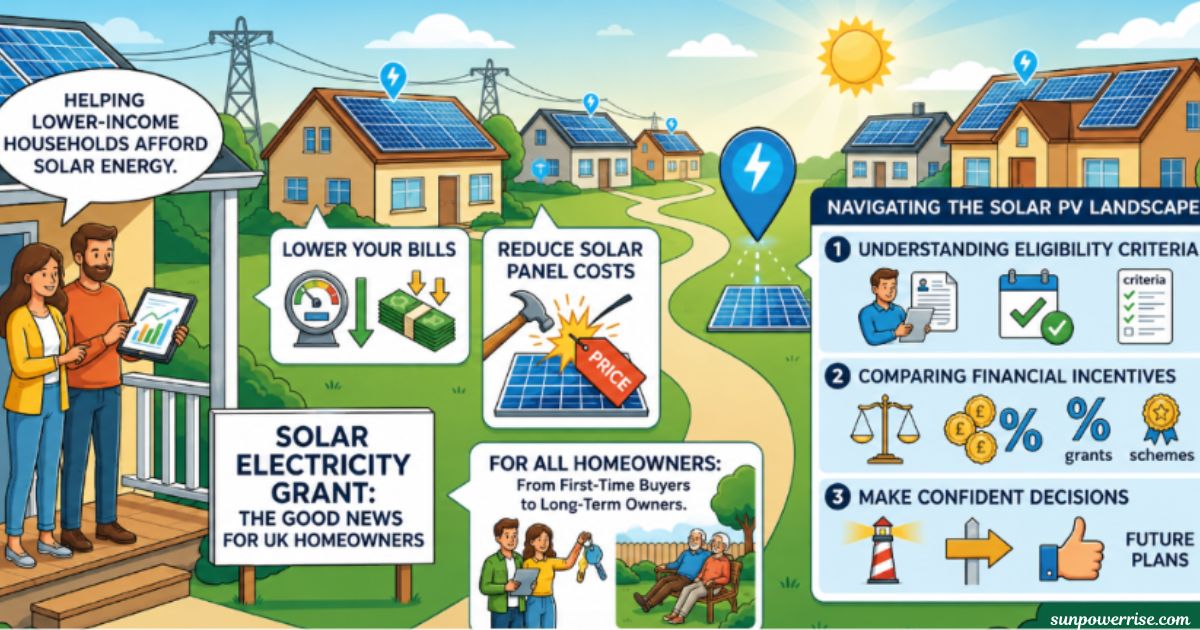
The good news for UK homeowners is that the UK Government offers several solar electricity grants and schemes specifically designed to help lower-income households afford solar energy without breaking the bank.
Whether you are a first-time buyer or a long-term homeowner trying to reduce costs, navigating the world of solar photovoltaic (PV) systems does not have to feel complicated.
From understanding eligibility criteria to comparing financial incentives, this guide walks you through everything you need to know about the solar electricity grant landscape in the UK so you can make confident decisions about your solar panel cost, your bills, and your future.
Understanding Solar Electricity Grants in the UK
Decoding The Incentives
The term solar electricity grant covers a wide range of financial incentives designed to make solar photovoltaic (PV) systems more affordable for UK homeowners.
These programmes exist to help people switch to clean, sustainable power while tackling carbon footprints and reducing household energy costs.
Understanding how grant money works and what each programme covers is the first real step toward cutting your upfront costs and making solar panel installation a reality.
The Four Core Pillars
In the UK, there are currently four main programmes available to homeowners. These are ECO4 (Energy Company Obligation), the Home Upgrade Grant (HUG), the Warm Homes scheme covering England and Wales, and Home Energy Scotland, along with various local authority grants.
Each of these solar power grants has its own targets, ranging from providing 100% financial coverage for low-income households to offering a loan of up to £5,000 for eligible households or monetary support for off-the-grid homes.
Targeted Support, Maximised Impact
What surprises most people is how different these programmes are from one another. Some cover battery top-ups and storage add-ons, while others focus purely on solar panel installation.
For low-income families and tenants, the Warm Homes programme can provide up to £30,000 in support, which is genuinely life-changing.
Knowing which schemes apply to your situation and what level of coverage you qualify for can save you thousands of pounds and significantly reduce your accessible investment threshold.
Eligibility Criteria For Solar Panel Funding
The Baseline Property Check
Before you apply for any funding, you need to understand that eligibility requirements vary quite a bit between schemes. The most common baseline requirement across programmes is property ownership.
You typically need to own your home to qualify. Some grants also look at your property type and your Energy Performance Certificate (EPC ratings), meaning the energy efficiency of your existing home plays a direct role in whether you qualify.
Income Thresholds & Installer Credentials
Household income is another major factor, as many grants are means-tested and specifically support lower-income households.
The Boiler Upgrade Scheme (BUS) focuses on heat pumps and biomass boilers rather than solar thermal systems, so it is important not to confuse it with solar-specific grants.
Above all, your solar panel installation must be carried out by a Microgeneration Certification Scheme (MCS) certified installer to access any government-backed solar panel grants, since this guarantees quality and compliance with industry standards.
Smart Metering & Technical Sequencing
One thing many applicants overlook is the practical side of the criteria. You will need a smart meter in place because it tracks your exported energy and supports your SEG application. Installation sequencing also matterscertain grants require the PV system to go in first, before you can add a battery as a top-up under the same programme.
Always read the paperwork carefully, check the fine print of all contracts, review your means-tested benefits status, confirm your EPC rating sits at D or lower, and make sure you understand any income-related benefits that could affect your requirements before you sign anything.
Key Solar Electricity Grants and Schemes
Smart Export Guarantee (SEG)
The Smart Export Guarantee (SEG) launched in January 2020 as a government-backed scheme that requires licensed electricity suppliers with more than 150,000 customers to pay small-scale generators for the low-carbon electricity they push back into the National Grid.
At Fuse Energy, the current SEG tariff sits at £0.10/kWh, which represents a solid ongoing return for homeowners who generate more than they consume.
Eligible technologies include solar PV, wind, hydro, micro combined heat and power (CHP), and anaerobic digestion, giving a broad range of renewable setups access to the scheme.
Stacking Savings Independently
As one of the most widely used solar power grants for homeowners across the UK, the SEG works as an ongoing payment for exported electricity that operates completely separately from installation grants.
Crucially, having an existing grant does not disqualify you the SEG covers both panels and solar energy storage, which makes it particularly attractive.
However, rates vary because individual suppliers set their own figures, which can be either fixed or variable, and payments never happen automatically, so you must actively sign up to receive them.
The Self-Consumption Pivot
To access the SEG, your system must come from an MCS certified installer, you need a functioning smart meter to track exports, and you must register with an eligible supplier.
While the scheme actively incentivises pushing excess energy into the grid, many homeowners are now choosing a battery instead, storing that energy for later rather than selling it.
That shift toward self-consumption delivers stronger long-term savings compared to the 7.5p per kWh export rates offered by some suppliersand when you factor in the above zero guarantee on SEG payments, the financial case for renewable technology becomes even more compelling.
ECO4 Scheme
The £4 Billion Funding Blueprint
The ECO4 (Energy Company Obligation) scheme runs as a major government scheme with one clear goalcutting carbon emissions and improving energy efficiency across low-income households throughout the UK.
Running from April 2022 to March 2026, this £4 billion programme targets fuel-poor and vulnerable households across England, Scotland, and Wales, providing up to 100% grants for free solar panel installations where homeowners hold an EPC rating of D or lower and receive means-tested benefits.
The scheme deliberately takes a whole-house approach, pairing solar panels with insulation and heating upgrades to deliver comprehensive improvements.
Council-Level Flexibility (LA Flex)
Under the LA Flex (Local Authority Flexibility) element, local councils in areas including Brighton, Croydon, Peterborough, Portsmouth, Southampton, and West Sussex can extend access to households that fall just outside the standard criteria.
To qualify through this route, your household income must sit below £30,000, or you must receive a qualifying state benefit or pension.
The focus throughout ECO4 remains on achieving genuine carbon neutrality progress by installing energy-saving technologies at scale and delivering 100% financial coverage for those who need it most.
The Whole-Home Retrofit Advantage
Solar electricity grant opportunities are highlighted by the ECO4 scheme, which stands out for its genuine commitment to combining multiple home energy improvements under a single application.
Rather than just fitting solar panels and moving on, the scheme looks at the home as a whole, addressing insulation, heating, and generation together.
For eligible applicants, this low-income focused approach, backed by the full power of a £4 billion programme, represents the most comprehensive solar panel installation support currently available through any government scheme in the UK.
FAQs
What is a solar electricity grant, and who offers it in the UK?
A solar electricity grant is financial support offered by the UK government and local councils to help homeowners cover the cost of solar panel installation and reduce energy bills.
Am I eligible for a solar electricity grant in the UK?
Eligibility typically depends on your household income, EPC rating, property ownership, and whether you receive means-tested benefits each funding scheme carries its own specific criteria.
Which is the best solar electricity grant available right now?
ECO4 remains the most generous option, offering 100% funding for solar panel installation to low-income households with an EPC rating of D or lower across England, Scotland, and Wales.
Can I combine a solar electricity grant with battery storage?
Yes, several solar electricity grant programmes, including the Home Upgrade Grant and Home Energy Scotland, allow battery storage to be included, significantly boosting your long-term savings and self-consumption.
What is the Smart Export Guarantee and how does it work?
The Smart Export Guarantee (SEG) pays UK homeowners for every unit of excess electricity they export back to the National Grid, with rates typically ranging between 5p and 15p per kWh.