

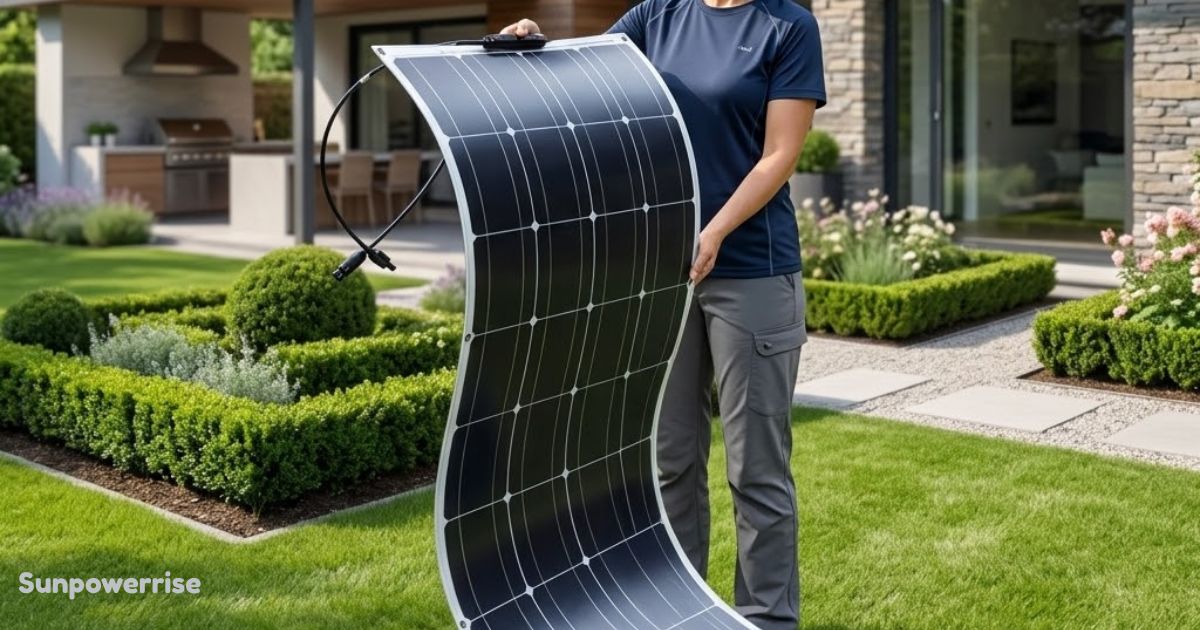
Flexible solar panels use thin-film solar technology rather than thick crystalline blocks. They usually need twice as much space to match the output of a standard UK rooftop setup, so domestic roofs and commercial roofs rarely benefit from swapping over.
A drill-free install using adhesive instead of screws is brilliant for stealth builds and weekenders doing short summer tours, but it won’t beat a proper rooftop array for sizing a whole house’s wiring system, which is why I always help clients weigh market options, warranty length, longevity, and the panel’s suitability before committing.
What Are Flexible Solar Panels?
Strip away the marketing, and a flexible backing panel is really just thin-film photovoltaic technology laid over plastic, metal, or lightweight glass instead of the usual silicon wafers locked inside rigid glass frames.
I’ve handled dozens of these things at only 2- 4 mm thick, and they genuinely feel like a stiff sheet of card rather than glass, which is exactly why installers can get them flush against curved roofs, fibreglass pop-top roofs, and other tight spaces without a structural frame getting in the way.
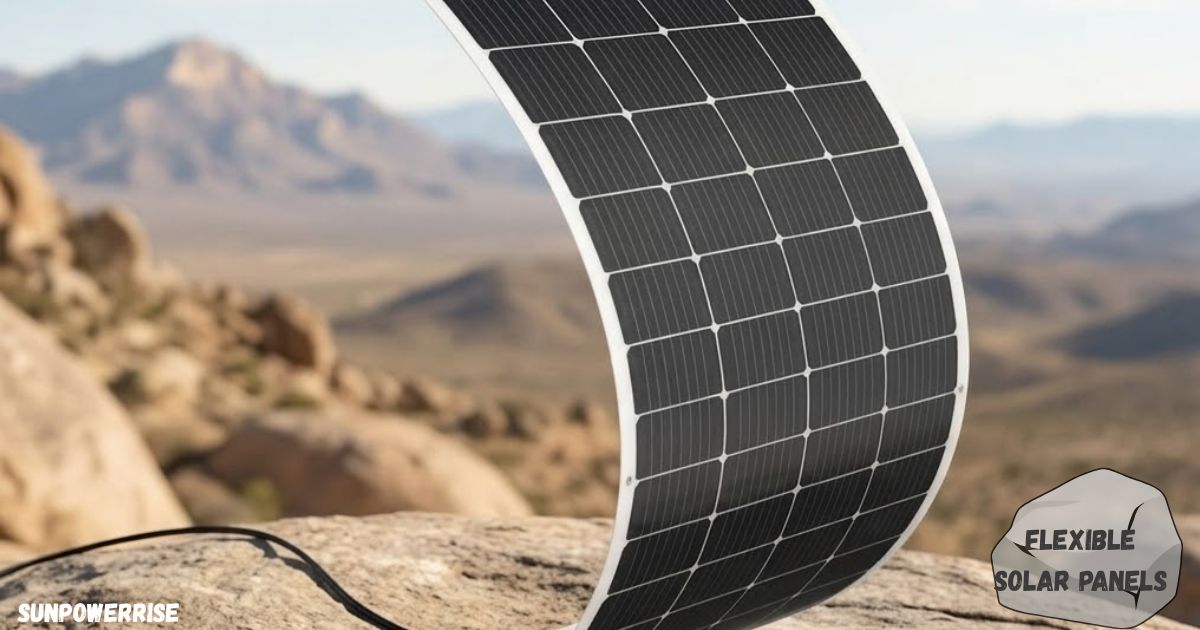
Because the whole thing can flex, bend, and curve through gentle curves, and even conform to an S-shape in places, these thin, bendy solar panels skip the heavy mounting systems that rigid arrays need and simply get bonded with adhesive.
Owners like that they can transport and install these panels quickly, and once mounted, they sit ultra-thin and light, ready to handle portability needs for caravans, rooftops, and other tricky spots.
I’ve also fitted panels that arrive rolled up or get bent into shape on-site, and while they’re not as efficient as crystalline panels, they hold real value for off-grid applications, domestic roofs, and commercial roofs alike, especially where lower efficiency is an acceptable trade for weight and shape.
How They Work
The science underneath a flexible module is no different from any other solar setup: sunlight strikes a photovoltaic material, electrons get energised, and out comes electricity.
What changes is the build. Instead of glass and aluminium wrapped around a solid block, manufacturers stacked thin semiconductor layers onto a substrate, and that layered design is exactly what lets the sheet flex in the first place.
There are really two families worth knowing. Thin film solar, most commonly CIGS (short for Copper-Indium-Gallium-Selenide), places a thin layer of material on plastic backing connected to electrodes on the front and back.
The layers run about 300 times thinner than standard cells, sometimes just a few micrometres across, and that’s what makes them so lightweight and easy to bend or roll up.
The other family is a lightweight version of ordinary monocrystalline cells, like the monocrystalline semi-flexible panels built by SunPower, which use a metallic backing, drop the glass front, run only a few mm thick, and offer a limited bending angle of around 30 degrees.
Where Flexible Solar Panels Are Used
Target Applications
I rarely recommend flexible panels for standard UK homes, because weight, shape, and surface constraints matter more to these buyers than squeezing out maximum efficiency.
Instead, I see them go onto motorhomes, campervans, boats, caravans, curved roofs, portable solar kits, lightweight sheds, outbuildings, and temporary installations, and now and then they show up in building-integrated systems or big commercial projects where designers bond panels into façades or other unusual structures.
Structural Freedom, Stealth Silhouette, and DIY Simplicity
The real draw is ease of installation rather than raw output. A pop-top camper genuinely can’t be drilled into or carry the weight of rigid glass, so these panels are often the only route to a permanent full-sized solar array on that kind of roof.
For vanlife folks running a stealth build, keeping panels flush avoids the dead giveaway silhouette that gives away an unassuming panel van, which matters a lot under strict UK rules for full-timers.
And for people doing entry-level or weekend vanlifer builds, with a stripped-back electrical system, no fixed kitchen, and no exterior metalwork, sticking down a drill-free installation panel is just the sensible, simpler build choice, even if it means accepting a shorter lifespan and performance compared with rigid panels for a summer of use.
Advantages of Flexible Solar Panels
Three things sell people on these panels every single time: lightweight build, genuine versatility, and often easier installation.
Because they weigh so little, they suit low load-bearing roofs that could never handle secure mounting systems, racks, or brackets, and because they curve, they mount onto surfaces that rigid glass simply can’t reach; some models can even be bonded straight down with adhesive, cutting cost and labour together.
Superior Performance in Low-Light and High-Temperature Environments
Performance-wise, I’ve noticed these panels genuinely shine on grey days. Thanks to their ability to absorb a broader range of light, including UV and infrared light waves, they give better performance in cloudy weather compared with string-connected crystalline panels.
They’re also handy for anyone chasing off-grid solar power on a road trip or campsite, since you can roll up the sheet for the trip; some models even allow semi-transparency, opening doors to solar canopies and windows.
Balancing Low Initial Costs Against Scale Efficiency
On cost, flexible PV modules sit at a genuinely low cost for a few hundred pounds and skip professional installation in many cases.
Though if you were replacing a full rooftop system, that price difference usually gets eaten by extra installation costs, and lower manufacturing costs don’t always offset it, since thin film uses less raw material but needs more panels for the same shading-resistant output as better in partial shade designs promise.
Downsides
Every trade has a downside, and here it’s mostly about durability. Because these sheets need a plastic front coating to stay bendable, they’re far more prone to damage than glass.
Add in a shorter warranty, often just 12-18 months against 25 years for glass units, and it’s clear these compromises are real, since the strains of being flexed, moved around, and left to sit with plastic fronting clouding with age all shorten real-world life.
Thermal Degradation and Efficiency Loss from Flat-Mounting
Efficiency also takes a hit once panels are glued flat. Sitting flat against a roof isn’t an efficient angling for PV generation, and that same flat position kills airflow, so panels heat up with the roof underneath and run less efficiently than they would mounted properly, though nowhere near as badly as crystalline panels would suffer.
Add harsh environmental conditions without proper encapsulation, and some thin film technologies will degrade faster, meaning output degradation, limited roof space issues, and a need for more space required overall in short, weaker build quality and exposure conditions management show up fast in reduced electricity and long-term durability.
Efficiency of Flexible Solar
Numbers help cut through the sales talk here. Ordinary thin film panels generally top out around 13% efficient, while SunPower monocrystalline systems claim up to 25%, and panels on the market usually deliver somewhere in the 50-170W output range, so buyers should always check the actual module efficiency rather than the flashier cell efficiency figure that manufacturers love to quote.
Looking at named products makes this concrete: Renogy’s 100W flexible solar panel sits at 15.7%, EcoFlow manages 15.5%, and Bluetti’s FX series climbs to 17%, all trailing behind rigid panels at around 20%.
At the top end, high-quality flexible panels from Solbian reach 17-18%, and Solara Power-M claims 18.8%, though those extra points cost hundreds of pounds more.
None of this happened by accident, either. Flexible technology was born for the marine market, where its toughness against sea spray and harsh weather made it the obvious choice long before vanlifers caught on, and that maritime pedigree still explains why the best back-contact cells and PERC cells models hold up so well under real-world power generation demands.
How to Install Flexible Solar Panels
Fitting these panels properly is where most DIY jobs go wrong, so I always slow down here. For panels used off-grid on the move, you’re mostly unrolling and propping them toward the sun, and optimising positioning to squeeze out extra watts.
For permanent jobs on boat or caravan roofs, though, you’re looking at watertight cabling, a proper cable gland placement, and a solar charge controller wired in afterwards.
Calculating Flex Angle Limits and Axis Curvature
Before any flexible solar panels goes down, check its panel curvature and flex angle limits, since every sheet, including a 200W panel, has a maximum curvature, say 240°, spread across its whole length of 160cm, working out to about 1.5° per centimetre, and across a 75cm width that translates to roughly 112°.
Preparation, Dry-Fitting, and Managing Roof Ventilation
My install sequence always follows the same order: dry-fit the layout with painter’s tape, then wash and degrease the footprint with isopropyl alcohol; next, drill and saw for the cable gland, file sharp edges, apply anti-rust paint, and fit the gland in a high spot clear of pooling water.
Ventilation comes next on a ribbed panel van roof: you simply stick to the ribs and leave channels for airflow, but on a flat pop-top roof, you build air gaps yourself using thick beads of adhesive or tape, always leaving breather breaks so the panel isn’t sealed, bonded flat and airtight.
FAQs
Are flexible solar panels any good?
Yes, flexible solar panels are genuinely good for curved roofs, motorhomes, and boats, though they trail rigid panels on efficiency and lifespan.
Are flexible solar panels a thing?
Absolutely, they’re a real and popular option built from thin-film photovoltaic technology or lightweight monocrystalline cells, used widely across vanlife, marine, and off-grid setups.
How long do flexible solar panels last?
Most flexible solar panels carry warranties of up to five years, far shorter than the 25-year guarantee on rigid panels.
Can you walk on flexible solar panels?
Many high-end marine panels are walked on safely, but budget models risk damage and cracked cells underfoot.
Why do flexible solar panels get hot?
They’re usually bonded flat to a roof with poor airflow, so cell temperature rises and efficiency drops on hot days.