

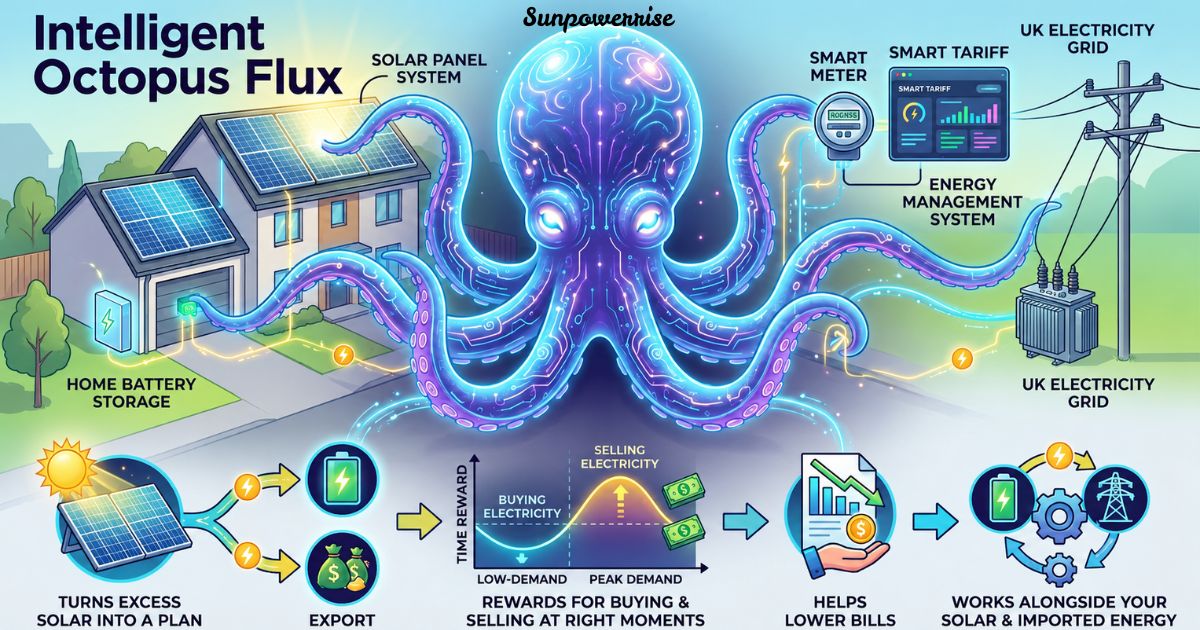
Intelligent Octopus Flux turns excess solar electricity into something you can actually plan around. It rewards you for buying and selling electricity at the right moments, helps you lower bills, and works alongside your solar panel system and imported energy rather than against it.
The Energy Saving Trust has long said that shifting time-of-day habits around your electricity bills pays off, and that’s exactly what pushed me toward Octopus Flux.
Across the UK, more UK homes are generating their own electricity, running batteries, and looking at smart tariffs as a real strategy rather than a gimmick, and that’s why this tariff has become one of the fastest-growing choices among solar households.
Compared with ordinary solar export tariffs, this one offers among the highest export rates in the country, while also cutting your import costs, all while easing peak periods of consumption on the grid.
What is Intelligent Octopus Flux?
Octopus Flux is a smart import and export electricity tariff from Octopus Energy, built for homes with solar panels and a compatible battery. It runs on time-based pricing, so you charge battery power when it’s cheap and export to the grid when prices peak. The whole idea is to buy low and sell high, using super-cheap import rates overnight and peak export windows later on, with daytime rates sitting between the two.
The Intelligent Octopus Flux version adds peak and off-peak periods, and although rates shift with the Ofgem price cap every three months (the tariff change frequency), the exports 65% of solar-generated electricity figure used in official numbers comes from a home with a 4.9 kilowatt-peak system, a 5.2kWh battery (standard sizes), annual consumption 3,400kWh (the UK average), and solar irradiance 850kWh per kWp.
You’ll need an Android smartphone or Apple smartphone and tablet, plus households must already be on standard variable tariff terms with Octopus Energy; average earnings & savings £1,067 per year is the headline number, and there’s an exit fee, no, if you ever want out.
Standard vs Intelligent Flux
I’ve used both versions, and the split really comes down to user effort. With Standard Octopus Flux, you manually set battery schedules, choosing your own battery charges and battery discharges around tariff timingsgreat if you enjoy optimising schedules yourself or already run a third-party automation platform. It works with compatible battery brands including Tesla Powerwall, GivEnergy, and SolarEdge.
Intelligent Octopus Flux Automatic flips that: Octopus takes control, using real-time price data and automated algorithms to optimise import, optimise export, and battery use with no manual scheduling at all.
It currently only works with the GivEnergy battery ecosystem, thanks to a direct integration with the manufacturer’s platform, which means custom scheduling is limited, but typical savings potential is strong.
Comparing the two on automation level, battery compatibility, and best suited for fit: Standard Octopus Flux gives predictable setup and works with different-brand batteries, while the automatic route uses smart controls and smart battery controls to maximise savings and maximise profits without a finely tuned battery schedule.
If you don’t have a hands-off routine battery, the manual Flux route still earns solid export earnings, just with lower export rates than its automated sibling, and a slightly background process feel once you’ve dialled it in.
How Automation Works
The daily rhythm makes sense once you see it laid out. Overnight, you charge the battery from the grid; through the day, you use solar first, then top up the battery or export surplus; at evening peak, you either discharge the battery to the home or export to the grid, and you repeat daily, either by a scheduler or manually, which is the essence of manual Flux.
With the automated route, the Octopus algorithm watches wholesale prices and forecast data, then charges the battery from solar during excess generation, or from cheap grid power to prepare for peak.
It discharges during high-price export windows, or to supply home when that’s the cheaper overall option; you simply sit back while your battery becomes something like a virtual grid participant that both balances home demand and helps national grid stability.
On the Intelligent Flux Auto side specifically, Octopus runs battery for you: it fully charges off-peak times and discharges to grid and home during the 4 pm-7 pm peak period, using weather forecasts to calculate electricity production, factoring in home usage, appliances.
Eligibility
Before switching, check the basics: you need a working solar array (the Solar PV System), a Home Battery, and a Smart Meter capable of half-hourly readings.
The eligibility checklist also covers an Export MPAN, and generating electricity capacity matters less than whether your system can store electricity efficiently and track electricity exported correctly, with exports and imports logged correctly by your provider.
On the technical side, you’ll need a Compatible Inverter with accurate monitoring and timed control, plus reliable connectivity- a steady connection between your smart meter, battery, and app.
Most modern solar setups already tick these boxes, and a SMETS2 meter usually works instantly, though some SMETS1 Secure models also qualify; if you’re chasing Integration for Intelligent Flux, you’ll specifically need a GivEnergy battery and access to its linked control platform for the automated scheduling system.
The full list of eligible battery manufacturers is wider than people expect: AlphaESS, EcoFlow, Enphase, Fox ESS, GivEnergy, Hanchu ESS, Huawei, Sigenergy, SolarEdge, SunPower, and Tesla all qualify.
You’ll also need a recent model iPhone or Android phone, and you must already hold an Octopus import tariff and Octopus export tariff, meeting the full eligibility requirements before your compatible battery and daily tariff schedule can properly sync, giving you sufficient power and clean generation during daylight hours.
Pros and Cons of Octopus Flux
On the plus side: this tariff is genuinely Designed For Solar-Plus-Battery Homes, giving Access To Time-Based Import and Export Windows through the low-cost import window 02:00 to 05:00 and high-value export window 16:00 to 19:00.
There’s also No Limit on Export Volume, since you’re paid for the actual amount exported, and being part of the Flexible Tariff with No Exit Fees family means you can move away without penalty any time.
Now the Cons: it cannot operate without smart meter support, so homes without a battery or homes without timed control simply can’t follow the pattern. This is genuinely Built Around Scheduled Battery Use, meaning you must charge during the early morning window and export during the late afternoon window consistently to benefit.
Weighing both sides, the tariff rewards households that utilise stored energy strategically and generate their own electricity, provided you have the half-hourly data infrastructure and a meter installed or activated before applying.
Why did Octopus set up Intelligent Octopus Flux?
There’s real strategy behind this move: it helps Octopus stand out from the competition, attract customers, and offer some of the best export tariffs around, while also encouraging solar households to store electricity for use during export during high demand.
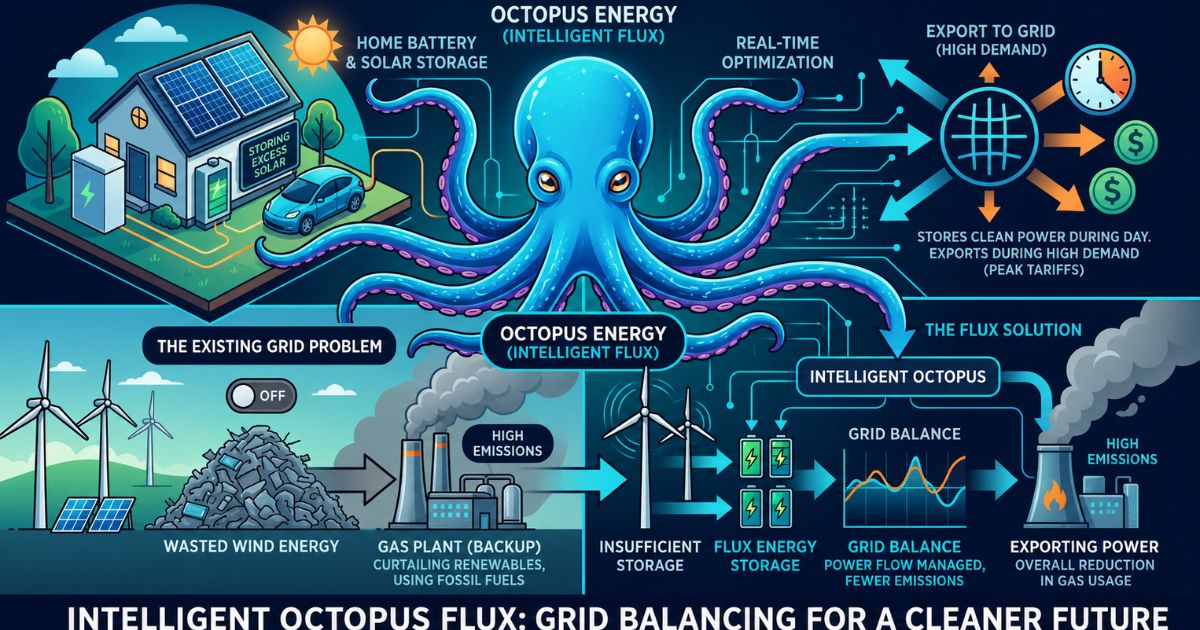
Behind this sits a genuine grid problem: the National Grid often has to turn off wind farms and other major renewable generators because of insufficient storage, then turn on gas plants to cover the gap.
In 2022 alone, the grid paid £215 million to turn off systems and spent £717 million on gas power plants, totalling £932 million in network costs, part of energy bills, with the overall grid’s balancing costs reaching £2.7 billion in 2024/25.
Rather than building storage infrastructure itself, Octopus puts the job on households to buy batteries, maximising income for them in return, a quick, effective way to improve the situation while profiting.
As Alex Schoch put it when discussing smart tariffs demand increase: since 2022, the company has seen an 80% increase, and everyone benefits from the arrangement, helping meet customer needs while easing pressure on wind farms and solar farms alike.
Alternatives to Octopus Flux
If your setup doesn’t quite fit, there are decent alternatives. Flat-Rate Export Tariffs skip the three-window time-of-use model entirely. Good Energy’s Solar Savings Exclusive tariff offers higher fixed export payments as a fixed payment per unit exported, which suits no-battery homes that don’t want any monitoring or scheduling hassle.
Other providers run Other Time-Of-Use Export/Import Tariffs with shorter time-of-use models.ON Next Export Exclusive tariff’s fixed export rate of 16.5 p/kWh is a good example, giving less upside than Flux’s peaks but still a step up over flat export tariffs for homes exporting surplus power.
For those without battery storage or half-hourly readings, sticking with a basic export tariff under the Smart Export Guarantee, paying roughly 5-10 p/kWh, keeps things low-hassle and a simpler choice when your home setup doesn’t align or you’d rather avoid hands-on optimisation and a different tariff structure altogether.
Final Thoughts on Octopus Flux
Stepping back, the intelligent octopus flux tariff gives solar-powered households a genuinely structured approach to running their existing system.
The three daily price windows create a clear pattern, offering low-cost charging in the early hours and a strong export value in late afternoon whenever the grid requires additional support.
Success really depends on understanding system behaviour and the level of control you want. Households that store energy reliably and keep accurate half-hourly smart meter readings manage to reduce daytime reliance on imported electricity while managing to earn more for power generated.
For anyone preferring a simpler arrangement, fixed-rate export tariffs offer predictable earnings without needing time-based involvement, but if your battery-powered household setup and compatible equipment can follow the rhythm aligns naturally.
FAQs
What is Intelligent Octopus Flux?
It’s a smart import or export tariff from Octopus Energy that pays you higher rates for exporting solar energy at peak times and charges you less for importing overnight.
Who is eligible for Intelligent Octopus Flux?
You need solar panels, an eligible smart battery (like Tesla, GivEnergy, or Enphase), a smart meter with half-hourly readings, and an existing Octopus import/export tariff.
How much can I earn with Intelligent Octopus Flux?
The average solar household earns around £1,067 per year through combined export earnings and import savings.
What are the peak and off-peak windows for Intelligent Octopus Flux?
The cheapest import window runs from 02:00–05:00, and the highest export window runs from 16:00–19:00.
How long does it take to switch to Intelligent Octopus Flux?
The full switching process usually takes five to eleven weeks, including smart meter setup and export MPAN approval.