


When I first started testing Renogy solar panels, I never expected them to challenge everything I thought I knew about solar panel performance and partial shading.
The brand dropped something genuinely exciting with their 200-watt Shadow Flux, a panel built around N-type cells and TOPCon cell technology instead of the usual monocrystalline or PERC cells that dominate the market.
This shift alone gives the Shadow Flux a tighter footprint and a real bump in efficiency that you can actually measure.
Standard Panels vs Renogy Solar Panels
What really grabbed my attention was the 16 bus bars packed into each solar cell, which cuts down on resistance and reduces hotspot performance issues that plague traditional designs.
I set up a proper comparison between the Renogy solar panels Shadow Flux and a standard panel under real solar conditions, running multiple shading tests to measure actual power output, and the numbers told a story worth sharing.
Whether you run your setup through a Victron solar charge controller or feed directly into a power station, understanding how this panel handles an array change how you think about your whole system.
Grand Canyon Torture Test
On the portable side, Renogy solar panels’ 100-watt Ultra Lightweight Portable Panel went through something far more brutal than a backyard test, a full torture test across 19 days on the Colorado River through the Grand Canyon, battling whitewater rapids, brutal extreme conditions, and record daytime temperatures.
I needed to keep camera batteries and phone batteries alive throughout, so real-world production mattered more than spec-sheet numbers.
I ran one panel per array because hooking up two would have maxed out the Victron solar charge controller, and with one side shaded for half the day and the other in open sunshine, the setup worked almost like a mast on a sailboat.
Shadow Flux & Partial Shading Performance
The Shadow Flux earns its name by tackling partial shading in a way that standard solar panels simply cannot match, and the secret starts at the cell level with 16 bus bars per solar cell that deliver lower resistance and dramatically better hotspot performance.
Unlike a series string of conventional monocrystalline or PERC cells, the N-type cell and TOPCon cell architecture inside this panel gives it real shade tolerance that goes beyond what typical bypass diodes offer at the panel level.
I pushed the Shadow Flux Renogy solar panel hard under genuine solar conditions, and in full sun, it was pulling 193 watts, a clean baseline before any shading drama began.
Shading Test Performance
When I covered just two cells, output held strong at 183 watts to 184 watts, which barely registers as a loss compared to what a standard 200W panel does in the same situation.
Moving the shade across eight cells covered dropped it to 157 watts to 158 watts, still respectable wattage that keeps your power station or charge controller fed.
The real shock came when I ran the entire panel shaded test: the Shadow Flux held at 117 watts to 118 watts, which is nearly six times the output the traditional panel delivered in the same conditions, and even with more than half the panel blocked, it still pushed out 42 watts to 50 watts instead of dropping to zero power.
Real-World Gain & Limitations
Now, I want to be straight with you. If someone tells you this is a complete game-changer that turns zero power into a flood of energy, the real test results say otherwise.
The honest gain sits around 4 to 10 percent in most mobile systems, and shade-tolerant technology cannot replace actual sunlight or diffuse light; if light drops, generation drops with it.
That said, the Renogy solar panels Shadow Flux absolutely shines when large leaves or hard obstructions hit at midday during peak radiance or peak irradiance, covering full cells completely in those specific moments.
A cell bypass at this level beats anything a conventional panel can offer, including scenarios with a boat mast, an RV air conditioner, or any severely shaded installation on mobile systems.
Shading Test Results & Data Comparison
I lined up the Shadow Flux directly against a standard monocrystalline 200W panel from Renogy and ran every stage of the shading test with the same ladder and board, making sure solar conditions stayed consistent so the comparison was clean and honest.
The standard panel opened at 184 watts in full sun, and the Shadow Flux immediately pulled ahead at 192 watts to 193 watts, a gap that already tells you something about the N-type cell advantage before shading even enters the picture.
Both numbers reflect solid performance for the solar conditions that day, and they gave me a reliable baseline for every partial shading stage that followed.
Minor Obstructions: 2 Cells Shaded
With 2 cells shaded, the standard model crashed to 143 watts a significant loss from 184 watts while the Shadow Flux barely flinched, holding between 183 watts and 184 watts with almost no power loss.
Mid-Scale Shading: 8 Cells Shaded
Pushing to 8 cells shaded dropped the traditional panel to 92 watts to 94 watts, a brutal collapse that exposes how poorly conventional bypass design handles real shadow exposure, while the Shadow Flux stayed productive at 157 watts to 158 watts and kept useful charging input flowing.
Extreme Blockage: Full & Half-Panel Results
The entire panel shaded result settled the debate completely, 18 watts to 19 watts from the standard panel versus 117 watts to 118 watts from the Shadow Flux, and even with more than half the panel shaded, the Shadow Flux delivered 42 watts to 50 watts, where a traditional solar panel delivered nothing useful.
Panel Size & Specs
The 200W Flex panel runs 29 x 63 inches and covers 1,827 square inches, while the Shadow Flux 200 measures a tighter 30 x 50 inches at just 1,500 square inches, making it 17.9 percent smaller with a 327 square inches reduction in total area.
That kind of size difference matters enormously on rooftop installs and mobile systems where every inch counts, and when you pair that smaller footprint with the N-type cell and TOPCon cell core and its 16 bus bars per cell for reduced hotspot performance issues, you get genuine efficiency gains packed into less space.
The rigid panel and glass panel construction also separates it from ETFE and flexible panel options, giving the Shadow Flux a durability edge that shows up clearly on the spec sheet.
The voltage profile of this panel deserves serious attention before you connect anything. The open circuit voltage sits at 36.5 volts, and the optimum operating voltage runs at 31.3 volts, both well above what a traditional 12-volt solar panel system expects.
Renogy solar panels built serious wattage potential into the Shadow Flux, but matching that potential to the right equipment separates a smooth install from a smaller model compatibility headache.
Pricing Of Renogy Solar Panels
The Shadow Flux 200 carries an MSRP of 299 dollars, working out to roughly 1.49 per watt, but renogy solar panels regularly run it on sale price at 239 dollars, which drops the cost to around 1.19 per watt and puts it surprisingly close to a standard 12V solar panel in terms of value.
When you stack that against the Shade Stopper 100W panel at 190 dollars or the SIG 100W panel sitting between 230 dollars and 240 dollars, the Shadow Flux delivers double power output for a similar or lower cost, which kind of price comparison reframes the whole budget conversation around shade tolerant solar panel options.
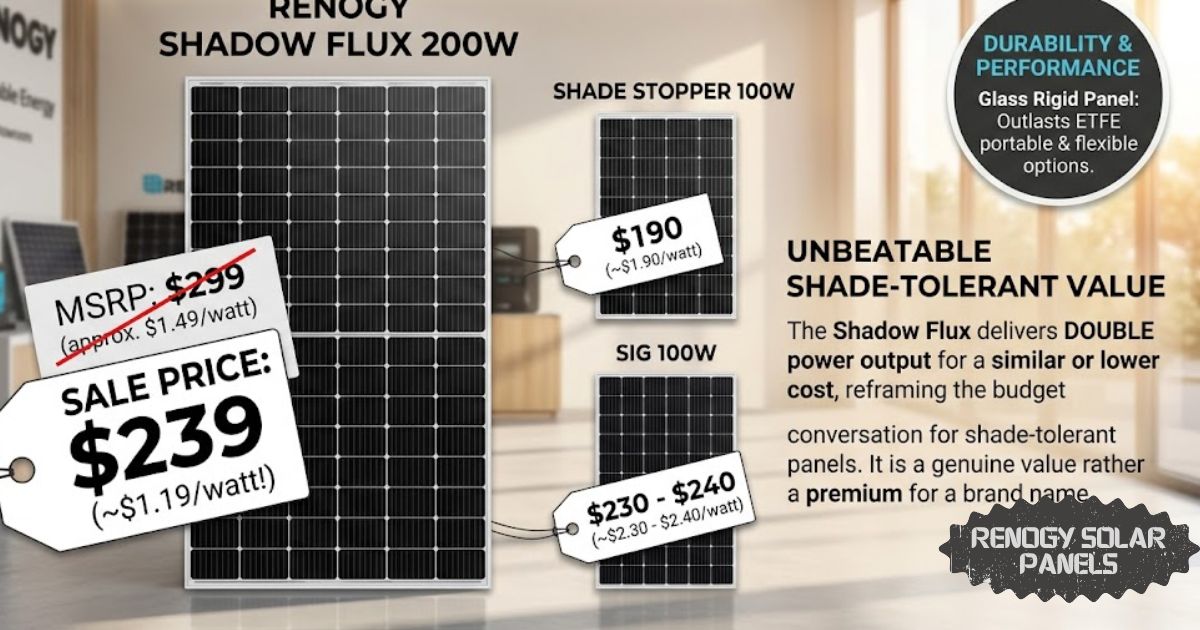
For a glass rigid panel that outlasts ETFE portable and flexible options and performs at this level, the pricing reflects genuine value rather than a premium for a brand name.
FAQs
What makes the Renogy solar panels Shadow Flux 200W different from a standard solar panel?
The Shadow Flux uses an N-type cell and TOPCon cell with 16 bus bars per solar cell, giving it better shade tolerance and higher efficiency than a standard monocrystalline panel. It also sits 17.9 percent smaller in footprint while delivering more wattage under partial shading conditions.
How much power does the Shadow Flux 200W produce when partially shaded?
With eight cells covered, the Shadow Flux still pushes out 157 to 158 watts, while a standard 200W panel drops to just 92 to 94 watts in the same shading test.
Is the Renogy Shadow Flux 200W worth the price?
At a sale price of 239 dollars or 1.19 per watt, the Shadow Flux delivers double power output compared to similarly priced shade tolerant solar panel options like the SIG 100W panel at 230 to 240 dollars.
Can the Renogy Shadow Flux work with any power station or solar charge controller?
Not every setup is compatible. The open circuit voltage of 36.5 volts and optimum operating voltage of 31.3 volts exceed what many smaller power station units handle, especially those capped at 28 volts.
How durable are the Renogy solar panels 100W in extreme conditions?
The 100W portable panel survived 19 days on the Colorado River through the Grand Canyon, handling 115 degrees Fahrenheit heat, wind-driven sand, and full submerging in river water without any damage.