

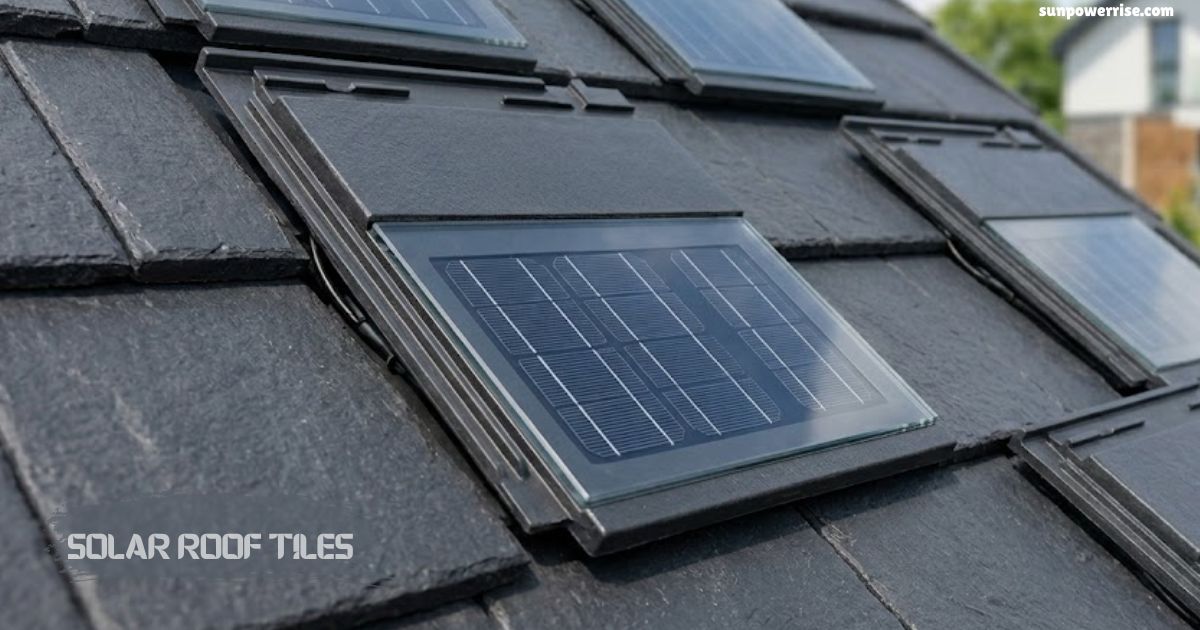
Solar roof tiles replace standard roof coverings slates, concrete tiles, or clay tiles with individual units that generate electricity while sitting flush with the rest of the roof, so the house keeps its normal silhouette instead of carrying a rack of panels on top.
Every roof I inspect tells a different story, but lately, solar roof tiles keep stealing the spotlight from traditional solar panels. Instead of bolting a bulky rack onto existing tiles, this solar technology slips quietly among normal roof tiles, so the appearance barely shifts.
People call them solar slates or solar shingles, and once you know what to look for, you will spot them on streets you have walked past a hundred times.
What Are Solar Roof Tiles?
Picture a solar roof tile as an ordinary-looking roof tile with a small solar module built into it, engineered to survive weather the way any slate or tile has to.
A standard solar panel is large, close to 1.9 by 1 metres, and sits on a frame above the existing roof covering. Some installers swap out a section of the roof for a lower-profile finish, but it still reads as a panel to anyone looking up from the street.
Integrated tiles go further: they become part of the roof’s actual structure, working into a flat, slanted, or curved roof rather than sitting on top of it.
A good manufacturer supplies matching non-solar tiles for the edges of the roof, so the join between “generating” and “non-generating” sections is only obvious up close. That flexibility is why tiles do well on angled roofs, roofs with eaves, and other awkward shapes the smaller unit size lets a crew cover more of the roof than a handful of chunky panels ever could.
Types of Solar Tiles
Two families lead this market. Silicon solar tiles stay rigid but are built thin enough to sit flush against slate or clay. CIGS tiles use a thin-film blend of copper, indium, gallium, and selenide instead lighter and flexible enough to follow curved or unusually shaped roofs that rigid tiles can’t.
Efficiency is the trade-off worth understanding before you compare brands: solar tiles generally run in the 12–20% efficiency range, compared with roughly 18–25% for today’s best monocrystalline panels.
That gap is exactly why tile installs typically need more roof area to hit the same output as a panel system of the same rated size worth flagging to anyone comparing a tile quote against a panel quote on price alone.
Large-Format Solar Tiles
Large-format tiles, such as SolarTyle and Nulok SolacTrix, interlock and cascade down the roof line like ordinary tiles, just bigger. Their size means fewer units per roof, better per-unit efficiency, and the seamless look most buyers are chasing.
Small-Format Solar Tiles
Small-format tiles, including ErgoSun and GB-Sol, copy traditional roofing materials more closely but run less efficient unit for unit, so more of them are needed to match the same total output.
The trade-off is flexibility on awkward roofs. I’ve stood on jobs where a single dormer ruled out large-format tiles entirely, and small-format units solved it by lunchtime.
How Do Solar Roof Tiles Work?
Every photovoltaic module runs on the same science that powers satellites: a PV module tucked inside the tile catches sunlight and converts it to direct current (DC) electricity. A semiconductor layer inside each cell releases electrons the moment light hits it, and an inverter converts that DC into the alternating current (AC) that actually runs a kettle, a TV, or the lights.
The real difference between a tile and a panel isn’t the electronics it’s the design brief. Panels are built to chase raw output; tiles are built to chase a clean roofline without sacrificing too much of that output.
Tiles still carry MC4 connectors on the back, get wired in series into a string, and feed that string to a central inverter exactly like a standard panel system does; no specialist inverter required.
A standalone inverter from a brand like Solis works fine, as does a hybrid inverter built into something like a Tesla Powerwall 3 or a Sigenergy SigenStor. Installers choose AC or DC coupling depending on the battery and inverter selected, so a tiled roof slots into most existing setups without a full rewire.
Why Choose Solar Roof Tiles
The case for tiles usually starts with looks: they stay close to invisible, a genuinely discreet option next to on-roof panels that have themselves gotten sleeker over the years.
Owners of listed buildings or homes in conservation areas often choose tiles specifically to get around planning restrictions that block visible panels outright tiles slide past rules that would otherwise kill a project.
Despite the thin profile, they’re built to handle the worst of British weather: heavy rain, gale-force wind, hard winters. Most carry a lifespan rated to 30 years, in line with any decent roof covering, and they double as the actual weatherproof layer, so the building is never without cover while it’s generating power.
Financially, tiles make the most sense when you’re building new or replacing a roof section anyway, since they cut roof wastage by acting as covering and generator in one.
Developers working to tight architectural briefs like the flexibility: tiles handle dormers, odd angles, and tight spaces better than rigid panels, which is why they turn up disproportionately on new-build specs rather than retrofits more on that below.
New Build vs Retrofit: Where Tiles Actually Get Used
This is worth being honest about, because marketing copy for tiles tends to blur it: solar tiles are overwhelmingly a new-build product, not a retrofit one.
Industry estimates vary one installer puts retrofits at roughly 10% of jobs against 90% new build, while independent figures put the new-build share closer to 56–69%, but every source agrees the split leans heavily toward new construction.
The reason is straightforward: tiles only make financial sense once you’re already re-roofing, because you’re not paying for two coverings. If your existing roof is sound and doesn’t need replacing, ripping off good tiles to fit solar tiles rarely pencils out against simply adding panels to the roof you’ve already got.
Cost of Solar Roof Tiles
The cost trips most people up at first. A 4 kilowatt-peak (4 kWp) install runs near £12,000 as of late 2025 well above the outlay for plain solar panels of the same rated output. That figure covers tiles and installation, but not removal of existing roofing or scaffolding, so always push for a full breakdown.
Real numbers on an 8 kW system: SolarTyle around £16,000, Nulok SolacTrix around £17,500, and Ergosun around £24,000, against an in-roof panel system like Viridian at roughly £11,500 for the same output.
That gap looks steep until you remember on-roof panels still need a mounting rack, while tiles replace the roofing you’d be buying anyway during a full re-roof which is exactly why the maths shift in favour of tiles once a re-roof is already on the table.
A grant worth knowing about: solar installations in the UK currently qualify for 0% VAT relief, which is due to run until 31 March 2027. That applies to the installation as a whole, not just the tiles, so it’s worth confirming with your installer that it’s been applied before you sign anything it’s a straightforward saving that’s easy to miss if nobody mentions it.
Standard Roofing Costs
Use standard roofing as your baseline: roughly £60 per m² for concrete tiles and £85 per m² for slate, covering materials and labour. On an 8 kW roof of 42–46 m², that’s about £2,500–£3,500 and that figure is what narrows the price gap between tiles and panels, since you’re not buying two separate coverings.
This offset logic only holds if you need a new roof anyway; if your existing tiles are fine, the labour-intensive process of re-tiling a sound roof makes the solar tile premium much harder to justify.
Solar Roof Tiles vs Solar Panels
Picture two roofs side by side: tiles suit new-build houses best, panels still rule on existing roofs, largely because tiles run close to 1.5x the cost of a standard panel install for the same output. On looks, panels stay visible once mounted; tiles win on discretion, which is the whole point for buyers dealing with strict planning rules.
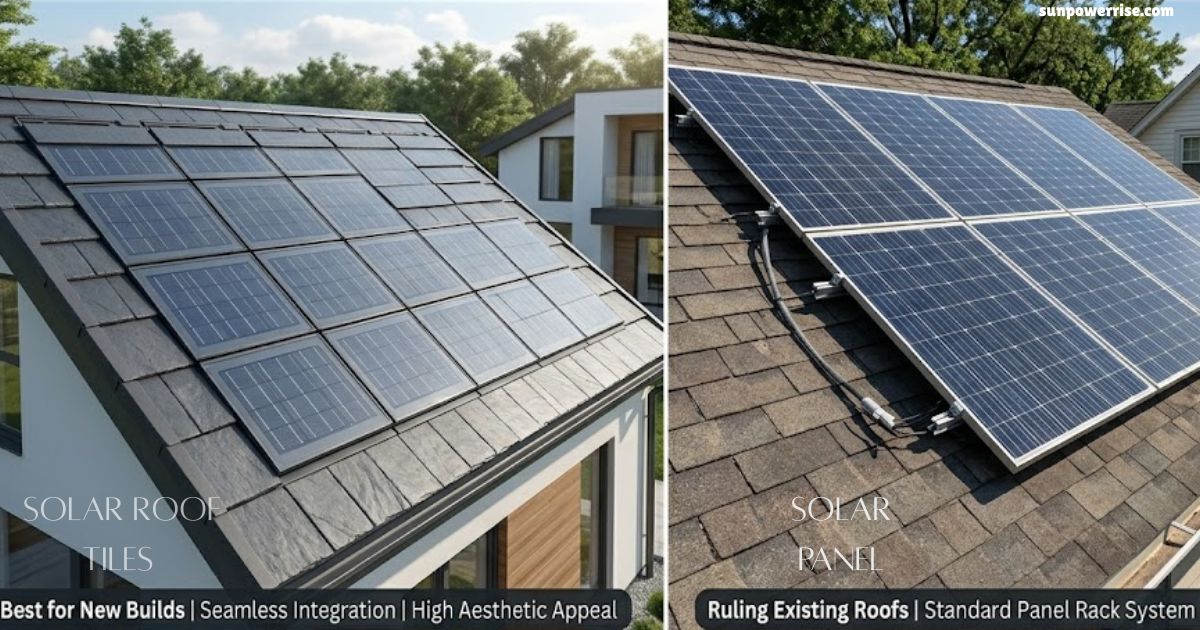
Running the numbers on an 8 kW job: Viridian In-Roof uses 18 panels rated at 445 W each across 42.3 m² for £11,500, with payback near 8 years (6 with the roof offset counted). SolarTyle needs 84 tiles at 95 W each, covering 41.3 m² for £16,000, paying back in 10 years (9 with offset).
SolacTrix uses 121 tiles at 66 W each over 44.5 m² for £17,500, breaking even at 11 years. Ergosun needs 457 tiles at just 17.5 W each, spread across 45.7 m² for £24,000, with the longest payback at 14 years, dropping to 12 with offset applied.
The data still favours panels on raw efficiency and return on investment remember that 18–25% panel efficiency against 12–20% for tiles. Where tiles claw some of that back is on shaded roofs: dummy tiles in dark corners stop a single shadow choking the current flow for the whole string, which is a real advantage panels don’t share as cleanly.
Maintenance, Life Expectancy & Warranty
The upkeep story is good news: because the tiles sit flush with the rest of the roof, there’s no gap underneath for debris or birds to nest in a genuine problem with some on-roof panel installs. Some products carry a rated lifespan of 40 years, backed by a 25-year warranty, though regular checks are still sensible, the same as with any roof.
Manufacturers and installers sometimes add a separate waterproofing warranty on top of the standard cover, which is worth asking about directly rather than assuming it’s included. Day to day, a rinse with warm water now and then covers most of what tile cleaning ever needs.
FAQs
Are solar roof tiles any good?
Yes, they offer a sleek, discreet way to generate clean energy while doubling as your roof covering, though they’re less efficient and pricier than standard solar panels.
How much do solar roof tiles cost in the UK?
On average, solar roof tiles cost around £13,000 in the UK in 2026, covering both supply and installation, with prices varying by system size and roof type.
What is the average cost of solar roof tiles?
UK 2026 pricing runs approximately £2,400-£3,200 per installed kWp, making solar tiles roughly double the cost of conventional solar panels.
Can I replace my roof tiles with solar panels?
Not directly, standard solar panels mount on top of your existing roof, while true solar roof tiles (BIPV) replace the tiles themselves as an integrated roofing layer.
What is the average lifespan of solar roof tiles?
Solar roof tiles typically last 25-30 years, similar to standard solar panels, though their efficiency may gradually decline with age and weather exposure.