

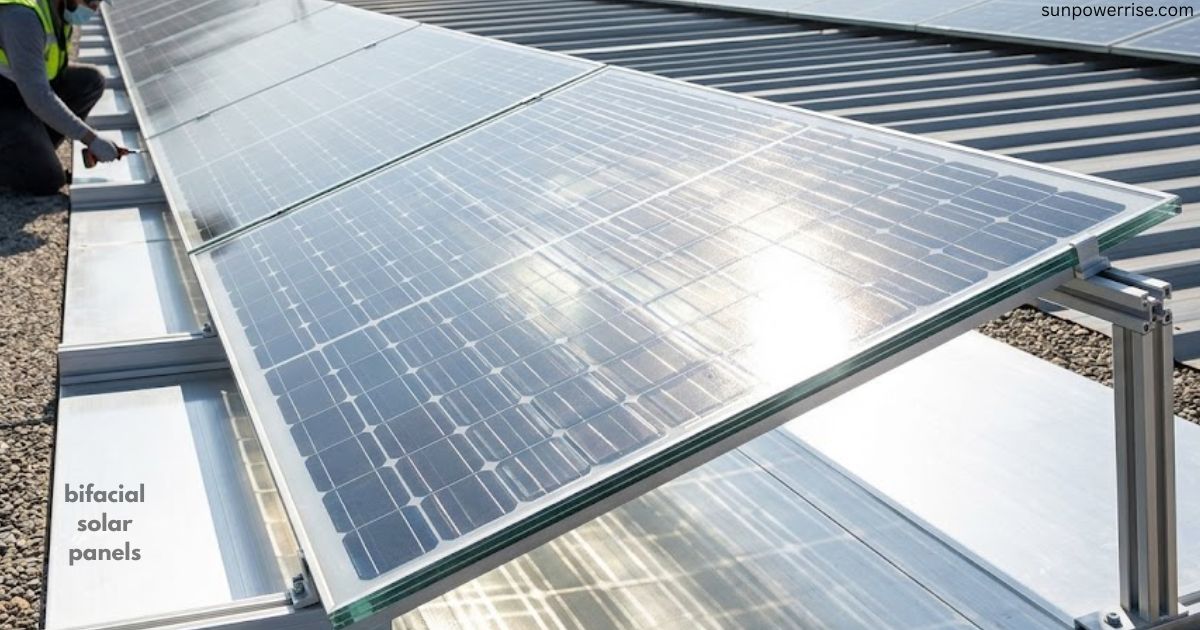
A bifacial solar panel generates electricity from both its front and its rear surface, not just the front like a standard panel. The top still does what every panel does absorbs direct sunlight but the back is built to catch light that’s already bounced off the roof, ground, or whatever reflective surface sits beneath it, turning that otherwise-wasted light into extra power.
After years spent assessing rooftop and ground-mount energy options for clients, I’ve come to see bifacial panels as the sharper pick for anyone trying to squeeze more electricity out of a limited footprint as long as the site actually lets that rear side do its job, which, as you’ll see below, isn’t every site.
Bifacial Solar Panels
Most bifacial panels use monocrystalline cells rather than polycrystalline, since monocrystalline offers better efficiency despite a slightly higher upfront cost. Instead of the opaque black backsheet you’d find on a standard panel, bifacial modules use a second pane of glass (or a clear polymer sheet) on the rear, so light passes through instead of getting absorbed and wasted.
Because there’s no need for a solid backing, many bifacial designs are also frameless no metal gridlines interrupting the surface, which gives them a distinctive, almost transparent profile installers sometimes use as a selling point on its own.
How Do Bifacial Solar Panels Work?
The front works exactly like a conventional panel. The rear catches “albedo light” sunlight reflected off whatever’s underneath the array. How much of that reflected light actually becomes usable electricity depends on two things: the bifacial ratio (how much irradiance hits the back compared with the front) and module bifaciality, a manufacturer-stated figure for how efficiently the rear cells convert that light.
Three variables move these numbers the most: tilt angle, the reflectivity of the surrounding surface, and mounting height. A white or light-coloured surface can reflect upward of 80% of incoming light back toward the panel, while a dark surface like asphalt reflects very little which is a big part of why site selection matters more with bifacial than with standard panels.
Vertical vs. Horizontal Mounting
Bifacial panels are typically installed one of two ways. Vertical mounting stands the panels on edge, usually on open ground or solar farms, which lets them catch two generation peaks a day morning and evening sun and sheds snow and debris better than a flat angle. Horizontal mounting sits the panels at a shallower tilt, relying on reflected light bouncing up off gravel, sand, or light stone underneath. Which one makes sense depends entirely on the site, which is really the question every buyer should start with.
Where Bifacial Panels Actually Make Sense
Here’s the part worth being blunt about: on a typical UK pitched residential roof, your own roof surface sits directly behind the panel, so there’s nothing for the rear cells to capture the main advantage of the technology is effectively switched off. That’s not a flaw in the panel; it’s a mismatch between the technology and that particular site.
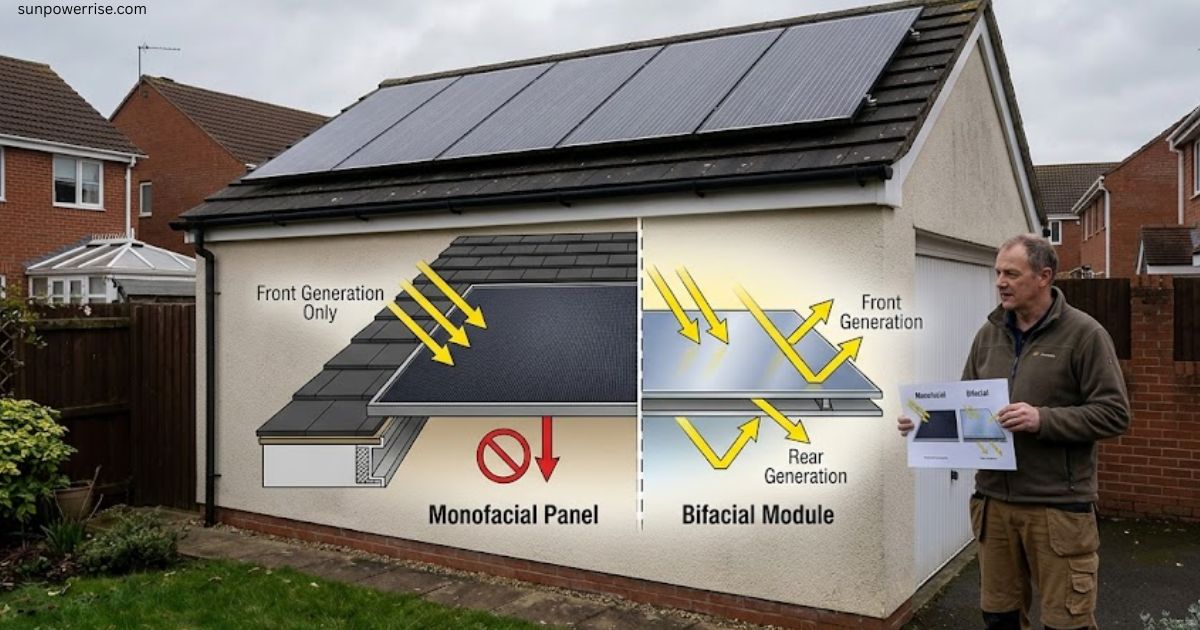
Bifacial panels earn their keep on flat roofs, ground-mounted arrays, solar carports, pergolas, and commercial or utility-scale installations, where there’s genuine clearance and a reflective surface beneath them. If you’re set on a bifacial system and have a pitched roof, raising the array on a frame with real standoff height is the only way to get any rear-side benefit, and even then the gain will be modest.
Do Bifacial Panels Work Under Cloudy UK Skies?
This is the question UK homeowners actually ask, and it’s a fair one given how much of our light is diffuse rather than direct. The short answer is yes, to a degree diffuse light still reaches the rear cells, and field studies in temperate, overcast climates have recorded measurable bifacial gains even without strong direct sun. The gain is smaller than you’d see in a sunnier, higher-albedo climate, but it doesn’t disappear.
Advantages And Disadvantages
On the plus side: higher output per panel under the right conditions, especially paired with single-axis trackers, which also improves the levelised cost of energy (LCOE). High-albedo surfaces snow, light gravel, white membrane roofing suit bifacial setups well, and the smaller footprint needed for the same output makes them attractive on constrained sites.
The glass-on-glass build is more durable against wind, hail, and UV degradation, and because there’s no metal frame, bifacial panels largely avoid potential-induced degradation (PID), which is part of why warranties now regularly stretch past 30 years.
On the downside: rear-side output is entirely dependent on the site, panels need real standoff height to work properly, and manufacturing and installation costs remain higher frameless glass needs careful clamping, and the higher DC involved means engineers have to design the system accordingly.
What Energy Gain Can You Actually Expect?
Numbers vary a lot by study and site. A 2023 review pooling 12 separate field studies (Heriot-Watt University) found gains ranging anywhere from 5% to 45% over monofacial panels, depending heavily on albedo and mounting. A separate 2023 study carried out in India narrowed that to roughly 31–35% under its specific test conditions. Treat any single “X% more power” claim including the ones on this page as a starting estimate, not a guarantee; your actual gain depends on your roof or ground surface, height, and local light conditions.
Leading Manufacturers
LG, Canadian Solar, LONGi, Trina Solar, Jinko Solar, and REC Group are among the most established names supplying bifacial modules to the UK market. Efficiency across current models generally sits between 20–22%, with a handful of higher-end panels pushing past that.
How Much Do Bifacial Solar Panels Cost In The UK?
Expect to pay roughly 10% more than an equivalent monofacial system. A small 1–2 bedroom home on a 3kW system typically lands between £4,950–£6,050; a medium 4kW setup runs £5,500–£6,600; a larger 6kW system for a 4–5 bedroom house can reach £10,450–£11,550. The 0% VAT rate on energy-saving materials (in place since April 2022), the Smart Export Guarantee (up to roughly £1,141 on a mid-sized system), and ECO4 for qualifying low-income households can all reduce the real cost.
Savings And Break-Even Points
A 1–2 bedroom home using around 1,800 kWh a year can expect annual savings near £570, paying back in 13–15 years with lifetime savings around £6,270. A medium 4kW home using 2,700 kWh can see roughly £860 a year and £11,180 over its lifetime. A larger 6kW system serving 4,100 kWh of usage can generate around £1,305 annually, paying back in 10–11 years with lifetime savings near £19,575.
Looking After Your Bifacial Panels
Because both faces are exposed glass, keep both sides clear of dirt, algae, and debris; a dirty rear panel loses you the exact advantage you paid extra for. Clean panels when they’re cool to avoid thermal stress, have a professional inspect the array annually, and watch for shading from nearby structures or growing trees, since shading affects bifacial arrays on two sides instead of one.
FAQs
Is a bifacial solar panel better?
Yes, in the right setting bifacial solar panels capture light from both sides, giving higher efficiency and better energy output than standard monofacial panels.
Where should bifacial solar panels be placed?
They perform best near reflective surfaces think light-coloured roofs, gravel, sand, or snow. Since more albedo means more energy captured on the rear side.
Do bifacial panels need special inverters?
Not usually, most bifacial panels work fine with standard string inverters, though pairing them with a micro-inverter or power optimiser can help capture their variable rear-side output more accurately.
When not to use bifacial solar panels?
Skip them on tight pitched roofs or shaded residential installations, since poor light absorption at the back limits the real benefits.