

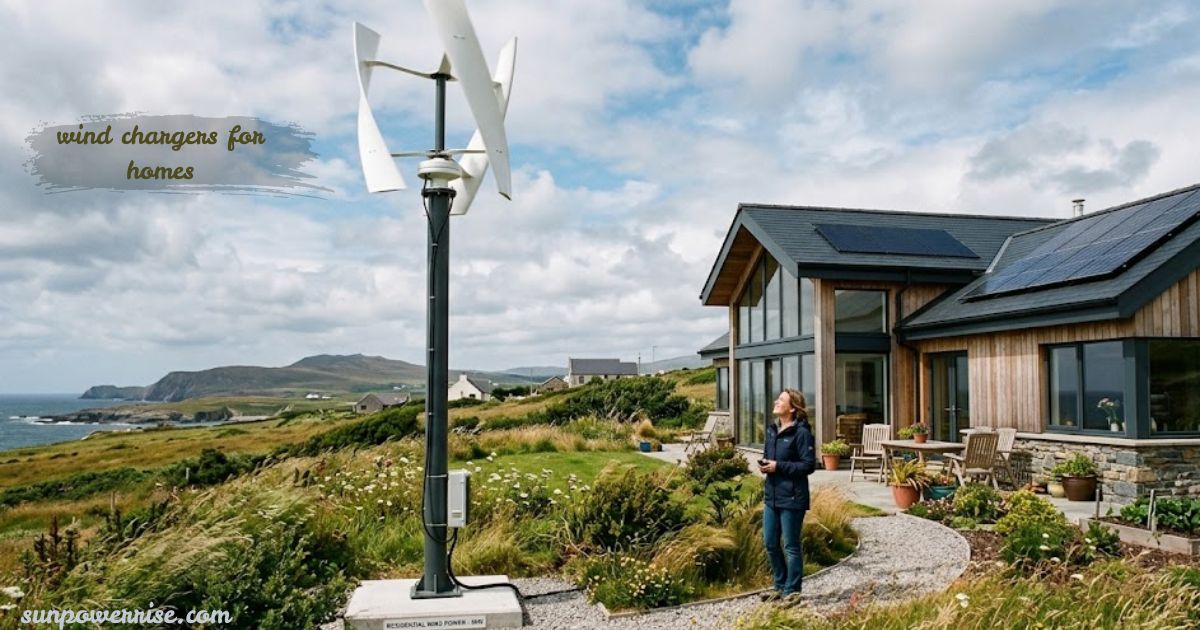
Wind chargers for homes are catching on fast as electricity costs in the UK push more homeowners to look for off-grid answers, and I noticed this shift myself after my own energy bill jumped last winter.
Wind Chargers For Homes
Wind turbines sit at the top of the list of power solutions people search for, mainly because they let a family save electricity month after month. My neighbour installed one two years ago, and watching his setup work sparked my interest in writing this comprehensive guide.
Small home units copy commercial models that supply a third of the country’s grid power, just on a smaller scale.
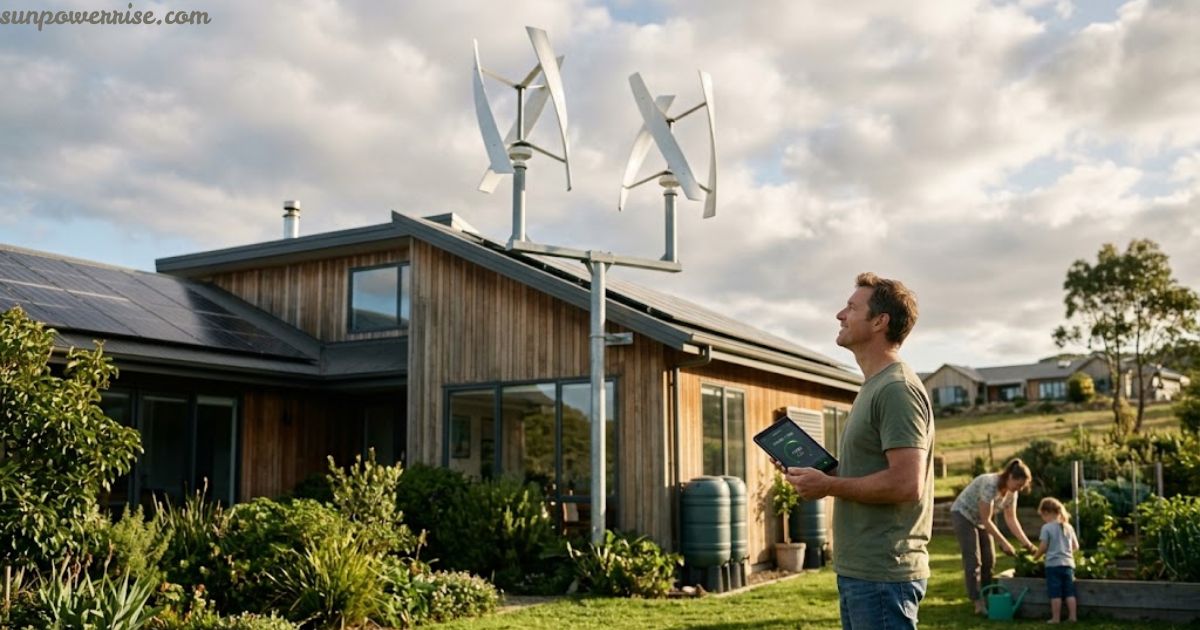
Every homeowner’s household energy consumption differs, so picking the right home wind turbines takes some thought before you buy a wind turbine. A good unit also depends on your local wind resource, since wind rarely blows the same way in two different gardens.
If your goal is to power a house fully, you need to weigh size against real-world efficiency, not just the sticker price. Below, I cover the top five affordable and built to last options, along with what I call the best wind turbine generators on the market today.
How Does a Home Wind Turbine Work?
A home turbine starts working the moment the wind blows against its blades. The pressure makes the blades spin, and this motion turns a shaft inside the unit, a process engineers call rotating. That shaft connects to a small generator, and this is where the real magic happens.
The generator produces direct current, better known as DC electricity, straight from the spinning shaft. This raw DC power doesn’t head straight into your kitchen sockets; instead, it flows into a home battery system first. From there, the power passes through an inverter, which changes it into a form your house can actually use.
That final form is alternating current, or AC, and it’s the standard type of electricity that runs through homes everywhere. Without this conversion step, your appliances simply wouldn’t switch on. I always tell people this three-step chain blade, battery, inverter is the easiest way to remember how the whole system behaves.
What Size Wind Turbine Do You Need to Power Your Home?
According to Ofgem, the average UK residents household burns through about 2,700kWh annually in a typical 2-3 bedroom home. Since wind stays naturally variable, estimating output is never an exact science, no matter how good your equipment is.
Still, figures show a pole-mounted 1.5kW turbine could generate roughly 2,600kWh yearly, while a 10kW system might reach closer to 10,000kWh, meaning the smaller unit copes fine with a small house but struggles to fully cover a large house.
Steps to Calculate Your Property’s Actual Energy Needs
To get real numbers for your own property, start by checking your power bills to understand your true electricity consumption, then use an anemometer to record local wind speeds accurately. Once you have both figures, compare them against the manufacturer efficiency rating listed for the model you’re considering. I did exactly this before helping a friend choose his system, and it saved him from buying something far too small.
System Optimization and Battery Storage Solutions
Choosing the right wind chargers for homes setup starts here. Whatever size you settle on, optimising the setup for maximum efficiency and daily usability matters just as much as the turbine itself.
Much like home batteries paired with solar energy, batteries here store the power you generate during windy conditions so you can draw on it later when the air goes still.
Brands such as the EcoFlow PowerOcean, in both Three-Phase and Single-Phase versions, offer solid battery systems starting at 5kW capacity and expandable to 45kW with additional batteries, and their IP65 dust-proof and waterproof rating means you can safely install outside home too.
Target Energy Production and the Role of Local Wind Speed
Looking beyond the UK average, general household energy consumption figures often sit near 10,649 kWh per year, which breaks down to about 877 kWh per month as your target energy production. Local wind speed plays a huge role here, and speeds around 14 mph, or 6.2 m/s, are usually seen as workable for residential wind turbines.
A machine’s power rating, measured in kilowatts, tells you what it can achieve, so as an example, a 1.5kW turbine might only manage around 300 kWh per month at that wind speed.
Recommended Turbine Range and Key Technical Specifications
Because most home units rarely hit their rated capacity in real conditions, matching an average household’s needs often calls for something in the 5 to 15kW range.
Manufacturer specifications always list several figures worth studying, including the rated power output achieved under optimal conditions, the expected annual energy output, the cut-in speed and cut-out speed that define when the blades start and stop, plus the overspeed protection that guards the unit during storms.
Factors to Consider Before Investing in a Wind Turbine for Your Home
Location sits right at the top of the checklist, since every setup needs generous open space, and this matters even more for standalone models that stand tall on their own pole. Properties inside conservation areas, heritage areas, or other protected areas will likely need extra permission before any work starts, so check this early to avoid wasted planning.
Wind speed deserves just as much attention, and experts generally advise against these systems in spots averaging under 5m/s. You can look up rough figures for your postcode on the Met Office website, though I’d still suggest buying an anemometer to measure things directly, since it accounts for local dips and hills the national data misses.
Tracking readings across the year also reveals seasonal variations that a single measurement would never show.
Planning permission works differently here compared with solar panels, which rarely need formal approval. In England, you can usually skip planning permission if there are no other turbines or air source heat pumps already on the property, the blades sit at least 5 metres off the ground, and the plot avoids a Conservation Area, World Heritage site, or the grounds of a listed building.
For roof-mounted systems specifically, the house must be detached property, the blades must stay within 3m above the roofline or 15m above the ground, and everything must sit at least property edge distance of 5 metres from the boundary, while standalone systems must stay under 11.1m tall and sit at least 1.1 times height away from that same edge.
How Much Does a Home Wind Turbine Cost?
The final cost shifts a lot depending on the model, the manufacturer, the overall size, and the complexity of the installation itself. As a rough guide, a small 0.5kW to 2.5kW roof-mounted turbine typically costs around £2,000, though because it generates fairly little electricity, the return on investment can take quite a while to materialise.
Bigger standalone systems generate far more usable power, but they also carry a much steeper price tag. A typical 5kW standalone turbine can run anywhere from £30,000 to £40,000 once you factor in planning permission, site preparation, and the final electrical grid connection work needed to hook everything up safely.
Top 5 Best Wind Turbine Chargers
Here are the best wind chargers for homes you can buy right now.
5000W Vertical Axis Wind Turbine Generator
First up is the 5000W vertical axis wind turbine generator, a genuinely high-performance pick built as a renewable energy solution for serious off-grid systems.
It boasts a low start wind speed, runs with low-noise operation, and supports 12 volts, 24 volts, and 48 volts setups, while its MPPT charge controller keeps maximum power output steady and its durable materials shrug off harsh weather conditions.
Because of its vertical axis design, it pulls power from every one of the wind directions, making it ideal for homes, farms, and remote locations dealing with inconsistent wind patterns, whether the buyer needs it for residential or light commercial use; overall it’s an eco-friendly, cost-effective, and genuinely sustainable energy choice.
SMARD 4000W Horizontal Wind Generator
Second on my list is the SMARD 4000 watts horizontal wind generator, a strong option built as a small household wind turbine for anyone chasing solid off-grid energy solutions.
It performs best under medium wind speeds, delivers consistent power generation, and runs comfortably on 12V, 24V, or 48V systems thanks to its MPPT controller, which lifts energy output and improves battery charging across the board.
Its aerodynamic blades and durable construction give it stable performance that owners describe as genuinely reliable, and as an eco-friendly energy source, it doubles nicely as backup power, making it one of the more sustainable energy solutions and honestly a smart investment for most households.
10 kW Vertical Axis Wind Turbine Generator
Third comes the 10 kW vertical axis wind turbine generator, prized for its high efficiency in homes, camping, and general off-grid applications.
Built for 12V or 24V setups, its vertical axis design lets it keep working even in low-wind conditions and other variable wind conditions, which suits diverse environments rather than one narrow climate.
Its MPPT charger sharpens energy conversion, while low noise levels and reliable performance round out a unit that quietly earns you free energy from raw wind power for years.
200W Compact Vertical Axis Wind Turbine
Fourth is the compact 200 watts vertical axis wind turbine, a neat alternative energy generator built for everyday household use.
It runs at 48V DC and outputs standard 220 volt AC output, and the complete package even bundles a battery system for reliable energy storage on-site.
Thanks to its vertical axis design, it stays efficient in weak wind power, delivers long-lasting performance across tough weather conditions, and suits off-grid homes and small cabins perfectly, all while quietly trimming your electricity costs through genuine eco-friendly power generation.
5 kW Vertical Axis Maglev Wind Turbine
Finally, rounding out the list is the 5 kW vertical axis mag lev wind turbine, my personal favourite for anyone chasing serious household power generation.
It ships with an efficient battery system rated for 15 kWh of storage output, and it blends both wind and solar energy into one neat off-grid solution.
Its magnetic levitation, or mag lev technology, keeps low friction in every spin, producing near ultra quiet operation, and the bundled solar panels and battery setup give you continuous power supply in both urban areas and rural areas.
FAQs
Can a 10KW wind turbine power a house?
Yes, a 10kW system can generate around 10,000kWh yearly, which easily covers a large house’s household energy consumption in most windy spots.
What size of wind turbine to power a house?
Most homes need somewhere between 5 to 15kW, though the right size always depends on your local wind resource and true electricity consumption.
How much does a 10KW wind turbine cost in the UK?
A 10kW standalone system typically runs well above £40,000 once you add installation, planning permission, and electrical grid connection costs.
Is a wind turbine enough to power a house?
A properly sized wind turbine paired with a good battery system can fully power a house, giving real peace of mind through every windy season.
How much does a 20 kW wind turbine cost?
Expect a 20kW standalone turbine to cost roughly £60,000 to £80,000, covering site preparation, installation, and full grid power connection.