

If you’ve ever wondered what fizzy drink has the most sugar, the answer might surprise you. Most people know that soda is not great for their teeth. What surprises many is just how much sugar hides inside one can or bottle and how some “healthier” drinks are not much better.
As someone who has spent time digging into nutrition labels out of pure curiosity (and a little bit of guilt after finishing a Big Gulp), I can tell you the numbers are more shocking than most people expect.
What Fizzy Drink Has the Most Sugar
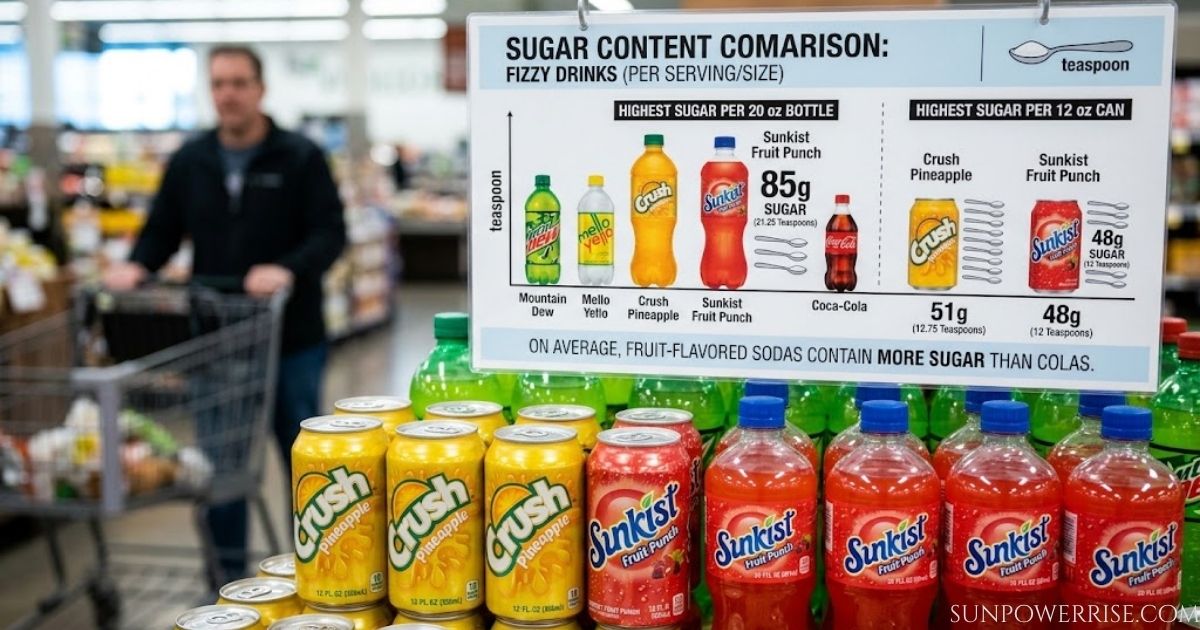
Soda: The Usual Suspect
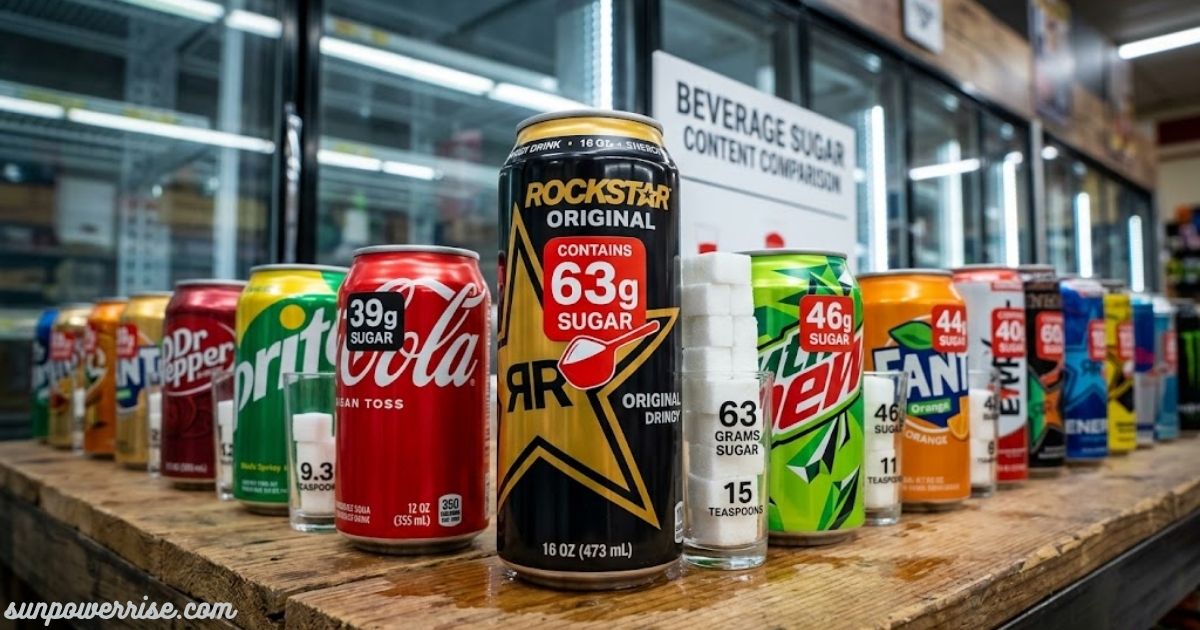
If you’re searching to find out what fizzy drink has the most sugar, regular cola is often the first drink people think of, and for good reason. A 355 ml can of Coca-Cola holds about 39 grams of sugar, which works out to roughly 10 teaspoons.
Mountain Dew edges it out with close to 47 grams over 11 teaspoons in the same size can. If you scale up to a larger 20-ounce bottle of cola, you are looking at 65 to 70 grams of sugar in one sitting.
Sprite is not far behind, landing around 61 grams per serving. To put that in perspective using measurements everyone understands: one teaspoon of sugar equals about 4 grams, so a 64-gram serving is close to a third of a cup of sugar poured straight into your drink.
Fountain Drinks Take It Further
Buy soda from a fountain machine instead of a can, and the numbers get worse fast. A 7-Eleven Big Gulp carries around 91 grams of sugar, about 32 teaspoons.
Step up to a Super Big Gulp, and you are drinking roughly 146 grams, or 40 teaspoons, in a single cup. Few people finish a fountain drink in one go, but even a partial cup adds up quickly compared to a standard can.
Energy Drinks Aren’t Far Behind
When people ask what fizzy drink has the most sugar, they often forget to check energy drinks. Energy drinks lean on caffeine and other stimulating ingredients to give you a lift, but sugar usually comes along for the ride.
A 245 ml can of Red Bull has about 27 grams of sugar, roughly 7 teaspoons. A larger Rockstar can, at 473 ml, holds closer to 62 grams, or 15 teaspoons. Drink a full 16-ounce energy drink, and you could be taking in around 54 grams of sugar without realising it.
Sports Drinks: Not as Healthy as the Ads Suggest
Gatorade and Powerade are marketed around images of professional athletes pushing through strenuous exercise, which makes them feel like a healthy choice. An 8-ounce serving has about 14 grams of sugar 3.5 teaspoons which sounds modest next to soda. The catch is serving size. A standard bottle holds 32 ounces, so finishing the whole thing means swallowing around 56 grams of sugar, putting it in the same range as a can of cola.
Juice and “Natural” Drinks Carry Hidden Sugar
Fruit juice gets a health halo because it comes from fruit, but the sugar content tells a different story. An 8-ounce glass of orange juice has about 24 grams of sugar 6 teaspoons and it is worth remembering that one orange only yields around 2 ounces of juice.
That means a small glass is roughly equivalent to squeezing four oranges, which is a lot more sugar than eating one orange at breakfast. Orange juice is also acidic, adding a second way it can affect tooth enamel beyond the sugar itself.
A 100% apple juice bottle (15 ounces) contains close to 49 grams of sugar, and a larger 591 ml bottle of tropical juice can reach 70 grams, or 17 teaspoons. Even a 591 ml serving of orange juice can hit 48 grams, about 12 teaspoons.
Iced Tea Sneaks Up on You
Plain tea has no sugar on its own, but bottled iced tea is usually loaded with sweeteners. Arizona Tea is a common example: a 23-ounce can holds about 51 grams of sugar, and an 8-ounce serving of sweetened iced tea generally runs close to 24 grams, or 6 teaspoons.
Snapple Lemon Iced Tea comes in a bit lower per serving, around 23 grams, but it still adds up fast in a large bottle. Because these drinks are marketed as light and natural, it is easy to overlook the sugar entirely unless you check the label or choose an unsweetened variety.
Milk Drinks Aren’t Sugar-Free Either
Even dairy and plant-based milk drinks carry more sugar than people expect. Chocolate milk (473 ml) contains around 58 grams of sugar, about 16 teaspoons.
Vitasoy, often seen as the “healthy” plant-based option, packs about 48 grams into a 240 ml serving, roughly 4.5 teaspoons. Plain skim milk is much lower, at about 11 grams per 8-ounce glass, and unsweetened vanilla soy or almond milk drops even further, to around 1 gram of sugar per ounce.
So Which Drink Wins (or Loses)?
So, to finally answer what fizzy drink has the most sugar: judged strictly by volume, the fountain soda is the runaway winner a Super Big Gulp’s 146 grams dwarfs almost anything else on this list.
Judged by concentration per ounce, sodas and some fruit juices sit close together near the top, while sports drinks and iced teas trail slightly behind but still add up once you account for a full bottle. Skim milk and unsweetened plant milks land at the bottom, making them a far gentler choice for your teeth and your daily sugar intake.
Why This Matters for Your Teeth
Sugar itself does not directly damage tooth enamel. The real danger comes from bacteria in your mouth that feed on that sugar, digest it, and release acid as a byproduct.
That acid is what erodes enamel and creates cavities over time. This is exactly why sugary sodas, juices, sports drinks, and sweetened teas all carry a shared risk, even though they taste and market themselves very differently.
Simple Ways to Cut the Risk
You do not need to give up every sweet drink to protect your smile. A few habits go a long way:
Skip sugary drinks right before bed, since sugar sitting on your teeth overnight does the most damage.Rinse your mouth with clear water after finishing a sugary beverage.
Drink your fill in one sitting rather than sipping slowly all day, which limits how long sugar stays in contact with your teeth.Brush and floss twice daily, and use an antibacterial mouthwash.See your dentist regularly for checkups.
Now that you know what fizzy drink has the most sugar, sugary drinks are not going away, and there is nothing wrong with enjoying one now and then. The goal is simply awareness knowing that a drink marketed as “natural” or “healthy” can still carry a surprising amount of sugar, and choosing water, skim milk, or an unsweetened option more often than not.
FAQs
Which has more sugar, Coke or Fanta?
Coke typically has slightly more sugar than Fanta per serving, though both fall in a similar high-sugar range, always check the local label since formulas vary by country.
What is the #1 unhealthiest soda?
Many nutritionists point to Mountain Dew as the most unhealthy mainstream soda, thanks to its high sugar content and added acids that harm tooth enamel.
Is Pepsi or Coke more sugary?
Pepsi and Coke are very close, but Pepsi usually edges out with slightly more sugar per can — a small but real difference for your teeth.
What is the unhealthiest fizzy drink?
Fountain sodas like a Super Big Gulp are often called the unhealthiest fizzy drink, since a single large cup can pack over 140 grams of sugar.
Is Fanta healthier than Coke?
Fanta isn’t truly healthier. It swaps some caffeine for sugar and artificial coloring, so it carries its own risks for oral health.